What is the 'dose zero'? Here's what you need to know about Pennsylvania's new recommendations for early measles vaccination
Published in Health & Fitness
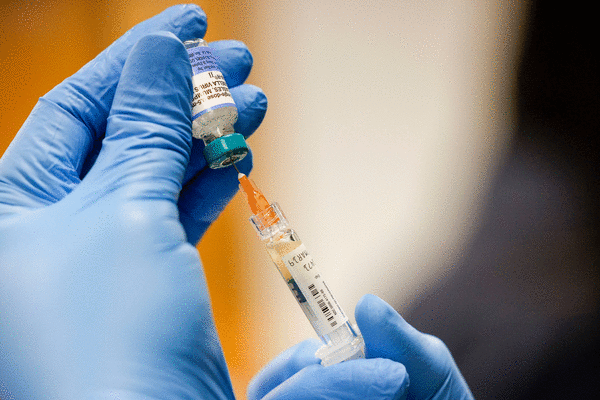
PHILADELPHIA — As Pennsylvania grapples with a measles outbreak that has sickened 130 residents, state health officials are recommending some parents vaccinate young children early to provide extra protection against the highly contagious disease.
Children as young as 6 months who live in or whose parents plan travel to affected counties should get a “dose zero” of the measles, mumps, and rubella shot, health officials said last month. Typically, children get their first measles shot at a year old.
Measles infects up to 90% of unvaccinated people who are exposed to it, and complications can be particularly serious for young children.
Here’s what you need to know about the “dose zero.”
What is the dose zero?
A “dose zero” MMR shot is an early vaccine given at 6 months old. Usually, a child receives the first MMR dose at 12 months old, then again between 4 and 6 years old.
Babies receive some antibodies from their mothers that can interfere with vaccines that contain weakened versions of a live virus, including the MMR vaccine, said Katie Lockwood, a Children’s Hospital of Philadelphia pediatrician.
Those antibodies mean that an MMR shot given before 12 months old can be slightly less effective at providing lasting immunity.
But a “dose zero” can still provide babies with some protection that’s especially crucial in an outbreak.
“What we see from that dose zero MMR is that you have some short-term protection that we believe will protect you during that period when you’re traveling to an outbreak area or internationally,” Lockwood said. (It’s long been recommended that parents opt for a dose zero if they’re planning to travel internationally with an infant.)
“But it’s not generating the same long-term immune response that we see when we give the routine vaccine at age 12 months.”
What happens after a dose zero?
Babies still need a second dose of the MMR vaccine at 12 months old to provide lasting protection against measles, Lockwood said.
Normally, kids then get their last MMR dose at around 4 to 6 years old. That dose is timed to protect children who may not have gotten vaccinated as babies — in school, they’re more at risk of contracting an infectious disease, Lockwood said.
But in an outbreak, the state health department recommends that children get their second dose earlier as well — as soon as 28 days after their first dose.
CHOP is now routinely recommending that children receive their final MMR dose at 15 months old. With 13 measles cases reported in Chester County since April, and 75 cases reported just to the west in Lancaster County, Philadelphia-area parents are close enough to the outbreak that many are opting in, she said.
“It’s still the parents’ decision. But there’s not really a downside to giving it early,” Lockwood said. “Especially with all of these cases, a lot of parents are reporting that it makes them feel more comfortable, knowing that their child is fully protected.”
How are area families reacting to the new recommendations?
Lockwood, who practices in Flourtown, Montgomery County, said she’s fielded “really thoughtful” questions from parents as they decide whether to vaccinate early.
“[They ask], ‘Why wasn’t this the standard the whole time?’” she said. “I always explain that it’s because measles wasn’t really around so we didn’t have to worry about it the way that we’re worrying about it now. Measles wasn’t a real threat to most children in their daily lives in the United States.”
Lockwood said that some parents who had opted to delay or forego MMR vaccinations have changed their minds in light of the outbreak.
“Chester County is really not very far away from most of my patients,” she said. “It does make it feel much more of a realistic threat to their child.”
Lockwood also tries to reassure parents who are still hesitant about vaccination.
“The MMR vaccine, because of some of the misinformation that has circulated around it for years, is one of the most studied vaccines,” she said. “For anyone who is worried about vaccine safety, this is really one with a wealth of safety data available. It’s been proven so many times to be safe and effective.”
Where can Pennsylvanians get vaccinated against measles?
MMR vaccines are generally available at doctors’ offices, urgent-care centers, federally funded health centers, and pharmacies. Philadelphia residents can get a free MMR vaccine at any city health center by calling 215-685-2933. Outside the city, county and municipal health departments and state health centers also offer the vaccine.
It’s recommended that residents call ahead to clinics to check on availability.
©2026 The Philadelphia Inquirer, LLC. Visit at inquirer.com. Distributed by Tribune Content Agency, LLC.







Comments