Stellantis employees raise health concerns after 5-day office return
Published in Health & Fitness
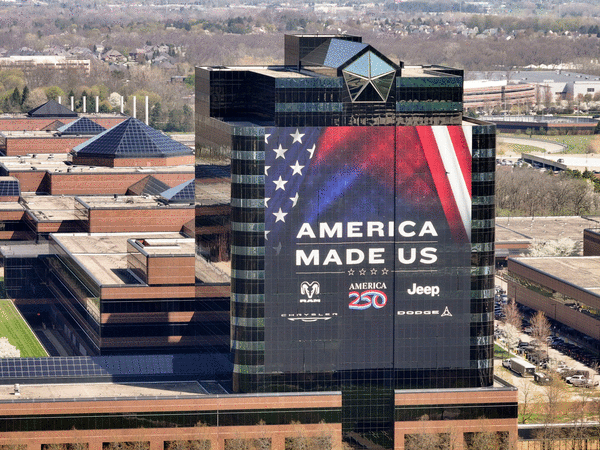
Michigan health and safety regulators inspected Stellantis NV's headquarters in Auburn Hills, Michigan, earlier this year after getting a report that "dozens" of employees in the tower part of the building were suffering from various ailments after returning to the office, records show.
Reported health issues included nose bleeds, migraines, vomiting, skin issues, digestive issues, coughing and tiredness.
The Michigan Occupational Safety and Health Administration did not ultimately cite the automaker, but — following the February inspection and interviews with at least nine employees who'd experienced different ailments — it issued the company a list of recommendations focused on ensuring healthy air quality and preventing mold, according to documents obtained by The Detroit News through a Freedom of Information Act request.
"Stellantis continually prioritizes the health, safety and well‑being of our employees," a statement from spokesperson Jodi Tinson said. "As part of our standard practice, we regularly assess our workplaces to ensure they meet or exceed safety and environmental standards. Recent assessments within the office areas confirmed a safe working environment. Ongoing housekeeping enhancements and preventive maintenance are in place to support employee comfort and well‑being."
Employee reports of environmental health concerns inside the 1990s-era Stellantis headquarters building come as the white-collar workforce recently was required to return to the office five days per week.
Such MIOSHA complaints at office buildings and plants aren't altogether rare, including for Stellantis rivals GM and Ford. But the Stellantis report is notable given that it raised several health concerns about the automaker's headquarters just as the company seeks to bring more workers back to the office.
Previously, the company championed a flexible work policy allowing for a majority of time to be spent at home. But early last year, it asked workers to be in-office at least three days per week. And in January, it announced the new five-day policy that fully took effect March 30. The company explained that "bringing teams together to build stronger connections is a competitive necessity."
'Significant' complaints cited
Stellantis told MIOSHA it had sought to prepare the building for employees' safe return by cleaning, flushing and upgrading air filtration systems. It also conducted air quality and mold testing.
Still, company representatives told regulators that they began receiving complaints as soon as workers started returning a year ago, and the number of complaints "have been significant" since the five-day mandate came down. The topic came up at a recent company town hall.
The employee complaint sent to MIOSHA in February alleged that "employees continue complaining about a multitude of illnesses and strange symptoms and are being forced to work from the building every day despite their complaints and evidence showing presence of mold, and medical proof they are sick." It said symptoms included nosebleeds, migraines, coughing and vomiting.
Other Stellantis workers told MIOSHA in interviews that they had dealt with a range of ailments since returning to the office. Some referenced a meeting of around 100 workers from different floors where concerns were discussed, and one said that a group of engineers had refused to come into work due to health concerns. At least two workers mentioned concerns over black dust they had seen; others flagged concerns about mice, rats, mustiness and flooding incidents.
Stellantis previously told employees that the air quality test results were satisfactory across the facility. MIOSHA inspectors wrote that the company's testing had found "slightly elevated" mold spore counts when compared to outdoor samples, but that the results “generally were considered acceptable for indoor air quality.”
Stellantis indicated to the agency that the slightly higher indoor mold spore levels might be due to the facility's indoor plants.
In its February inspection — which included several parts of the automaker's 15-story tower — MIOSHA officials said they did not find evidence of leaks or other moisture “that would suggest sources of indoor mold growth may be present in the facility.”
The agency, however, also noted that it doesn't have a standard or published limits for safe levels of mold exposure. It closed its investigation earlier this month.
Return-to-office rule gets pushback
The Stellantis return-to-office mandate has at times garnered harsh backlash in recent months on a Reddit forum where employees congregate.
Recent concerns and gripes range from high-priced cafeteria food, to leaky roofs and mouse issues, to parking frustrations as lots fill up again, to parents being unable to see their children as often. The News reached out to several workers for comment and didn't get a response. One employee recently posted about it being a good time to explore a white-collar union and shared a link to the United Auto Workers' organizing website. The News reached out to a local UAW leader representing some salaried workers at the automaker's headquarters but didn't hear back.
Stellantis isn't alone in receiving pushback as it pulls employees back into the office. Workers at crosstown rivals Ford Motor Co. and General Motors Co. have also griped as they are asked to increasingly commute to work; Ford started requiring four days in the office last September, while GM has since 2024 required three days.
A vulgar message featuring the face of Ford CEO Jim Farley appeared on monitors inside the company last fall, not long after the mandate came down, while GM CEO Mary Barra has criticized a small subset of workers she called "CAVE people" — currently against virtually everything — who were strongly opposed to increasing in-office days.
Still, it's a little different for Stellantis workers. Many Ford and GM white-collar employees recently shifted into gleaming new corporate headquarters buildings as they spend increasing time in the office — GM at Hudson's Detroit downtown and Ford in its new glassy facility in Dearborn dubbed "the Hub." Stellantis employees, meanwhile, are returning to the same sprawling 5.4 million-square-foot center in Auburn Hills that was built in the '90s and sat largely empty through much of the pandemic.
Stellantis announced its "Back Together We Win" five-day rule in late January. "We need people who are passionate about working together in person, side by side, engaging hands-on with our products and staying sharply aligned to our key objectives," said an email to employees announcing the change obtained by The News.
The goal is to improve customer satisfaction, strengthen innovation, and create more chances for mentorship and skill development, the note stated.
A related set of guidelines sent with the email stated that the company still supports some flexibility in work hours, but added that "employees are expected to spend the majority of their workday onsite." It said that the new rules would apply to all employees in all regions, not only the United States.
"We've seen an uptick in more companies wanting to have people come back," said Angela Hall, an associate professor at Michigan State University's School of Human Resources and Labor Relations.
"The reality is that we're in a situation now where we have low firing by employers, but (also) low hiring, so people are a lot more hesitant to, for example, quit because of this," she added.
Employers, Hall said, feel like they have the upper hand at the moment. And they may often believe they can't build the right culture, or mentor and develop new workers, if people aren't working in-person.
But she noted that there could be downsides, including around productivity, since many workers report they get more done while working remotely or in a hybrid model. Bosses who call everyone back in for the five days per week also risk losing their top-end talent, she said, since they are more easily able to land a gig elsewhere.
Jeffrey Sanchez-Burks, a professor at the University of Michigan's Ross School of Business, said bringing employees back into the office full-time doesn't necessarily boost cultural cohesion and increase collaboration like management hopes it does. Instead, he said executives need to also think through other types of office programming to build culture, from large company gatherings to small, focused team huddles or inviting in speakers from outside the company.
“You're being strategic about the culture," he said. "You’re not just being strategic about office occupancy rates."
©2026 www.detroitnews.com. Visit at detroitnews.com. Distributed by Tribune Content Agency, LLC.









Comments