How crowd-control agents can affect health
Published in Health & Fitness
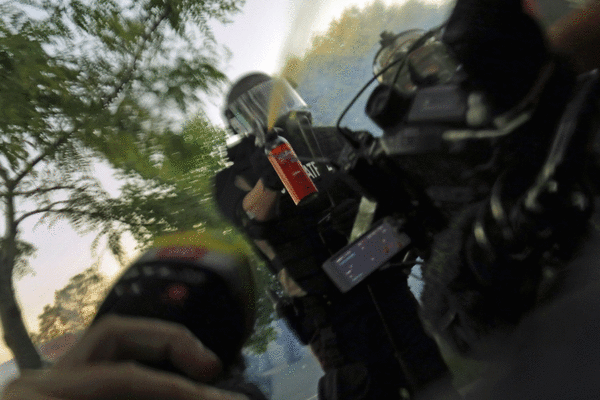
Grieving mother Naomi White walked along Kennywood Boulevard in West Mifflin, Pa., on March 15 with dozens of friends and family members who had gathered to call attention to the December traffic death of her 13-year-old son, Terrel Byars Jr.
Then she was hit with pepper spray. Within moments she was coughing and struggling to breathe.
After police ordered the group on that Sunday to disperse, White said, she soon felt the effects of the noxious agent. She and several other adults and children were treated by emergency medical personnel at the scene for the effects of pepper spray.
“It’s still hard to breathe,” White said the following day. Her skin continued to sting as well. “My face is burning.
Employed sometimes by law enforcement for crowd control, so-called “less lethal” weapons include an array of options, including chemical irritants, such as tear gas and pepper spray, kinetic impact weapons, including rubber bullets and beanbag rounds, and explosive devices like flash-bang grenades.
West Mifflin police, in the criminal complaint against Terrel Byars Sr., one of six protesters arrested March 15 and the father of the boy who was stuck by a vehicle in December, said Byars was pepper sprayed when he allegedly came between officers and those they were trying to arrest for obstructing traffic.
Such weapons are often framed as temporary deterrents, meant to disperse crowds without lasting harm or to subdue resisting suspects. But medical experts warn the aftereffects can be serious, particularly when used improperly, at close range or against vulnerable people.
“These weapons all have serious health risks,” said Rohini Haar, an emergency medicine physician in Oakland, Calif., and a researcher at the University of California, Berkeley. Dr. Haar has studied injuries and deaths linked to less lethal crowd-control weapons for more than a decade.
That “less lethal” term can be misleading, she said.
“The danger and the health risks are really related to how they are used and on whom, and when they’re overused or misused,” Dr. Haar said during a January media webinar focused on the short- and long-term health effects of crowd control agents.
Chemical irritants target eyes, skin, lungs
Tear gas and pepper spray are part of a broad category of chemicals, often called riot control agents or chemical irritants. While commonly referred to as tear gas, the most widely used compound is CS, or 2-chlorobenzylidene malononitrile, a crystalline powder developed more than 100 years ago. Considered generally non-lethal, it is banned in warfare under the 1925 Geneva Protocol.
Pepper spray is typically made from oleoresin capsicum, or OC, or a synthetic version known as PAVA.
Originally developed in the 1960s for mail carriers to defend themselves from animals, Dr. Haar said, pepper spray has increasingly been used in crowd-control situations over the past few decades.
When the chemicals in these agents come into contact with moisture on the body — such as in the eyes, mouth or lungs — they activate pain receptors. Symptoms can include burning eyes, tearing, coughing, skin irritation and breathing difficulty.
For Morningside resident Jay Yoder, 43, who was pepper sprayed by police during a 2020 protest Downtown, the effects were immediate and overwhelming. More than 2,000 people had gathered for the late May protest, about a week after George Floyd’s death in Minneapolis.
“I just remember the pain,” said Yoder, who uses they/them pronouns. “I couldn't see anything.”
After assistance being guided to the curb, Yoder was treated by volunteer medics, who flushed the eyes and skin with water. “I definitely sat on the curb for some time, like both in shock and sort of pain.”
Yoder and several other protesters sued the city over the incident. Also charged and later acquitted in connection with the protest, Yoder has since accepted a settlement from the city.
Pittsburgh Bureau of Police use-of-force guidelines say that oleoresin capsicum, a pepper-derived aerosol restraint spray, is authorized as a tool officers may deploy to control a physically resisting subject when lower-level techniques such as verbal direction or physical holds are ineffective.
Officers are required to be trained and certified in the use of pepper spray before carrying it, and deployment is meant to be deliberate and controlled. The policy also outlines officer responsibilities after OC spray is applied, emphasizing that, after exposure, officers should, when safe to do so, relocate the exposed person to fresh air, allow them to flush eyes and skin with water and monitor for signs of distress.
Over decades of research, Dr. Haar said, chemical irritants have been shown to injure “any different part of your body,” including the eyes, skin and respiratory system.
The spray affected far more than Yoder’s eyes.
“It was down the whole way from my scalp, down the whole right side of my body,” they said. “My eyes definitely, definitely burned. … (A)ll my skin was really, really burning too.”
The reaction lingered long after the initial exposure. The most intense effects of pepper spray generally last for 15 to 30 minutes, but skin, eye and lung irritation can linger for a few days, according to webPoisonControl, an online poison resource.
“Every time I sweated or cried for like, maybe 10 days, it would kind of react,” Yoder said. “It was like there was still pepper in my system.”
Days after being pepper sprayed, White said friends still were urging her to go to a hospital to seek treatment for the lingering effects in her eyes and on her skin.
Newer formulations linger longer
Some newer formulations of CS tear gas are “silicated,” meaning silicon has been added. Dr. Haar said these powder versions — as opposed to a true gas — can last longer in the environment because they do not dissipate as easily.
Yoder also described exposure to tear gas during the 2020 protests, when canisters were deployed nearby.
“The streets were just kind of clogged with this smoke. We were all coughing and just trying to get out of the path.”
Pittsburgh officers deployed pepper spray at a protest in 2025, said Eliza Durham, spokeswoman for the city's Public Safety Department.
During a rally July 15 near Carnegie Mellon University related to a visit by President Donald Trump to the Pennsylvania Energy and Innovation Summit, some demonstrators allegedly resisted dispersal orders and were "pushing and shoving officers, jabbing toward them with their protest signs," Durham said in an email.
When protesters allegedly pulled one of the officers into the crowd, two other officers deployed quick bursts of pepper spray. No tear gas or other riot control agents were used that day, Durham said.
Rubber bullets, beanbag rounds
Another major category of crowd-control weapons, “kinetic impact projectiles,” covers rubber bullets, plastic bullets, beanbag rounds and shot pellets.
Particularly when fired from close range, such weapons can cause serious injury. At that distance, Dr. Haar said, “They can hit as hard as live ammunition.”
Because such projectiles are not shaped like typical bullets, their trajectories can be unpredictable at longer distances, potentially striking bystanders or hitting vulnerable areas such as the face or eyes, she said.
After years of reviewing global data, Dr. Haar concluded that kinetic impact projectiles are inherently unsafe: “There is no role for projectiles in crowd control.”
Weapons containing metal components, such as bean bag rounds filled with steel pellets, pose particular danger due to their density, she said. Another high-risk type involves firing multiple pellets with a single trigger pull, increasing the likelihood of widespread injury.
Pittsburgh police policy governing "discharge of firearms and less lethal weapons" says that impact projectiles are permitted in "dangerous or high-risk situations" where officers are trying to de-escalate a situation with a "minimal potential for death or serious injury." Their use also must be deemed "reasonable and necessary."
The document also says officers are not to aim these projectiles at the head, neck, throat, chest or genital area "unless deadly force is justified." Instead, officers should direct them to the lower abdomen, at belt level, the buttocks, arms, thighs and legs, below the knee.
Additionally, the document says that anyone shot with beanbag rounds must be taken to a hospital for evaluation and treatment.
Pittsburgh police do not use rubber bullets, Durham said.
Psychological impacts can linger
While research on long-term mental health effects is still emerging, Dr. Haar said studies have documented significant psychological consequences.
In surveys following protests in Portland, Ore., in 2020, researchers found high levels of anxiety and trauma-related symptoms among those exposed to chemical irritants, Dr. Haar said.
For Yoder, the experience left lasting emotional effects even after the physical pain faded.
“It took me a while to reacclimate to experiencing Downtown as a normal place that I go to see an opera,” and returning to the area can make their heart race.
“I would go back with people and (ask), ‘Hey, will you just walk down this block with me?’” Yoder said. “Because I start sweating and my heart rate goes up.”
People who are injured or directly exposed may experience stress, anxiety and post-traumatic stress symptoms. But Dr. Haar said the impact can extend beyond those present at an event.
She described a “chilling effect,” in which people who see or hear about the use of crowd-control weapons may feel afraid to attend demonstrations.
“That’s its own mental health impact,” she said.
_____
© 2026 the Pittsburgh Post-Gazette. Visit www.post-gazette.com. Distributed by Tribune Content Agency, LLC.







Comments