Florida vaccine debate: explaining chickenpox, Hep B, Hib and pneumococcus shots
Published in Health & Fitness
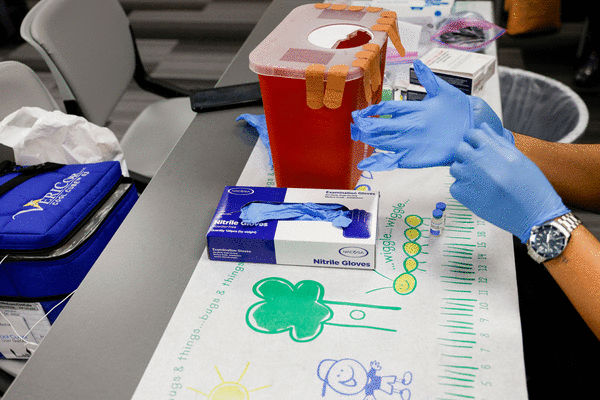
MIAMI – Florida’s surgeon general wants to do away with all state vaccine mandates. But the first step in his plan targets four specific vaccines.
Earlier this month, the Department of Health had a meeting during which officials unveiled a proposal to drop the requirement for the chickenpox; the Hepatitis B; the Haemophilus influenzae type b, or Hib; and the Pneumococcal conjugate vaccines.
Unlike many of the state’s other required vaccines, the Health Department can drop those four requirements without needing legislative approval.
If the department continues on its current path, the four vaccines could be out of the state’s requirements by the Spring. But what do they do, and why have public health experts recommended them? Here’s what to know.
Chickenpox/Varicella
The Varicella, or chickenpox, vaccine was added to the recommended schedule of childhood shots in 1996, making it one of the newer childhood vaccines.
Dr. Ravi Jhaveri, the division head of pediatric infectious diseases at Ann & Robert H. Lurie Children’s Hospital of Chicago, said that though there’s a popular notion that chickenpox is a “rite of passage,” kids can still develop severe complications from it.
Sick children can get severe pneumonia, severe encephalitis or have their scabs become “super infected” with other bacteria, he said.
He said people with chickenpox tend to be most contagious before their rash appears, so having the vaccine helps protect children who may be exposed before anyone realizes. Chickenpox, which is transmitted through the air, is more contagious than many other viruses.
A high vaccination rate means the most vulnerable children are protected, Jhaveri said. Some children, like those who are immunocompromised or who are going through cancer treatment, can’t get the vaccine. Instead, they rely on a high level of public immunity for protection.
On a practical level, Jhaveri said getting kids vaccinated for chickenpox means fewer sick kids having to miss class and fewer parents having to miss work to take care of their ill children.
Last year, there were 705 cases of chickenpox across Florida, according to data from the Florida Department of Health. Pinellas County had the most cases, with 175 infections.
Hepatitis B
During the news conference where Ladapo and Gov. Ron DeSantis announced their plan to end vaccine mandates in the state, DeSantis specifically questioned whether the Hepatitis B vaccine was necessary.
“I think about something like a newborn baby, do they need that hepatitis shot?” DeSantis said in September. “What’s the rationale for it? We know how you can get that, OK, so, a baby needs that?”
Hepatitis B is primarily spread through bodily fluids like blood or semen. It can also be transmitted from an infected mother to her child.
When it comes to Hepatitis B, Jhaveri said doctors and public health professionals tried to control the disease’s spread by only targeting those with known risk — and it didn’t work. There were women who gave birth without prenatal care, and without knowing they were infected.
Infection only came under control with the administration of vaccines to all infants, which was recommended officially in 1991. One 2010 study found that within 10 years of the universal Hepatitis B vaccination, cases among children aged 6-19 dropped by 68%.
“This is an infection that is lifelong with no cure,” Jhaveri said, noting it can lead to liver cancer and liver failure. “If you offered me the chance to protect my child from getting liver cancer, I would do it in a heartbeat.”
Hib and Pneumococcal conjugate
Dr. Jeffrey Goldhagen, the chief of the Division of Community and Societal Pediatrics at University of Florida Jacksonville, said that Hib and pneumococcal infections can lead to meningitis, which can cause death or leave children with lasting brain injuries.
In his early career as the head of a pediatric emergency department in Minneapolis, before the Hib vaccine was available, Goldhagen would see children die every year from the infections. Annually, doctors would have to perform hundreds if not thousands of spinal taps to check for meningitis among sick children, he said.
“In many respects, I would say that two of the most important vaccines currently that we give children are those two vaccines,” he said.
The Hib vaccine was recommended for children starting in 1989 and the pneumococcal vaccine was recommended for children starting in 2001.
In Florida, very few children contract Haemophilus Influenzae invasive disease, according to data from the Florida Department of Health. Over the past 10 years, there have been fewer than 375 cases among children aged 0 to 4 throughout the state.
Goldhagen said it’s impossible to convey how the prevalence of vaccines changed the practice of pediatric medicine, and changed childhood.
When a child used to go to the doctor with a high fever, a pediatrician’s first response was to rule out the vaccine preventable diseases. Now, doctors largely don’t think of them, he said. Though, as vaccination rates drop, Goldhagen said pediatricians have to be skeptical of those illnesses again.
And among parents, the fear of illnesses like polio, measles and other sicknesses were always present.
“I understand parental rights, and parents have the right to make the decisions,” Goldhagen said. “But those decisions are being influenced by political policies. So children are being used as political pawns.”
©2025 Miami Herald. Visit at miamiherald.com. Distributed by Tribune Content Agency, LLC.





Comments