'The Mosquito Bowl' review: Peter Berg's latest a brutal portrayal of war
Published in Entertainment News
Filmmaker Peter Berg is a stranger to neither football movies (2004’s “Friday Night Lights”) nor war dramas (2013’s “Lone Survivor”).
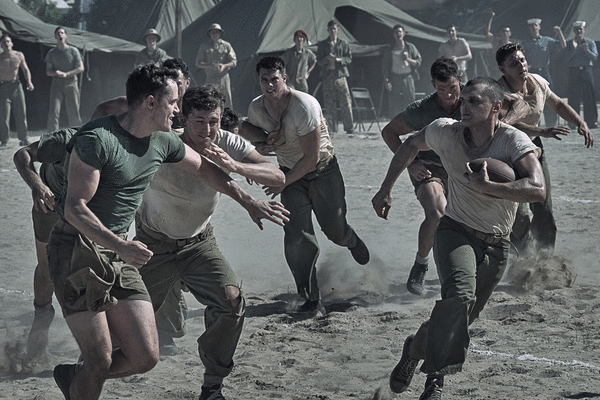
He has brought those two worlds together in the most violent of collisions with an impactful film, “The Mosquito Bowl,” which lands on Netflix this week after a limited theatrical run.
The logline: “Following the attack on Pearl Harbor, four of America’s top college football stars set their fame aside to enlist in the Marines. As they prepare for the brutal Battle of Okinawa, they’ll play in a legendary game featuring some of the greatest players in history — a game that, for many, will be the last they ever play.”
You may go into “The Mosquito Bowl” sketching out a rough outline for the film’s narrative in your head — the central characters going off to war, enduring basic training and engaging in combat, all leading to the movie’s meaty middle built around a cathartic game of football in the dirt.
And you’d be on the money. For a while.
The movie apparently takes cues from the book on which it’s based, Buzz Bissinger’s “The Mosquito Bowl: A Game of Life and Death in World War II,” by devoting surprisingly little time to its namesake game of pigskin. (If Bissinger’s name rings a bell, he is also the author of the football-focused “Friday Night Lights: A Town, a Team, and a Dream.”)
“The Mosquito Bowl” is, unequivocally, a war film — and a thunderous one at that.
We may be guilty of recency bias here, but it struck us as boasting the most intense re-creation of war since the unforgettable first act of Steven Spielberg’s acclaimed 1998 work, “Saving Private Ryan.”
Based on real people and events, “The Mosquito Bowl” introduces us to its four main characters engaged in a safer form of warfare, the kind relegated to the gridiron. Dave Schreiner (Tom Francis) and Bob Bauman (Bill Skarsgård) are teammates on the Wisconsin Badgers football team; John McLaughry (Nicholas Galitzine) plays for the Brown Bears; and Tony Butkovich (Ray Nicholson) is a running back for the Purdue Boilermakers.
Tony is a cocky star running back — who’s been drafted by the then-Cleveland Rams — and we see him set a record against Wisconsin, which Dave chooses to take personally.
Soon, the men say goodbye to family members and wash up on Parris Island. There, a hard-nosed drill instructor makes it clear that he couldn’t care less that they’re football players — played in a fun bit of stunt casting by former Indianapolis Colts punter and current ESPN star Pat McAfee — before whipping them into fighting shape.
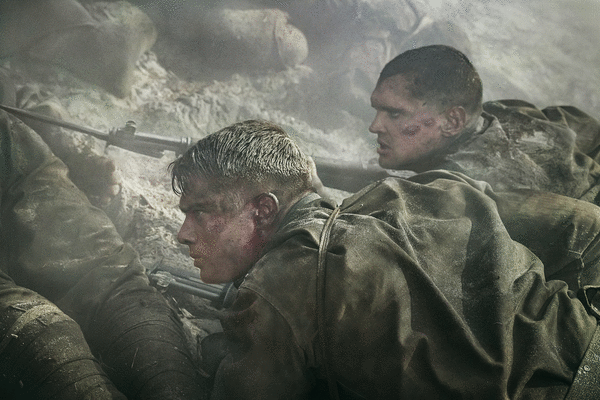
Then, “The Mosquito Bowl” showcases its visceral combat chops as the men hit the beaches of Tarawa in November 1943. With this shockingly lengthy sequence, Berg reminds us that war is indeed hell, with Tony, Dave, John and Bob witnessing soul-shaking horrors as the bullets fly and bombs explode. It is both impressive filmmaking from Berg and more than a little taxing for the viewer.
The Mosquito Bowl is held after the men return from the battle, as they are staged at Guadalcanal, with other former players among the Marines temporarily calling the island home. The men are commanded to play in the game, as superior officers see it as a way for them to help all the combat-weary men blow off some steam.
The film’s climax comes during the battle on Okinawa, which is not as lengthy as the Tarawa sequence. Even after being acclimated to the ferocity of Berg’s staging, the stretch remains difficult to endure.
To the credit of Berg, who co-wrote the screenplay with Mark L. Smith (“The Revenant,” “The Midnight Sky”), he clearly had no interest in making “The Mosquito Bowl” an easy experience for viewers. His goal, he says in his director’s statement, is to have those who watch the film leave it with “profound respect for the courage of those who serve and a renewed appreciation for the enormous responsibility that comes with sending them into war.”
We wish, though, as he was bending the facts to suit his narrative — essentially a necessity of the adaptation process — that he did a bit more to massage the evolution of the relationship between Dave and Tony. That would have helped round out the story, especially given the dynamic performance of Nicholson, whose wild eyes refuse to let you forget for a second that he’s the son of legendary actor Jack Nicholson.
“The Mosquito Bowl” is less effective at investing viewers in its players-turned-warriors than it is at reminding you that war is hell — and brings with it an unfathomable loss of life. By accomplishing the latter, it remains deeply resonant.
———
‘THE MOSQUITO BOWL’
3 stars (out of 4)
MPA rating: R (for intense sequences of graphic war violence, grisly images, and language throughout)
Running time: 2:07
How to watch: On Netflix Nov. 25
———
©2026 The News-Herald (Willoughby, Ohio). Visit The News-Herald (Willoughby, Ohio) at www.news-herald.com. Distributed by Tribune Content Agency, LLC.











Comments