Tony Berlant, artist known for large-scale found-metal collages and comic Kate Berlant's dad, dies at 85
Published in Entertainment News
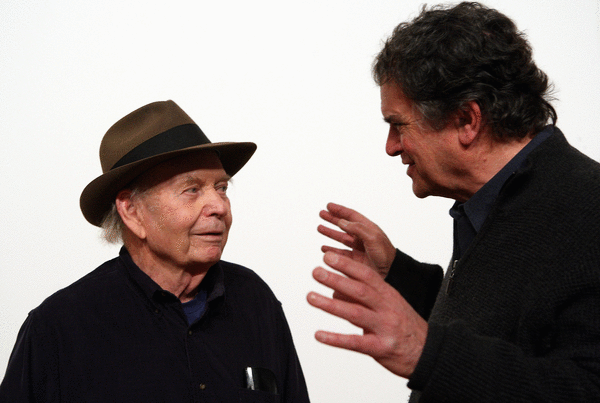
LOS ANGELES — Tony Berlant, a seminal influence in the West Coast Pop Art movement of the 1960s, died Tuesday after a long battle with Alzheimer’s disease. He was 85.
L.A. Louver, his longtime gallery, confirmed his death to The Times.
Berlant, a “master of painting without paint” who called Santa Monica his home for many decades, developed a signature style making collages using shards of printed tin instead of paper and thousands of shiny nails instead of glue. He often worked with vintage metal street signs and ads. In recent years, he printed personal photographs onto the metal, giving the colorful works story structure and an autobiographical bent.
One of his most recent shows, in fall 2018 at Hollywood’s Kohn Gallery, featured cut metal collages that blended elements of assemblage, Pop Art and abstraction. He was also known for his metal cube sculptures, which have been called quilt-like.
Berlant was a collector of both ancient Southwest pottery and Paleolithic stone objects. In fact, he co-curated two museum exhibitions: “First Sculpture: Handaxe to Figure Stone” at the Nasher Sculpture Center in Dallas and “Decoding Mimbres Painting: Ancient Ceramics of the American Southwest” at LACMA. He was also a founding member of the Mimbres Foundation, an archaeological conservancy that studies and preserves ancient Native American pottery.
Berlant was part of L.A.’s famous Ferus Gallery art scene in the 1960s, a group of “Cool School” artists that also included the late Ed Moses and Robert Irwin as well as Ed Ruscha, Larry Bell and others. The Ferus Gallery was a revolving door of experimentation at the time and helped fuse the city’s otherwise sprawling and disparate art scene.
Berlant was part of one of the earliest museum exhibitions of Pop Art in 1963, “Pop Art USA,” at the Oakland Art Museum. He showed his work alongside Robert Rauschenberg, Andy Warhol and Claes Oldenburg.
The L.A. visual art scene may be more established today, but it’s also more commercial and safer in some ways. However, Berlant firmly believed that L.A. still retains its defining creative spirit.
“My New York friends tend to think of the ’60s as a kind of golden moment that’s now been erased by commercial focus,” Berlant told The Times in 2018. “But I think L.A. is [still that]. It never left. I just assume that there’s all kinds of fantastic artists working that I’ve never heard of because they pop up here and there, and I see them, and I’m just really excited by that. It’s what makes you feel good about a place.”
Berlant was born in New York City in 1941 and moved with his family to L.A. at a young age. He attended high school in the area, and frequented art galleries and museums across L.A. and Pasadena. “As soon as I had a car, I didn’t go to the beach,” he told UCLA’s magazine in 2018. “I went to the museums and around to every gallery — there weren’t that many — twice every month.”
The artist attended the University of Southern California for a year in 1959. He later transferred to UCLA, where a professor, the large-scale abstract painter William Brice, placed him in an upper-level class taught by visiting artist Richard Diebenkorn, renowned for blending American realism with Abstract Expressionism. Berlant earned three degrees in three years: a bachelor’s degree, a master of arts in painting, and a master of fine arts in sculpture. He went on to teach alongside Brice and Diebenkorn from 1965 to 1969.
Berlant’s first break as an artist came while he was still an undergraduate. In 1961, the influential art critic Clement Greenberg, who championed the Abstract Expressionist movement, selected one of his paintings for an exhibition of L.A. artists at LACMA. Three years later, LACMA’s Contemporary Art Council (now the Modern and Contemporary Art Council) awarded him its New Talent Purchase Grant.
From then on, Berlant worked between L.A. and New York, although he considered L.A. “his village.” It was where he met Marcel Duchamp, held existential conversations with fellow artists at Café Tasco on Venice Boulevard, and created lasting friendships with artists Ed Moses, Vija Celmins, Ken Price, Charles Garabedian, Gwynn Murrill, Chris Burden, Nancy Rubins and Jimmy Hayward and architect Frank Gehry.
Moses, Garabedian and Diebenkorn, who all had ties to UCLA, helped introduce Berlant to Peter Goulds, the founding director of L.A. Louver, which in 1978 became his longtime gallery. Berlant’s work is included in the permanent collection of LACMA, as well as the Hirshhorn Museum and Sculpture Garden in Washington, D.C., and the Art Institute of Chicago.
L.A. is also where Berlant met his wife, Helen Méndez, a performance artist and set designer. They made a home in Santa Monica, where Berlant established his studio, and where their only daughter, the comedian, actor and writer Kate Berlant, was born and raised.
Kate Berlant talked about her parents in a recent HBO comedy special, noting on her press tour that when she was about 2, she painted roughly 150 giant plates. Her parents staged a serious art show for her. “There’s such a thing as being supported too much, by your parents, maybe,” Kate Berlant joked. “And I think I’m the product of that.”
Her father knew what it meant to be supported, too, by art world giants. A towering, collaged-metal self-portrait in the 2018 Kohn Gallery exhibition was based on a Polaroid that Andy Warhol took of Berlant in the ’70s. Asked what he would tell his 20-year-old self in that Polaroid, he told The Times: “I realize now that my life has been a lot more exciting when I talk to people. But I’ve forgotten a lot of the exciting stuff that happened. Just follow your instincts and do what makes you happy. That’s what artists do. They work from inner need, necessity ideally. And it’s a wonderful thing to do, inexplicably wonderful.”
Berlant is survived by his wife, daughter and brother, Jeff Berlant.
©2026 Los Angeles Times. Visit at latimes.com. Distributed by Tribune Content Agency, LLC.



Comments