Class acts: 2026 San Diego Music Hall of Fame honorees have made indelible mark, on and off the bandstand
Published in Entertainment News
SAN DIEGO — The San Diego Music Hall of Fame is still expanding nine years after debuting with an inaugural class of Lifetime Achievement Award honorees that included Jack Tempchin, Jason Mraz, Sue Palmer and — posthumously — Lou Curtiss, John Ciccolella and Mark “Big Toe” Goffeney.
“This year we’re inducting our first punk band, The Penetrators, our first reggae band, Big Mountain, and our first radio DJ, Claudia Russell,” said Jefferson Jay, the hall’s founder and driving force. “I want to continue to honor people who have contributed greatly to our rich and diverse community. Music and musicians should be celebrated — not just those who are household names — and we’re doing that.”
This year’s class reflects that diversity well.
In addition to the Penetrators, Big Mountain and Russell, the inductees include: Dr. Oliver Luck, a retired jazz trombonist, music educator and music therapist, who — at 95 — is this year’s oldest honoree; vibrant blues mainstays Lady Dottie & The Diamonds, whose leader and namesake is 83 and still performing with her band; longtime drum and vocal standout Larry Grano, who last month moved to North Carolina; and Mojo Nixon, the late master of musical mayhem, who died in 2024 at the age of 66.
They will all be honored at Friday night’s induction ceremony at Mission Valley’s VISION: A Center for Spiritual Living. The evening will also feature more performances than at any previous edition of the event.
The lineup will feature: Lady Dottie & The Diamonds; the Grano-anchored band Back to the Garden; members of the Penetrators, Big Mountain and the Beat Farmers (who will play in honor of Nixon); bluesy singer and guitarist Hugh Gaskins; Electric Waste Band; singer-songwriter Ashley E. Norton; and the band Gato Papacitos. Luck will not perform, but will be saluted in song by Hall of Fame founder Jay and trombonists April West and Patrick Escalante.
Penetrators’ front man Gary Heffern, a longtime resident of Finland, will not be able to attend. His role will be filled for the night by Manual Scan band co-founder Kevin Ring. The late Nixon will be saluted by the Beat Farmers, the veteran San Diego band whose uproarious behavior — on and off stage — nearly matched Nixon’s.
Lasting impact
Each of this year’s honorees have made a lasting impact, in some cases both on and off the bandstand.
Lady Dottie was a top chef at the downtown restaurant The Bayou, where she began singing with pianist Joey Guevara. Their musical partnership led to the formation of Lady & The Diamonds in 2002. The band has won several San Diego Music Awards and toured Europe twice.
“It’s wonderful that we can see Dottie gets the recognition she deserves,” Guevara said. “She can do it all and she’s so easy to work with. Dottie’s more than just a bandmate. She’s family.”
In addition to having performed in multiple bands in San Diego and leading a few of his own, Dr. Luck has collaborated with everyone from Duke Ellington to R&B vocal great Solomon Burke. A U.S. Air Force band veteran, he went on to work as a music therapist, taught music at La Jolla and Lincoln high schools, and is the author of the book “Music is Math: An Easy Method for Reading & Counting Music Rhythm Patterns.”
“Oliver’s life and career are quite amazing,” said Jay, who first met Dr. Luck at last year’s San Diego Music Hall of Fame induction ceremony.
“Bob Magnusson, Kamau Kenyatta, Jim Plank and the other great jazz musicians who were there were so excited to see Oliver. He’s like a hero to them, although he may not be so widely known to the general public. But he’s delightful and humble, and he’s exactly the kind of person we want to honor.”
Formed in 1978, the Penetrators were not quite the first San Diego punk-rock band (a distinction that goes to the Zeros). But the Pens, as some fans still fondly call them, had an outsized impact. The riotous band’s performances and records inspired a good number of aspiring musicians here, including the young Eddie Vedder in his pre-Pearl Jam days, and — in Ireland — the future members of U2. In 1995, Vedder was a guest artist on “Painful Days,” a solo album by Penetrators’ lead singer Gary Heffern.
“Our band never made it and I didn’t have any idea we were inspiring Eddie or other people,” Penetrators drummer Kmak said. “(Guitar star) Steve Salas sat in with us and gushed about the impact we had on him when he was in high school. The Penetrators showed a lot of people here you didn’t have to have a big record company behind you and that you could just do it on your own, which we did. It was a good time.”
Big Mountain launched in 1991, 13 years after the Penetrators. The brainchild of singer-songwriter Joaquin “Quino” McWhinney, the band struck gold in 1993 with its bouncy reggae version of Peter Frampton’s “Baby I Love You Way.” It became an international Top 10 hit and Big Mountain went on to do multiple world tours, as well as becoming the first American band to headline Jamaica’s prestigious Sunsplash festival, not once, but twice.
“That was an honor and it was like a dream come true to play in Jamaica,” James McWhinney said. “But one of the most insane gigs we played was for 40,000 people at the Japanese edition of Reggae Sunsplash in Tokyo. The audience went nuts; I’ve never seen anything like it.”
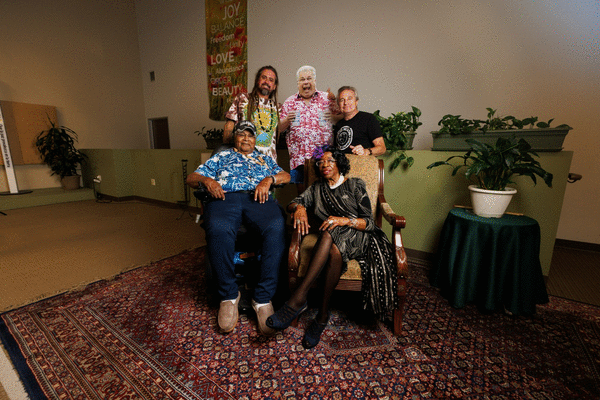
Lady Dottie, Luck, Kmak and Big Mountain singer and percussionist James McWhinney gathered last week at VISION for a photo shoot. While it was the first time the four had met, they established an almost instant camaraderie
“My late uncle, Eddie Arias, ran the San Diego Musician’s Union,” McWhinney said.
“Eddie Arias!” Dr. Luck responded with a broad smile. “I knew him well.”
A few minutes later, Dr. Luck and Lady Dottie (born: Dorothy Mae Whitsett) chatted like long-time pals as they sat side by side.
“I’ve been to Lady Dottie’s gigs,” McWhinney said.
“Me, too!” Kmak chimed in.
Dottie smiled.
In a coincidence that neither Dottie nor Luck was aware of, after moving to San Diego two decades apart — Luck in the 1960s, Dottie in the 1980s — both regularly performed here in the band led by San Diego jazz patriarch Fro Brigham, who would make an excellent posthumous San Diego Music Hall of Fame honoree himself.
“Oh, yeah,” Dr. Luck said. “Fro was the man!”
“I was with Fro for 15 years,” Dottie said. “We played downtown at Patrick’s II and had a good time. Fro is the one who named me Lady Dottie.”
“I first saw Dottie perform when I was 10 and I’m 53 now,” Big Mountain’s McWhinney recalled. “It’s an honor to sit next to these amazing musicians, like her and Dr. Luck, who were way ahead of my time.
“When I see people like them, I’m just awed. Because I’m only 53 and I’m already tired! So, to see the kind of longevity the two of them have reminds me of the power of music, and how it will keep you up and running.”
Kmak agrees.
“It’s inspiring to see their longevity,” he said. “It tells me that you can go as long as you want because music keeps you young. Being in the same room with Lady Dottie, Dr Luck and James from Big Mountain. I had never met them before, but you could feel the brotherhood and sisterhood of music. San Diego is a a great place, a big little town.”
“I appreciate Jefferson Jay so much for doing the Hall of Fame,” Kmak continued. He doesn’t have to do this, but he’s doing it, just like Kevin Hellman does with the San Diego Music Awards. I am so grateful for all the work they do.”
This spirit of community — of veteran musicians coming together as virtual strangers and then quickly bonding — has been foundational at the San Diego Music Hall of Fame almost since its inception in 2018. And even though this year’s honorees represent distinctly different musical genres and approaches, the conviviality between them at last week’s photo shoot was palpable.
“It’s a pretty amazing lineup of folks that probably would never be in the same room otherwise,” Jefferson said. “And that’s really what this is all about: bringing people together.”
Versatile drummer/singer Grano and former KSDS Jazz 88 radio program director/DJ Russell will be present for their inductions. Both were out of town when the photo shoot and interviews for this story took place. The late Nixon was represented by a life-size cutout that McWhinney and Kmak held between them. The interviews have been edited for length and clarity.
Lady Dottie
Birthplace: Talladega, Alabama
Age: 83
Next gigs: On Saturday, at Seven Grand in North Park and Oct. 24 at Grand Ole BBQ in El Cajon
Finish this sentence — I devoted myself to music because: Well, I grew up in church and I loved singing in church, and I just couldn’t stop. Then the devil got a hold of me! (laughs) When I was young and picking cotton, the blues got a hold of me. I love the blues and when I sing, I want to make you feel something. That’s the way life is: You feel it. My mother and father had 13 kids — seven girls and six boys — and I was the fourth child. Our whole family was musical. (Actor) Blair Underwood is my cousin.
What are your biggest musical and non-musical inspirations? I couldn’t really tell you, because I don’t know the answers myself. I’ve been in the music for so long, it’s just become a habit for me. I’ve got to be singing or humming, and it just comes out of me. It’s in my heart.
What does getting a San Diego Music Hall of Fame Lifetime Achievement Award mean to you and The Diamonds? It means I’ve done something right in life. I know in my heart that — if you stay around long enough — you will survive. And I’m just surviving.
Do you sing to yourself at home? All the time. I have music always on. I live alone and music is there for me.
How often do you perform? Well, right now about three times in a month. Before that we played everywhere, The Diamonds and me. I’m glad we play less because I need a break! I’ve been doing this in San Diego for 42 years. I came here in 1984, and I’ve been going ever since.
Does music mean something more or different to you than it did 60 years ago? No. It’s in my veins and in my brain. This is what I do and you can’t stop. I’ll go down on stage, you know? Because (she sings): “I did it my way!”
What are the keys to being a really good singer and a really good cook? Well, to be a singer, it has to come from you and you have to know what you’re doing. Nobody else can tell you how to sing. I’ve never had any teachers and never had anybody tell me what to do. And with cooking, I don’t have to measure anything. I just know what to put in and how it comes out. And I know just what to put in my singing. Cooking and singing are my two favorite things in life.
Do you have any go-to dishes as a cook? Oh, yeah! Collard greens, black-eyed peas, fried chicken, roast ham — all that Southern food. And for dessert, banana pudding, cobbler, pound cake.
Words I live by: The Lord is my shepherd. So, whatever I do, I know the good Lord got my back.
Do you have any advice for young musicians? I would tell them that if you want to succeed in life, go for it. Just like I said: The Lord is your shepherd, so go for it.
Joel Kmak of the Penetrators
Birthplace: Hammond, Indiana
Age: 69
Next gig: Nov. 1 at Winstons in Ocean Beach
Finish this sentence — I devoted myself to music because: I love the experience of being in a band, playing to the audience and occasionally recording in a studio.
What does getting a San Diego Music Hall of Fame Lifetime Achievement Award mean to you? It’s amazing. A lot of hipsters pooh-pooh it. But it’s always thrilling when you get recognized for years and years of grit and playing for next to nothing, and doing it out of love. I’m absolutely thrilled. Rewards don’t make or break a band. A lot of people I know who are very deserving and have never won any award, so I’m appreciative and respectful.
First recording: A friend recorded our performance at the homecoming assembly at Grossmont High School, 1972. The band was named King Righteous and The Royals. It was a Sha Na Na type of band. I was later in a band called called Steaming Chicken.
Next recording: The Farmers SD, not to be confused with the Beat Farmers, are working on a new record. We cut two new tracks at a studio in Point Loma two months ago. Release is pending.
What drew you to music and how old were you? Like many at the time, seeing the Beatles on "The Ed Sullivan Show" in 1964 did it for me — although it would be six years before I would get a proper drum set when I was 12. It took six years of playing toy snare drums and beating on boxes before my dad got me a blue sparkle Beverly drum kit at Montgomery Ward’s in 1970. I wish I still had it.
Biggest musical inspirations: Ringo, Charlie Watts and Mick Avory of the Kinks.
First gig: At church in Old Town. I was the drummer for the King’s Strings, a church band. Shortly after that, gigs at the Friday night dances at the YMCA in La Mesa and dances at Emerald Junior High and Parkway Junior High.
Best gig: I have a lot of “best gigs,” but the one that comes to mind would be opening for the Pretenders at the Marquee Club in London in 1979 with the Hitmakers. There was also the San Diego Street Scene 20th anniversary show where the original lineup of the first Street Scene played throughout the day, with the Paladins, Beat Farmers, Los Lobos and X on the same stage.
Worst gig: I was in a country band in the 1990s and they talked me into playing at a crafts fair, which turned out to be a pumpkin patch in the parking lot of Parkway Plaza. There should have been a puppet show!
Best day job: The one I have now. I work for myself.
Worst day job: I was a dishwasher at the Top Shelf, now the Brigantine in La Mesa, around 1975.
If I wasn’t a musician: I would be a college graduate.
Words I live by: Be your best, all day and every day.
Dr. Oliver Luck
Birthplace: Washington, D.C.
Age: 95
Finish this sentence — I devoted myself to music because: I love it! My mother was a classical pianist and I was drawn to her playing, and music, in general.
Do you play piano? I don’t play piano at all. I got my bachelor’s degree in music therapy at Carnegie Mellon. I took up trombone because my brother went into the army and left his trombone at home.
What was your first gig as a trombonist? I was in the U.S. Air Force Band when I played my first gig. I never soloed, until the leader of the band said: “It’s your turn.” So, I played a solo and looked at the audience out of the side of my eye, and they were laughing.
Were you daunted? Or did it make you want to play better? It made me better. I’m always going to be better. I learned to always be prepared, no matter what the situation was, and to do whatever I was doing to the best of my ability. You have to understand what you’re hearing and then adjust your playing to whatever it is — jazz, or classical, the blues or country-and-western.
What does getting a San Diego Music Hall of Fame Lifetime Achievement Award mean to you? I think it’s an honor. You don’t get those everyday; sometimes you never get them. So, I feel blessed and honored. A lifetime award is a lot of attention.
If you weren’t a musician, what would you be? I guess I’d be a fisherman. It’s very relaxing and exciting, and it requires patience.
How big a thrill was it for you to play several concerts in Duke Ellington’s orchestra? It was fantastic! That was a big honor to be asked to play with Duke. I was booked for another gig, in the Rose Bowl Parade, and I got a call saying: “Duke wants you.” So, I canceled my other gig. I wasn’t even listed as a player in Duke’s band. They cooked the books and put me down as an arranger!
Was that your biggest musical honor? I’d have to think about that. I’ve been in a lot of bands and I’ve traveled around the world. I’ve been very lucky.
What was the San Diego music scene like when you moved here in 1966? There were lots of bands and clubs. I joined the Musicians Union here. A lot of times when a (national touring) band came into town to play and had a problem, they’d call me and say: “Hey, we need you.” And I’d say: “I’m on my way.” I get good gigs no matter what happens.
How often did you practice? I didn’t really practice. I just played every day.
Were there key things you taught your music students? Basically, to study and understand what you’re doing, what your playing, and why.
Was there anything special you taught your trombone students? No, not really. Because the instrument can only produce what you put through it, and you’d have to have the desire to play. I would work with you to help you achieve. I got letters from former students, thanking me for all the time I spent with them. That was really nice.
Up until what point did you regularly play music? I don’t play now. But if they have a program here, where I live, with a band and ask me to sit in, I’ll do that. Music tells us a story and my life has been very fulfilling.
What advice would you give to a young person? First of all, trust in yourself. Allow yourself to accept as much knowledge as possible, and use that knowledge to help yourself be successful and to help other people. This is a big world and there’s a lot to learn. Be thankful it’s happened for you.
You are 95. To what do you attribute your longevity? Well, I didn’t drink, I didn’t smoke and I didn’t do drugs. As a matter of fact, the first time i ever had a drink was the day I got married! I had some champagne. It tasted pretty good and I got silly. (laughs) Other than that, I’ve lived a clean life.
James McWhinney of Big Mountain
Birthplace: San Diego
Age: 53
Next gig with Big Mountain: Jan. 16 at the Holding On benefit concert in Negril, Jamaica.
What does music mean to you? Music is a crucial piece of life, like water and food. For a lot of people, it brings some kind of relief or connection and is a way to feel part of something. Music is medicine for the heart and mind. It’s brought nothing but gifts to me for my entire life, and I feel super blessed.
What does getting a San Diego Music Hall of Fame Lifetime Achievement Award mean to you and Big Mountain? Well, we are San Diego natives. For all musicians, any kind of recognition and appreciation for our musical services is a beautiful thing — and so many more musicians deserve it. On a community level, it means a lot to us to be able to know that we’re being appreciated for the long years that we have been here. If it wasn’t for San Diego, we wouldn’t have been given the opportunities to become who we are as Big Mountain.
First musical memories: It would be ranchero and Norteño music, because I come from a Mexican-Irish family. My grandparents and my uncles all played music. So, every Christmas, every Thanksgiving, every wedding, every celebration, every party, we were playing Mexican music. If you want to talk about watching everybody being joyful, having a great time, laughing and playing music all together — that’s a golden example of how a family should live and involve music in their lives. Out father was very into soul music and jazz, and that was influential on my brother and I as well.
What was your first band? Ital Vibes. Shiloh was my brother Quino’s first band and that laid the foundation for Big Mountain. Quino fell in love with reggae when we saw Bob Marley on “60 Minutes,” and from that point he was all in. Listening to reggae was a very heavy experience for us. It was a different energy in the early ’80s. My aunt married a Rastaman and, all of a sudden, dreadlocks and Rastafarianism came into our culture as we were trying to find our identity.
Best day job: For all of us in Big Mountain, music. For me, it’s doing music and building homes.
Worst day job: Pouring concrete in the middle of the winter, while it was snowing, in Tahoe.
Words I live by: Be true to yourself. Respect your brothers and sisters, and the people around you. Show appreciation, try your best to live with joy, and — when you’re struggling — reach out.
———
2026 San Diego Music Hall of Fame induction ceremony and concert
When: 5:30 p.m. Friday, Oct. 16
Where: VISION: A Center for Spiritual Living, 4780 Mission Gorge Place, Mission Valley
Tickets: $61.60
Online: eventbrite.com/e/san-diego-music-hall-of-fame-8th-annual-induction-ceremony-tickets-1997952007237
———
©2026 The San Diego Union-Tribune. Visit sandiegouniontribune.com. Distributed by Tribune Content Agency, LLC.







Comments