New Order/Joy Division alum Peter Hook embraces Rock Hall of Fame induction, but not his former bandmates
Published in Entertainment News
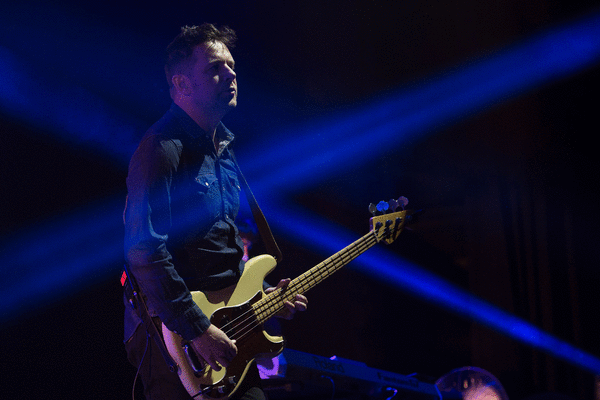
SAN DIEGO — It may indeed be divine to forgive. But Peter Hook has absolutely no intention of letting bygones be bygones — even for just one night — when he and his former bandmates in Joy Division and New Order are honored Nov. 14 at the 2026 Rock & Roll Hall of Fame induction ceremony at Los Angeles’ Peacock Theater.
“Their behavior is intolerable,” said Hook, currently on tour with his post-New Order band, The Light.
Just how intolerable to him is something the 70-year-old bassist and vocalist elaborated on during a candid phone interview last week. He was speaking from a tour stop with The Light in Washington, D.C.
Hook also discussed a variety of other subjects.
They included how seeing punk-rock upstarts the Sex Pistols perform in 1976 changed his life in a way that seeing Led Zeppelin the same year did not; the perspective that comes with age; and the accomplishments of the short-lived post-punk band Joy Division in the late 1970s; and of New Order, which debuted in 1980 and achieved international success with its mix of rock, dance music, electro-pop and more.
New Order has been cited as a key inspiration by R.E.M., Smashing Pumpkins, Radiohead and the Killers, whose band name was inspired by the video for New Order’s 2001 song, “Crystal.”
Hook also tartly responded to comments by Joy Division/New Order drummer Stephen Morris — published in Rolling Stone the same day this interview took place — that charged Hook is “quite an angry person. Basically, he doesn’t seem happy. He doesn’t strike me as being happy.”
Hook all but snorted in response, even before his interviewer could ask him about Morris’ remarks.
“Stephen is right. I am angry,” Hook said. “I’m angry about what (New Order) did to me and the fact that they got away with it. I’m not always angry. I’m just angry at him.”
The animosity and estrangement between Hook and New Order’s other founding members — Morris, keyboardist Gillian Gilbert (who is Morris’ wife) and guitarist/singer Bernard Sumner — stretches back at least two decades. All the English band’s members are from the greater Manchester area.
In 2001, Hook incurred the ire of his New Order bandmates when he alone trademarked the name of the Hacienda, a storied Manchester nightclub that hosted performances by such bands as Happy Mondays, Stone Roses, the Smiths and New Order. Hook’s bandmates also complained he was more focused at the time on being a “celebrity DJ” than on recording a new album with New Order.
They were further peeved in 2010 when — three years after Hook’s contentious departure from New Order — he formed his own band, The Light. Its repertoire consists entirely of songs by Joy Division and New Order.
Hook, in turn, accused his New Order bandmates of being unwilling to perform any Joy Division songs. He also charged that they refused to perform live all the songs from any of New Order’s albums in full, something he wanted to do to celebrate the band’s legacy.
His 2007 departure led to New Order splitting up and saw Sumner form his own band, Bad Lieutenant. When New Order’s members regrouped in 2011, minus Hook, they formed a new company without telling him. The new company restructured the band’s finances and reduced Hook’s share in New Order’s earnings to just 1.25%.
‘Survival mode’
Hook initiated a lawsuit in 2015 in which he contended he was losing millions in New Order royalties because of the restructuring. The case was settled in 2017, although the terms of the agreement remain undisclosed.
“It is humbling to think that music can have such power over the people (involved),” Hook said. “And I think that’s the point with New Order, because we still fight like (expletive).
“It’s a funny balance, isn’t it? In music, you’re trying to balance a lot of things — ego, skill, talent, what you do, how you do it, getting to where you can do it. There’s so many factors in it and it really does put you almost in a survival mode.”
Morris and Gilbert announced in June that they were withdrawing from touring with New Order for the foreseeable future. On Sept. 9, Morris announced he would not be able to attend the Rock & Roll Hall of Fame ceremony because of undisclosed health issues. On Tuesday, Gilbert announced that she is battling cancer.
That could leave the long-estranged Hook and Sumner as the only Joy Division/New Order alums to be present — presumably at different tables — alongside fellow Rock Hall inductees Phil Collins, Billy Idol, Iron Maiden, Oasis, Sade, Luther Vandross and Wu-Tang Clan. Either way, it should be a night to remember (and one that will be documented in a TV special that will air on a yet-to-be-announced date in December on ABC and Disney+).
Hook was alternately introspective and playful as he spoke while waiting for a flight in Washington, D.C. This interview has been edited for length and clarity.
Q: Prior to you forming The Light, the only group I ever saw live that had two bassists was Captain Beefheart & The Magic Band, although I believe Ned’s Atomic Dustbin later had two bassists and one lineup of King Crimson did for a short period. What inspired you to have a two-bass lineup?
A: Well, I feel quite honored to be in the same company as Captain Beefheart, to say the least. The reason for it was because of punk and that punk attitude about playing. I never actually learned to sing and play (at the same time), and I always used to look at Sting in amazement. And I always thought that singing bass players were the most evil thing in the world! I was right, wasn’t I? (laughs)
But it’s quite interesting. Because in Monaco (Hook’s side band from 1995 to 2000) and even New Order, there was always a low bass part and a high bass part. And the low bass part was played by another bass player. It was obvious to get somebody in (on second bass) because a lot of my melody lines in New Order go through the vocals, and neither Barney or I could ever sing and play at the same. I still think singing bass players are the devil. But now that I am one… (laughs)
Q: It’s been 16 years since you started your band, The Light. What are the musical qualities and the personal qualities that you look for in a band member?
A: Oh, my god! I think if we did that at the start, most bands would never make any records. A lot of times with bands I’ve found it becomes better the devil you know than the one you don’t. But what I look for in a band member — which some have got and some haven’t — is loyalty, tenacity and stamina. Those are the three most important things in the world, and I always felt that a group was about the people in the group.
I used to argue with Barney (New Order’s Bernard Sumner) all the time, because his idea in the group was that it was all about the songs. And I’d say: “Surely, not. Surely, it’s about the people who create the songs and then play them together.” It was a healthy argument in that respect; not everybody is like that.
Q: It’s been 39 years since you first performed in San Diego with New Order in 1987. With all the touring you’ve done, do you have any recollection of 1987 in San Diego?
A: Yeah, I do. I thought it was amazing because we went over the border into Mexico. It was the first time I’d ever been to Mexico, which was quite an education, to say the least. So, I’ve always had a really fond spot for San Diego. And I must admit that Humphreys Concerts by the Bay is a fantastic venue to play in, apart from the DB (volume) limit.
Q: We’re going back 39 years to 1987. What does music mean to you now that it did not mean to you back then?
A: Well, ’87 was the start of our, shall we say, hedonistic period. And I think, in all honesty, I lost what I was doing music for. I thought I was just doing it for the hedonism and not for the music. And I must admit that, when I finally did get sober in 2004, I realized how important music was — not only to me, but also to other people.
Q: You have stated in previous interviews that, in 1976 in the same week, you attended gigs by Led Zeppelin and the Sex Pistols. Did one of those mark the end of an era for you, and the other the beginning of a new one?
A: Well, no. Funnily enough, I got the dates wrong, But the point I was trying to make is that when I saw Led Zeppelin, it didn’t inspire me in any way to think that I could do what they were doing. But when I saw the Sex Pistols, for some insane reason, I thought that I could do it. The sound at that Pistols’ show was awful and the attitude was awful. And as a 20-year-old with the same attitude, I just thought I’d found my path. I wanted to be able to tell everyone to (expletive) off, just like Johnny Rotten did! So, it was the shallowest of reasons that inspired me.
Q: Congratulations on your upcoming double Rock & Roll Hall of Fame induction.
A: It’s funny. I was reading Stephen Morris’ interview slagging off the Hall of Fame in Rolling Stone, and that did make me laugh. It was very disingenuous, I thought.
Q: Does it mean more to you to be inducted with Joy Division than New Order, or vice versa? Or are both equal to you?
A: I never considered the two bands were very different. Because it was the three songwriters, me, Barney and Stephen in Joy Division, and me, Barney, and Stephen in New Order. So, I never (separated them). You know, we had to change our band’s name, which we did out of honor to (lead singer) Ian Curtis, because we knew it would never be Joy Division again without him (after his 1980 suicide). That was a simple decision to make.
We did make the same decision when New Order split up in 2007. It’s just that a couple of them decided to stab me in the back and bring the band back without my permission or consent.
Q: I covered the Rock & Roll Hall of Fame induction ceremonies for quite a few years. I witnessed reunions by bands whose members had not spoken in years — specifically, Talking Heads — and members of bands who, at that very moment, were embroiled in litigation against each other — specifically, the Byrds. But for that one night, they buried the hatchet. They sat at the same table, they shared the stage to give their induction acceptance speeches and they performed. Could you do that with your former band members?
A: Well, in my opinion, what happened to me and my family when the other three decided to take the (New Order) trademark was absolutely unforgivable, for a myriad of reasons. And given their behavior since that time, I’ve never felt like reconciling with them in any way. Their behavior is intolerable, as it would be to most other group members if it happened to them. And it’s just one of those things, you know. Steve Morris is right. I am angry. I’m angry about what they did and the fact that they got away with doing it. It’s just one of those things you have to live with.
Q: In an ideal world, would there be any need for you to be performing with The Light?
A: I love The Light. I love the fact that I don’t have to argue with Barney. I love the fact that I don’t have to put up with some of the members being unable to make decisions or express their opinions. I’m delighted to be able to do it, and now I understand why it’s Bruce Springsteen & The E Street Band, and Bruce Hornsby & The Range. I now understand that, because the vision we created as Joy Division and New Order at the start is very important to me and so is the sound of Joy Division and New Order. I can’t pretend to be Joy Division, and I won’t. And I can’t pretend to be New Order, and I won’t. I’ll leave that to them.
I don’t like being in this position of being estranged from the people that I began with and owe a lot to. But the thing is, you can pick your friends, but maybe you can’t pick your family, and that’s the trouble with it, isn’t it? It comes back right back to your question of what qualities do you look for in a bandmate. The thing is, you don’t. All you want is friendship, and that’s why a lot of people start bands with their friends. And then, when they realize how intense it is, your friendship goes out the window immediately. I mean, I don’t know what a therapist would say to that, but that’s just the truth.
Q: Punk and disco both broke big in the mid-1970s. In America, many kids who were into rock detested disco. In England, certain key elements of disco were embraced and absorbed into the music of Joy Division, New Order, and a lot of other U.K. bands. I grew up in Germany and it seems to me that, in Europe, there weren’t these pronounced divisions between musical styles that — in the ’70s — were very pronounced in the U.S.
A: That’s quite interesting, isn’t it? Because the actual difference in punk and post-punk, especially when the keyboard (synths) came in with bands like Heaven 17 and the Human League, was quite a marked thing. And it was particularly popular in Germany, wasn’t it? As you get older, the truth is divisions are boring. We don’t want divisions. We want to be able to listen.
I like disco music now. I wouldn’t have owned up to it when I was 20, when I was a punk. If there are any lessons in life, it is to live and let live. And to just take everything at face value as it comes to you and enjoy it if you can. If you don’t, you just move on to the next thing, don’t you? The only thing we can do, all of us, is just follow our hearts, do our best and hope for the best.
©2026 The San Diego Union-Tribune. Visit sandiegouniontribune.com. Distributed by Tribune Content Agency, LLC.









Comments