Dolly Parton always explained the magic trick she was doing
Published in Entertainment News
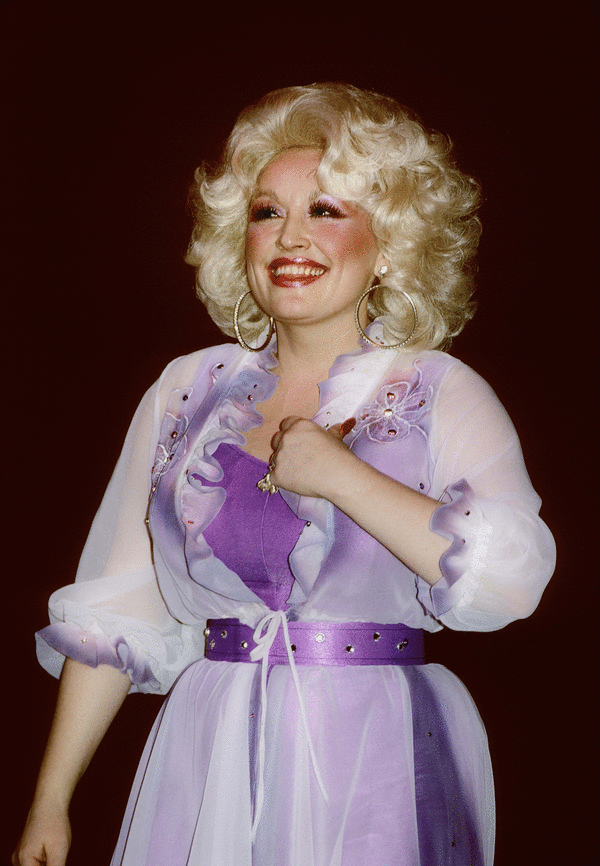
LOS ANGELES — One way to understand Dolly Parton’s unique blend of talents — her wit, her savvy, her intelligence, her pluck — is to consider that she wrote one of music’s most enduring love songs about a crummy boss.
The year was 1973, and Parton — who’d risen from a glamour-less childhood in Tennessee’s Great Smoky Mountains to something like celebrity as the so-called girl singer on Porter Wagoner’s popular TV show — had decided to leave Wagoner’s employ after seven years to strike out on her own.
Wagoner hated the idea and eventually sued Parton for breach of contract; she wrote “I Will Always Love You” to try to get the older country star to see where she was coming from. With its yearning melody and its tender yet plainspoken language, the ballad speaks vividly of affection and loyalty — so vividly that, after Parton’s homey original topped Billboard’s country chart, Whitney Houston’s grand pop reimagining went to No. 1 on the Hot 100 in 1992 and stayed there for 14 weeks.
Yet inside “Always” you can still hear traces of what amounted to a messy workplace dispute. “Bittersweet memories, that’s all I am taking with me,” Parton sings in a voice trembling with determination. She adds: “Goodbye, please don’t cry — we both know that I’m not what you need.”
Parton, who died Tuesday at age 80, made a career out of building illusions she delighted in dismantling. As a precision-minded songwriter, she bestowed a kind of emotional dignity on everyday characters in hardscrabble circumstances; as a glittering pop persona, she called constant attention to the artifice of her own A-list stardom. Her signature maxim — “It costs a lot of money to look this cheap” — drew laughs for decades even as it illuminated the unflinching honesty of her creative approach.
Put another way, Dolly Parton was a magician who never stopped telling you how she did the trick.
She came from a background of rural poverty rendered with characteristic detail in one of her first great songs, “Coat of Many Colors,” in which her mother uses “a box of rags that someone gave us” — can’t you just see it there in the corner? — to sew her a garment in the kaleidoscopic style of Joseph’s from the Bible.
“So with patches on my britches and holes in both my shoes / In my coat of many colors, I hurried off to school,” Parton sings, “Just to find the others laughing and making fun of me / And my coat of many colors my mama made for me.”
It’s a richly evocative piece of storytelling. The thing about “Coat of Many Colors,” though, is that it doesn’t end with the narrator broadening her schoolmates’ minds or even with her shaming them for their cruelty. “I tried to make them see that one is only poor if they choose to be,” she sings, but they don’t get it. The song is a lesson about the importance of empathy drained of the feel-good reassurance that might let the listener off the hook.
Alongside Loretta Lynn and Tammy Wynette, Parton cracked open the door to a male-dominated country-music business, and once she slipped through she wasted no time making herself at home: Her run of classic LPs from 1971’s “Coat of Many Colors” to 1974’s “Jolene” rivals hot-hand stretches from the likes of Paul McCartney and Aretha Franklin; in all, she logged 25 chart-topping country singles, including “Jolene’s” immortal title track, which she once claimed to have written on the same night she wrote “I Will Always Love You.”
In the late ’70s and early ’80s, Parton went pop (or close to it), scoring bouncy hits like “Here You Come Again” — “Looking better than a body has a right to,” she sighed in one of her finest line readings — and “9 to 5,” from the movie in which she, Jane Fonda and Lily Tomlin came up against another boss man looking to flex his feckless authority. For “Islands in the Stream,” Parton and Kenny Rogers borrowed the Bee Gees’ sound so effortlessly that people in karaoke bars still think they can pull off the song today.
You’d be tempted to view the work that came after that — her rootsy “Trio” albums with Linda Ronstadt and Emmylou Harris or the bluegrass trilogy she launched at the turn of the millennium — as some sort of course correction if Parton hadn’t then dropped the bubblegum-pink-coated “Backwoods Barbie” in 2008. (“Don’t let these false eyelashes lead you to believe that I’m as shallow as I look,” warned the title track.) I remember a gig Parton played around that time at the Hollywood Bowl where she appeared to lip-sync large portions of the show; I also remember that she was such a hoot onstage that not a soul in the place seemed to mind.
Parton’s influence on the generations that followed her is almost incalculable — the songwriting smarts she instilled in Kacey Musgraves, the attention Miranda Lambert pays to down-home folkways, the idea as seen in Sabrina Carpenter that pageantry is an act of satire and of aspiration. And that’s not even getting to Parton’s belief — now a given among famous musicians — that pop stardom is a platform. (Among the causes she lent her voice and money to: queer and trans visibility, childhood literacy and the speedy development of a COVID vaccine.)
Yet even as she entered her national-treasure era, Parton retained the attitude of a deeply sincere trickster. I spoke to her only once a few years ago as she and Garth Brooks were hyping a country-music awards show they were set to co-host. Parton had a rock album on the way — the one she decided to make to justify her induction into the Rock & Roll Hall of Fame — which led us to the subject of the weirdo grunge record Brooks released in the late ’90s under the alter ego Chris Gaines.
Ever mindful of the job at hand, Parton gently steered us back to the awards show, though not before turning to Brooks with a little smile.
“That was a great album,” she told him, and it was like nobody had ever felt so seen.
-----------
©2026 Los Angeles Times. Visit at latimes.com. Distributed by Tribune Content Agency, LLC.








Comments