It takes more than scenery to set the scene for 'Come From Away'
Published in Entertainment News



ORLANDO, Fla. — A key aspect of the hit musical “Come From Away” is its sense of place: The smallness of Gander, Newfoundland, its remoteness. “You are here … on the edge of the world,” go the lyrics to one song, emphasizing the town’s isolation, which had fewer than 10,000 residents when about 7,000 stranded travelers arrived on Sept. 11, 2001.
Perhaps to let the audience imagine that quiet seclusion, the scenery of the 2017 Broadway production consisted of a few trees and a bunch of generic chairs that the cast could rearrange as needed. Orlando Shakes is following that template when it presents the local professional premiere of this beautiful and emotionally uplifting show, which opens Aug. 28.
So how does the play convey its setting of far-off Gander, so foreign to the airline passengers trapped there after multiple flights were diverted from New York City in the wake of the 9/11 terrorist attacks? The ensemble of actors creates the town. And helping them are three key behind-the-scenes folks: A dialect coach, a music director and a choreographer.
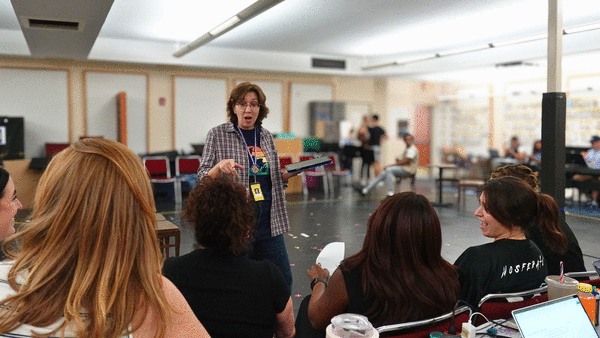
“Accent is identity,” says Lori Engler, the production’s dialect coach. “It’s like a thumbprint of who we are.”
The distinctive Newfoundlander accent is a key part of the story’s scene-setting. It emphasizes the close-knit aspect of the town of Gander: “The accent really helps to establish community,” she says.
And then it also serves to show the difference between the locals and those who “come from away.” But that raises another point: In a show where the actors play multiple roles — including the unexpected visitors from all over the world — there are other accents to master. In fact, the show employs 18 different dialects, Engler says.
The accents serve another important function: They help distinguish when an actor switches from one character to another, something that can happen quickly with minimal wardrobe change.
“Sometimes the actor doesn’t even get a different jacket,” Engler says. “It’s their voice that makes the character clear.”
If an accent helps define a region of the world, so does its local music. And the music of Newfoundland, jutting into the North Atlantic Ocean on the far northeastern edge of North America, is unique.
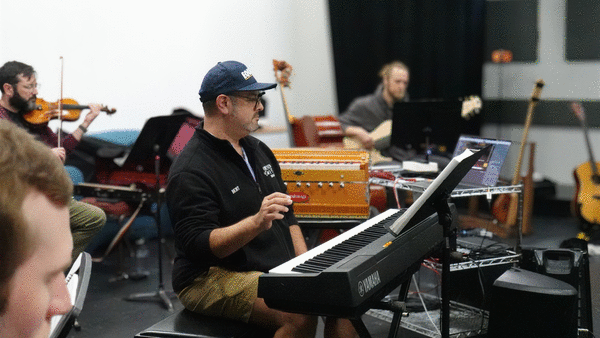
So unique, in fact, that music director Bert Rodriguez had to go on something of a treasure hunt to do it justice. He could have “cheated” with electronic keyboards duplicating sounds, but “it was really important to me to use the actual instruments,” he says. “There’s no comparison between digital and having the instrument right in front of you.”
Luckily, he owned a harmonium. As one does. “It instantly puts you in a different place,” he says of the instrument, which has a sort of wheezy drone sound. He found a bouzouki, a kind of “jangly mandolin,” and he scored needed orchestral whistles from the musician who played them in the Broadway production.
“We can utilize these instruments to tell the story and evoke feeling from the audience,” he says.
The music of “Come From Away” comes at the audience with a roar; the opening number, “Welcome to the Rock,” is as far removed from a standard Broadway showtune as, well, Gander is from New York.
“It’s primal. It’s earth,” Rodriguez says of the song. “It immediately says these are people of the earth, we are a foundation, we are here.”
That practicality is reflected in the way the actors manipulate the chairs to create an airplane, a diner, even a rocky ledge. They are literally building the world around them.
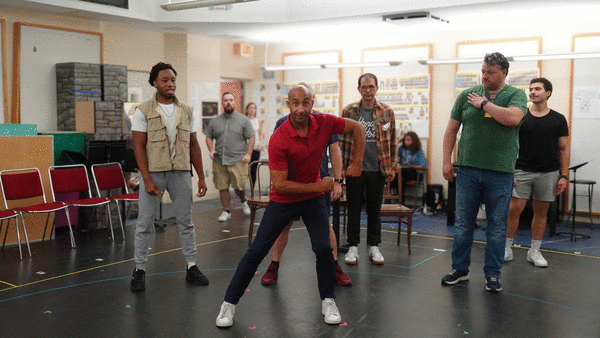
Choreographer Shane Bland has to make all the movements look artistic, while the actors maintain their characterizations.
“It makes the process a lot harder than ‘and 5-6-7-8,'” he says, contrasting the realistic movement to the stylized big dance numbers of more traditional musicals.
The chairs can represent different objects — a suitcase, for example — which influences the characters’ movement.
“It’s such a technical show, but when the audience comes in, it can’t look technical,” says Bland, who appreciates the show’s Canadian characters. He grew up in Alberta, where his father was a Mountie, one brother worked for Labatt Brewing and another was nearly drafted into the NHL.
“Mounties, beer and hockey,” Bland laughs. “That’s really Canadian.”
For him, that meant matching the actors’ moves to their characters’ culture, Canadian or otherwise.
“Every movement has to come from character and story,” he says.
So he designed the actors’ motions to reflect their characters’ emotional state. For many of the folks in the story, the dominant emotions are fear and confusion.
“I barely know where I am, I don’t know what’s happening,” Bland says of the underlying feeling. “What does that look like? It’s beautiful chaos. There are very few moments of calm, because nobody had that.”
At this point, you may be feeling a moment of sympathy for the actors — they are maintaining multiple accents, singing nontraditional music and responsible for moving the chairs that serve as their scenery. All while remembering their lines. Oh, and conveying the emotional truth that acting requires.
“There are so many things that the actors are doing at one time that the audience should never realize,” Rodriguez says.
To that end, the trio of creatives has worked closely together to support the cast, who have only about four weeks of rehearsal.
“How can we help you?” Engler says about their attitude. “We’re all doing the same thing really, helping them tell this story.”
That means the music, dialects and movement all have to function in tandem: Where is there time in that song to rearrange the chairs? Is that accent so strong that it obscures important lyrics?
“This is the most integrated dialect work I’ve ever done, and it’s absolutely necessary,” Engler says.
The musicians are also working hard, some learning to play less common instruments.
“We are so blessed to have so much talent in Central Florida,” Rodriguez says. “Almost everybody had to learn something outside their comfort zone.”
Which is fitting, as a primary theme of “Come From Away” is how people react when they find themselves outside their own personal comfort zones.
Rodriguez again points to the actors, who are portraying real people; the show is based on interviews with those in Gander at the time.
“These are ordinary people in extraordinary circumstances coming together for the common good, for the greater good,” Rodriguez says. “They are the heartbeat of the show.”
‘Come From Away’
• Where: Margeson Theater at the Lowndes Shakespeare Center, 812 E. Rollins St. in Orlando
• When: Aug. 26-Sept. 27
• Cost: $55 and up
• Info: orlandoshakes.org
©2026 Orlando Sentinel. Visit at orlandosentinel.com. Distributed by Tribune Content Agency, LLC.







Comments