Column: Why I loved Dolly Parton and her Dollywood
Published in Entertainment News
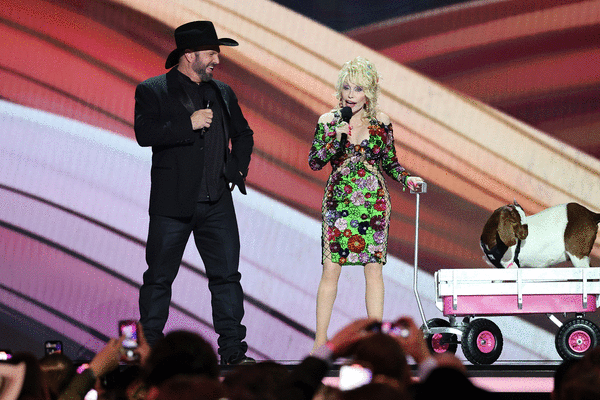
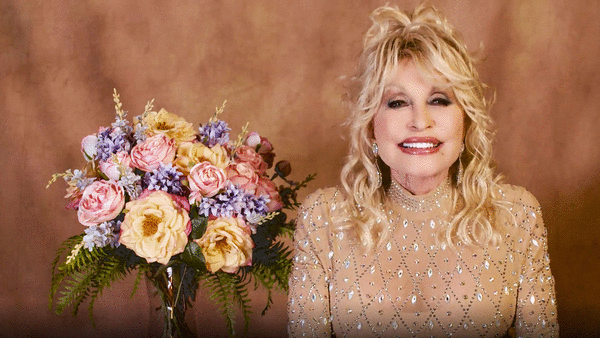
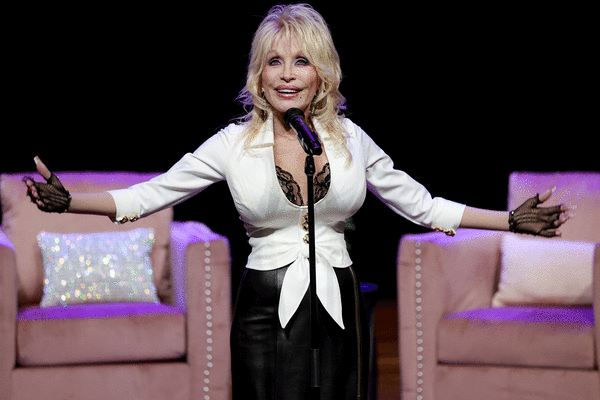


CHICAGO — In the middle of Dollywood — a theme park in the Smoky Mountains that I have visited 50 times or more — there’s a replica of the one-bedroom house in which Dolly Parton grew up in Sevier County, Tennessee, as one of 12 children.
It’s not the actual house, although some visitors tend to think so. But it’s the same size. And if you stand and peer through the window alongside the moms, dads and kids in strollers, as I often have, you hear a symphony of people articulating their new understanding of just how far this great American came.
Humble beginnings are a cliché. Parton, though, escaped a space barely big enough for 14 people to turn around. Humble does not do it justice, but palpably, she grew up surrounded by love.
She conquered country music, then Hollywood. Then she became an entrepreneur with her own theme park in Pigeon Forge. Just recently, she’d moved into Dolly’s travel stops, taking on the Buc-ee’s chain with her all-powerful, blue-collar brand, just as she once had taken on Burt Reynolds and the rest of the sexist movie business.
I now own a cabin up in the mountains above this place and, over the years, plenty of my friends have made fun of me for my obsession with Dollywood and Dolly Parton, the latter fandom being one I share with the former Illinois Gov. Pat Quinn. I was once in the same room as the governor and Parton (it was when her Broadway “9 to 5: The Musical” was in Chicago) and his face lit up with a smile of a wattage I’d never seen before and surely never will see from him again. I hope he is doing OK today.
Everybody loved Dolly Parton. That sounds like another cliché, but think for a second about how few people in the entertainment business that truly could be said about. America, in case you haven’t noticed, has taken sides.
Yet Parton masterfully stayed out of every fight in the culture wars, preaching love, philanthropy, mentorship and tolerance until her dying breath. Dollywood is in a town with a Trump Store (actually two when I last checked) and yet the LGBTQ+ community is welcomed in Dollywood as part of Parton’s loyal fan base.
Nobody ever wanted her to take sides and thus she rarely was asked anything she did not want to answer.
Indeed, it is my firm belief that, whatever this nation’s divisions, a critical mass of people understood that Dolly Parton must be left alone so we can say that at least one American belongs to everyone.
Even a republic needs its queen, and it was her.
Alas, there is no obvious heir.
Who else do we have who stands for fun, literacy (she put more books in school libraries than any other human), music and, above all, family?
I attribute some of that complexity to her being born in a part of America far more complex than people think. Sevier County sided with the Union, not the Confederacy, even though the state of Tennessee joined the Confederacy. And its people, many of whom had origins in northern England, Scotland and Ireland, were fiercely independent in their rural poverty and, of course, isolated by the mountains. They feel far more Appalachian than Southern, which is, of course, true of Parton herself.
I started going to Parton’s beloved county when my kids were little, repelled by the high cost and corporatization of Walt Disney World, and yet loving roller coasters and amusement parks. I also thought it not a bad think to teach two boys living in the city of Chicago about the other America. Dollywood thus became our Disneyland — from the Tennessee Tornado to the Wild Eagle to the Mystery Mine with the dead parrot before the big drop.
In the early years, especially, it felt like everyone working in the park was a Parton relative, especially anyone performing bluegrass music: Parton’s niece, cousins, uncle. There were 12 kids. That’s a lot of relatives. I would take adult friends, especially after I bought the cabin nearby. They’d always say the place exceeded expectations, being charmingly built into the mountains and all.
I never saw Parton at Dollywood, though; when I met her, it was in New York or Chicago, when I was writing about her shows. You’ll be shocked to know, she could not have been warmer or lovelier or more self-deprecating and funny. Everyone around her basically just smiled the entire time. Here was a woman known for a “fake” look, so to speak, replete with face-lifts and enhancements of this, that and the other, who actually was about the most genuine person you could ever meet.
Even with all of her money and fame, she was unchanged and unchangeable. She made so much fun of herself that any potential satirists were disarmed.
These days, my adult kids prefer to hike in the mountains and I have to drag them every Christmas to hear “A Tender Tennessee Christmas” at the Dollywood holiday pageant, which has become my ersatz church.
Alas, of course, Parton was mortal. And, as it appeared on Tuesday, had been doing less well of late than people knew.
I often would walk around Dollywood as someone who has seen a lot of entertainment businesses come and go, wondering what they would do when Parton died. I don’t doubt they have their contingency plans, rolling out right now. But this death on this Tuesday will have come as an unexpected shock.
I’ve often thought the park would see a surge in near-term popularity after Parton’s death, and I am sure that will be the case. The trickier time will come after years have gone by and she begins to recede in memory, as all of us eventually do.
But I think most anyone reading this will be gone by the time that becomes an existential problem. Queens can reign long after they leave us.
—Chris Jones is a Tribune critic
--------
©2026 Chicago Tribune. Visit at chicagotribune.com. Distributed by Tribune Content Agency, LLC.





Comments