Commentary: David Ellison's 30-movie pledge sounds like make-believe
Published in Entertainment News
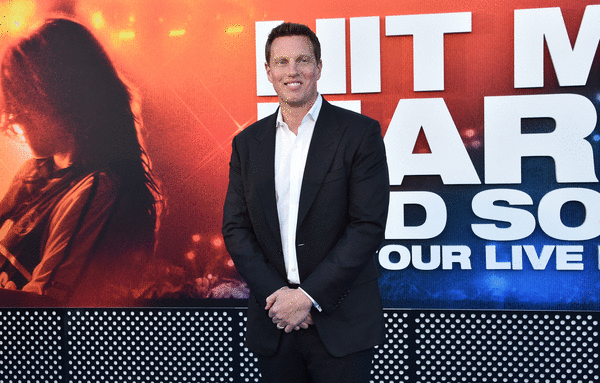
As Paramount waits for the antitrust trial over its proposed merger with Warner Bros. Discovery to start in March 2027, its chief executive, David Ellison, is bringing his perspective to the court of public opinion. In a New York Times op-ed published last Tuesday, Ellison discusses what he believes to be the biggest point of contention for the merger — the fate of CNN — and reiterates that he plans to commit to 30 theatrical releases per year. “Nobody can dictate what audiences will love,” he writes. “What I can promise is the work, and more of it.”
It’s an optimistic vision for a company trying to persuade regulators, shareholders and people within the industry that bringing together two legacy studios would lead to more aggressive investing in theatrical filmmaking, rather than a retreat from it. But Hollywood has seen merger-era optimism collide with corporate reality before.
The real question isn’t whether Ellison is sincere about wanting to preserve the theatrical experience. On Saturday, Bloomberg News reported that Paramount agreed to sign contracts with major theater chains to make good on Ellison’s 30-movie pledge for a three-year period if the merger goes through. A written agreement could certainly help alleviate some of the concerns surrounding the acquisition. According to the report, Paramount would face penalties if it didn’t keep up its end of the bargain with theaters. But whether the economics of the company Ellison is trying to build can support that commitment is the real issue.
The merger that brought together WarnerMedia and Discovery is an obvious precedent. The company’s competing financial priorities were quickly made apparent. Batgirl, a nearly finished film with a reported $90 million budget, was shelved after the merger closed in 2022 for a tax write-off. It was one of the most visible examples of wide-ranging cost-cutting that totaled between $2 billion and $2.5 billion.
Despite these measures, Warner Bros. Discovery emphasized that delivering a robust theatrical offering was a priority following WarnerMedia’s ill-fated “Project Popcorn” strategy to release its 2021 theatrical slate simultaneously on streaming. In a 2023 appearance at CinemaCon, chief executive David Zaslav expressed hope that Warner Bros. can eventually increase its output to 20 theatrical releases a year.
Those plans have since been scaled back. In 2025, Warner Bros. fell short of that mark, releasing 11 films. Now, the company is targeting between 12 and 14 films per year. That’s not necessarily because Warner Bros. lacks interest in expanding its slate, either. Since the start of the 21st century, Universal (along with its specialty label, Focus Features) has delivered the highest annual average of releases from a major studio at 17.2, according to CNBC.
That’s the fundamental challenge facing Ellison’s 30-film pledge: Even without factoring in the financial pressures of a merger, there’s no precedent for a major studio delivering that many wide releases. More movies do not necessarily translate into more hits, especially in an era when audiences have become increasingly selective about what they choose to see in theaters.
“Fewer movies are now doing more of the heavy lifting due to a new ecosystem since the streaming disruption,” Kevin Goetz, founder and CEO of the entertainment research and analytics firm Screen Engine, told Deadline in May. The result is studios placing their biggest bets on a smaller number of films — the inverse of Ellison’s promise to dramatically increase theatrical output.
But the challenge facing Paramount-Warner Bros. Discovery wouldn’t just be operational. The combined entity would reportedly inherit $79 billion in debt, likely creating pressure to prioritize safer, more predictable projects. That could put the studio at odds with the kind of risk-taking that has recently distinguished Warner Bros., which found success in 2025 with bold, filmmaker-driven films like Sinners, Weapons and One Battle After Another.
In his op-ed, Ellison points to "G.I. Joe: Retaliation," "Top Gun: Maverick" and "Terminator: Dark Fate" as examples of his theatrical track record as a producer, both good and bad, but the common denominator is that all three were built around established intellectual property. The biggest risk was putting Tom Cruise inside the cockpit of an actual fighter jet.
Warner Bros. isn’t the only studio to illustrate this tension. After Disney completed its $71.3 billion acquisition of 21st Century Fox in 2019, one distribution executive told the Wrap the deal was partly about buying “a place for theatrical films Disney wouldn’t make.” Instead, there are fewer 20th Century films coming to theaters to begin with. By 2022, 20th Century Studios president Steve Asbell told the Hollywood Reporter that the label would release two or three theatrical movies per year while more of its output was redirected toward streaming.
In other words, two of Hollywood’s biggest mergers from the past decade tell a similar story: a combined company’s other priorities — servicing debt and streaming investments — take precedence over its theatrical ambitions. That doesn’t guarantee that a Paramount-WBD merger would produce the same outcome. However, it’s clear that the incentives that make mergers appealing also risk reshaping the commitments made during them.
Ellison can promise more movies for theaters if the merger goes through. But future earnings calls, not the next op-ed, will be the real test of his word.
____
This column reflects the personal views of the author and does not necessarily reflect the opinion of the editorial board or Bloomberg LP and its owners.
Miles Surrey is a Brooklyn-based culture writer. His work has also appeared in The Ringer, Men’s Health, and Vox.
©2026 Bloomberg L.P. Visit bloomberg.com/opinion. Distributed by Tribune Content Agency, LLC.










Comments