Review: In 'Furious,' a female serial killer is more than the murders she commits
Published in Entertainment News
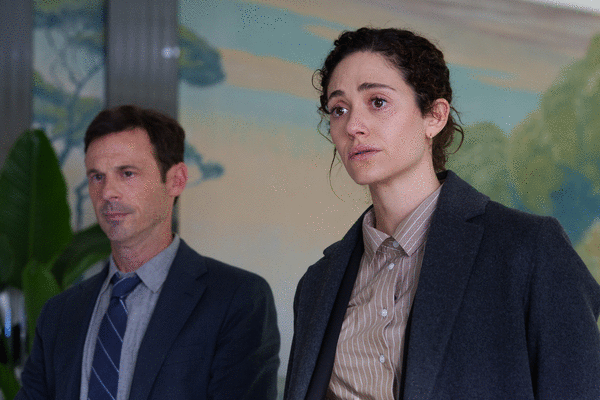
"Furious," which premieres Monday on Hulu, is technically a serial killer story, since there are multiple murders committed by a single character, but happily that is the least of it.
Broadly speaking, these kinds of stories — powered by a stop-them-before-they-kill-again clock, making their antagonists out to be finicky geniuses or horror movie monsters instead of opportunistic mediocrities — strike me as a low form of fiction. But "Furious" is as much relationship drama as procedural, animated by a quartet of excellent performances, with some things to say about abuse, exploitation and love along the way.
Although "Furious," created by Elizabeth Meriwether ("New Girl," "Dying for Sex"), acknowledges an inspirational debt to the 1987 Theresa Russell-Debra Winger film "Black Widow," all it really preserves are a couple of names, the idea of a female serial killer and an emotional relationship with the woman hunting her. The killer is Catherine (Lola Petticrew), a petite young woman who goes about in a variety of wigs, under a variety of names, careful to mask in public. Her murdering is not a compulsion but a mission, like Jeanne Moreau in "The Bride Wore Black."
Her nemesis is Alice Black (Emmy Rossum), a former police detective now answering phones for the FBI. She became persona non grata in the NYPD after identifying her detective boyfriend (Jake Lacy as Marshall) as the person who put her in the hospital, because, you know, cops. One day a request comes from former colleague Danny Kelly (Scoot McNairy) to assist him in investigating the homicide we see Catherine commit at the top of the series.
Various elements of the crime bring to mind an earlier killing; Alice believes they're connected and might have something to do with sex trafficking or, eventually, a Jane Doe cold case. This brings her to the desk of Nora Washington (Quincy Tyler Bernstine), who also happens to be running the very FBI department Alice has been hoping to join. "You requested my squad," says Nora. "Why do you want to work in the basement on sex crimes and crimes against children — do you hate yourself?" Maybe she does — she orchestrates internet dates where foreplay is a fistfight, and has some relevant trauma in her past.
Sharing scenes with the other principal characters, intense or sensitive as the moment requires, Alice is the hub around whom the series revolves and hurtles forward. Danny, who found himself isolated in the department when he said he believed her, is her only friend. ("But here's the crazy s—. You don't … talk to me anymore, either.") Nora, who has a hard edge and a drinking problem, has a few things to teach her, sometimes with a quote from Balzac ("Laws are spiderwebs through which the big flies pass and the little ones get caught") and Beckett (the dead "make a noise like feathers") or a tale from Greek mythology. ("I'm not a former cop. I went to a fancy school, and I'm very smart," she says, very drunk.)
As to Catherine, she is a mix of a sly fox and a wounded bird. She may be manipulative and murderous, but as we're given reasons to dislike her victims, a collection of rich white people — with one sad exception — and because Alice feels connected to her in some way, and because she's had a terrible life, there is not a little of the protagonist in her antagonist. There are some sad ironies stitched into the plot, and an upsetting late twist, though the show doesn't wallow in it. We understand that Catherine has her reasons, and in a strange way we want to see her carry out her mission. She may be a killer, but she isn't the villain.
It's not perfect. We are not surprised at least as much as we are. Some of the plot points strain credulity. There are some old-school jurisdictional clashes between the police and the FBI (as in every fourth episode of "The Closer"), and a heaping helping of professional jealousy within departments.
But the show stays fascinating less for the plot than for the performers. Rossum attacks her role as if playing a Greek tragedy. (The hair redoubles the impression.) McNairy, one of TV's most likable actors, brings warmth. Petticrew evokes broken innocence. Bernstine finds new notes in a role that typically runs to cliche.
I also want to mention the great Hope Davis as the sister of a victim, the son of a well-connected mogul with something to hide, and especially Steve Way, as Alden ("Ramy"), a force for good in Catherine's life, and for humor in the series; born with spinal muscular atrophy, he manages some excellent physical comedy in his motorized wheelchair. The direction (Brian Kirk helmed the first two episodes) is crisp and matter of fact, staying out of the way, which is all you can ask when the writing is good and the actors are too.
©2026 Los Angeles Times. Visit at latimes.com. Distributed by Tribune Content Agency, LLC.






Comments