Review: 'Little House on the Prairie' stays true to the spirit of the novel, if less so its letter
Published in Entertainment News
"Little House on the Prairie" is the third television adaptation to bear the name of Laura Ingalls Wilder's 1935 autobiographical novel of life on the Kansas plains in 1869 to 1870. The first, the Michael Landon television series that debuted in 1974, set in Walnut Grove, Minnesota, is really based on Wilder's subsequent volume, "On the Banks of Plum Creek," while a 2005 miniseries, shown as part of "The Wonderful World of Disney," was generally faithful to the letter and spirit of the text. The record shows that I liked it.
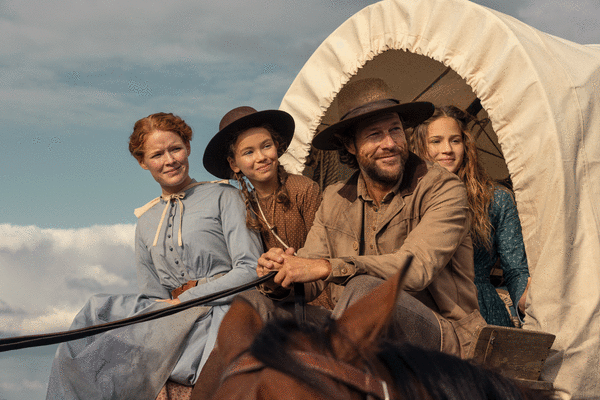
The new "Little House," created by Rebecca Sonnenshine and streaming on Netflix, is fairly faithful to its spirit, and less so to its letter. At its center is the Ingalls family: father Charles (Luke Bracey), or Pa; mother Caroline (Crosby Fitzgerald), or Ma; serious older sister Mary (Skywalker Hughes), and adventurous Laura (Alice Halsey), whose story this is. They are heading out to Kansas to what they imagine is free land, though they will have a thing or two coming on that account. "This will be our new forever," says Laura, who doesn't yet know that her future will be in Minnesota.
To be sure, the character relations remain essentially the same. Pa will play his fiddle. Laura and Mary will dance, when not getting in one another's hair, or sulking. There will be singing, frequently. Major episodes from the book — when Jack got lost, (Jack is the dog, and he will be found), the incident of Mr. Scott (Maclean Fish) down the well, Christmas, the one about malaria, and all the business of building the eponymous log house — are accounted for, if in some cases expanded upon or altered. So extensive are its innovations that, although I am going to point out certain departures from or additions to the text, because I am that sort of pedant, it may be best just to regard this "Little House" as an original thing, a variation on a theme by Laura Ingalls Wilder, or a reboot of the television show.
Some touches are drawn from Wilder's own history. Her mother was a teacher before she married Charles Ingalls; her maternal grandfather died from drowning. The black cowboy hat Laura sports is straight from a photograph of Wilder as a girl. Laura is made a sort of mini-Scheherazade to foreshadow the writer she'll become (though she'll also ask, "What am I ever going to need in a book?"). Baby Carrie, in the novel from the start, is born, as she really was, in Kansas, meaning that Ma is pregnant through much of the season — a condition that may have seemed too complicated for a 1935 children's book, but which adds new strains of drama to the miniseries. It also introduces a theme in which Ma, who has lost "so many" babies, is trying to give Pa a boy, though he is not the sort to be disappointed in another girl.
Also new to the story is Independence, Kansas, itself, which in the book is an offstage place to which Pa will sometimes go to fetch necessities, disappearing from the story until he returns. Here it's nearby — a nicely realized little movie town to which the whole family will sometimes repair, to shop, raise a church or join in a Founders Day celebration. It's dominated by a less than transparent booster, Eli James (Michael Hough), who comes with a self-important wife, Jemma (Mary Holland), and a pair of teenage twin girls who might be described as all dressed up with nowhere to go.
Notably, the series' treatment of Native Americans feels intended to rectify, or at least deepen, their portrayal in the book — naive or romantic, maybe, though not, I'd argue, negative — with added native characters and discussions regarding the land and treaties and such. While Ma frets about the natives in the neighborhood, for no reason she can articulate — one juvenile delinquent steals her cherished china figurine, but we understand that there are social causes for his behavior — Pa, who has built his house unwittingly on an Osage trail, has sympathy and perspective. (Ma will soften considerably, because this is that kind of show.)
It's not an issue for guileless, outgoing Laura, who acquires an Indigenous best friend, Good Eagle (Wren Zhawenim Gotts). Her father, Mitchell (Meegwun Fairbrother) will be a friend to Pa and her mother, White Sun (Alyssa Wapanatâhk), will provide a skeptical counterpoint to Ma. Mission-educated, they live in a nice house with a crucifix on the wall and shelves full of literature.
Most every character gets some backstory, some traumatic. The Ingalls left Wisconsin under a cloud. ("Why didn't anyone come to say goodbye?" wonders Laura.) (Still, it's good to see Martin Donovan as Pa's angry father in a fever-induced flashback.) Ma married Pa, her social inferior, against her mother's wishes. Caleb (Kowen Cadorath), a new character who works for another new character, Emily Henderson (Barrett Doss), at the general store, was abandoned as a small child. Echoing the character played by Victor French in the TV show, Mr. Edwards (Warren Christie) has a drinking problem, brought on by a family tragedy. (In the book he describes himself as a "wildcat from Tennessee"; here he has wild … cats.) Much of the time, someone is sad. Halsey and Hughes, who are very watachable throughout, are especially good with worried looks, and Fitzgerald, perhaps the series' MVP, is an artist when it comes to expressing concern.
Sonnenshine also invents tentative romances between Edwards and Lacey Aubert (Rebecca Amzallag), who is French, independent, runs the saloon, I guess you'd call it, dresses in black and wears trousers; between Emily and Dr. Tann (Jocko Sims), who is in the book, but much more established here; and between Mary and Caleb. All these storylines sacrifice the centrality of Laura as a character and observer and makes this "Little House" less a story of a family out on its own than a family in the context of community. (That's for later volumes in Ingalls' nine-book saga.)
It's very sentimental — which the novel, with its matter-of-fact, if sensually evocative prose, and it's child's eye view, is not. The dialogue here is ripe with sampler sentiments and weighted with meaning ("Hope is everything," "What if this is where we finally become who we're meant to be," "Life can get away from you if you don't speak your heart.") Much of the added material would have easily fit the TV series — temperamentally, it's very much a case of late 20th century broadcast television — which to some may be a recommendation.
It's pretty, often very pretty, to look at. The flat expanse of Winnipeg, Manitoba, where it was filmed, makes a good topographical match for east Kansas. Prairies are prairies.
———
‘LITTLE HOUSE ON THE PRAIRIE’
Rating: TV-PG
How to watch: Netflix
———
©2026 Los Angeles Times. Visit latimes.com. Distributed by Tribune Content Agency, LLC.











Comments