Q&A: Peter Asher: The vital musical link between the Beatles, James Taylor, Barbra Streisand and other legends
Published in Entertainment News
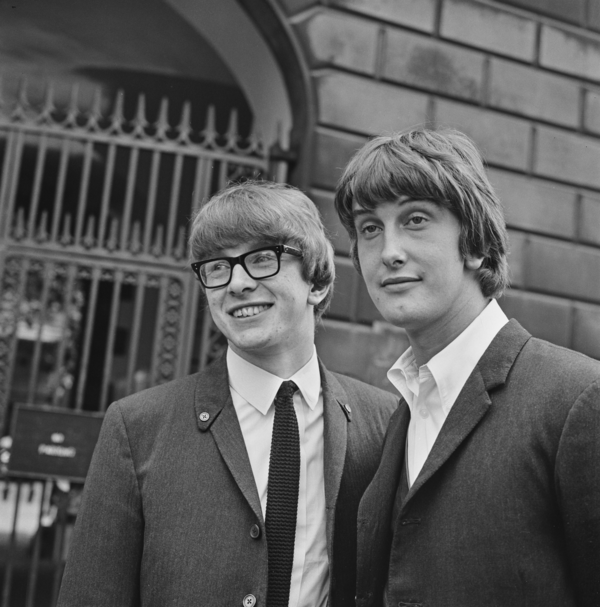


SAN DIEGO — Longtime fans of multi-Grammy-Award winner Peter Asher will surely smile and nod in approval as they watch such famous Asher collaborators as Linda Ronstadt, Paul McCartney, Carole King, Rufus Wainwright, Eric Idle, Twiggy and others ardently sing his praises in the new film documentary, “Peter Asher: Everywhere Man.”
Almost anyone else watching the film will probably wonder: “How the heck did I not know about this guy?”
It’s a fair question, given Asher’s remarkable track record as both a chart-topping recording artist in his own right and as a self-effacing, behind-the-scenes producer and manager whose life story is remarkable and then some.
Or, as Steve Martin says in the film: “Peter was always this kind of ghostly, legendary figure. I didn’t even know what he did.”
Speaking from his home in Malibu, the London-born Asher quickly noted that his now seven-decades-long career is the result of luck, pluck, good timing and resourcefulness, not ruthless calculation.
“Nothing I did was ever part of a master plan,” said Asher. “What I will give myself some credit for is that, when I see an opportunity, I’m pretty good at grabbing it.”
How many opportunities has Asher had? Here are some examples.
—As an in-demand child actor, he appeared alongside Boris Karloff in the English TV series “Colonel March of Scotland Yard.” Asher is now apparently the last living person to have acted with the storied horror music star.
—As a teenager in the 1960s, Asher was roommates with Paul McCartney, who was then dating Peter’s actress sister, Jane, and lived in the Asher family’s London home for several years. It is the same home where Peter’s mother had previously given oboe lessons to George Martin, who went on to produce all but one of the albums by McCartney’s band, the Beatles.
—As one half of the vocal duo Peter & Gordon, Asher topped the record charts in both the U.K. and the U.S. with the first of Peter & Gordon’s No. 1 hits, “A World Without Love.” It was written by McCartney for the Beatles, who turned it down.
—Asher was a founder and co-owner of Indica, the cutting-edge London bookstore and art gallery where John Lennon met Yoko Ono in 1966. Asher served as best man at Indica co-founder John Dunbar’s 1965 wedding to Marianne Faithfull. He later took the newlyweds as his guests to a party where Faithfull met Mick Jagger, for whom she soon left Dunbar.
—In 1968, Asher became the head of the Artist & Repertoire (A&R) department at the Beatles’ new record label, Apple, where the first artist he signed was James Taylor. Although he had almost no experience as a producer, Asher produced Taylor’s self-titled debut album for Apple. McCartney and George Harrison both made cameos on the album. Other artists Asher signed to Apple included Badfinger, Billy Preston and the Modern Jazz Quartet.
—When Taylor’s first album was a commercial failure, Asher moved to Los Angeles where he got Taylor a new contract with Warner Bros. Records. He produced Taylor’s next album, the chart-topping “Sweet Baby James,” and was his manager and producer into the 1980s.
—As Linda Ronstadt’s manager and the producer of 14 of her albums, Asher was pivotal in making Ronstadt a household name whose music deftly covered multiple genres. He was also instrumental in helping to create what came to be known as “The California Sound” in the 1970s — and for prominently crediting the ace studio musicians who performed on albums by Ronstadt, Taylor, J.D. Souther and other artists he produced.
—In 1977, Ronstadt, Taylor and Asher appeared on the cover of Rolling Stone together. It was the first time a record producer was featured on the magazine’s cover. He won the Grammy Award for Producer of the Year, Non-Classical, in both 1977 and 1989. His most recent Grammy, in 2002, was for producing a live comedy album by Robin Williams, a close friend. Only four other producers, including Quincy Jones and Rick Rubin, have won in that Grammy producer category twice or more.
—In addition to Ronstadt and Taylor, the artists Asher has managed includes Carole King, Joni Mitchell and Randy Newman. His credits as an album producer range from Bonnie Raitt, Barbra Streisand, Diana Ross, Jane Monheit and Cher to Morrissey, 10,000 Maniacs, David Sanborn, Cheap Trick’s Robin Zander, actress Pamela Anderson, and the recently deceased Raul Malo. Thirteen of the albums Asher produced earned Grammy nominations.
—Since 2017, he has hosted the weekly SiriusXM satellite radio show “Peter Asher: From Me To You” on the Beatles Channel.
Now 83, he is at work on Streisand’s second consecutive album of all-star duets. In September, Asher will embark on a 19-city East Coast concert tour that also features former Zombies’ singer Colin Blunstone and the 1980s English New Wave band the Fixx.
“Peter is a consummate British gentleman whose ethics are so solid that he can work and thrive in an industry where an understanding of ethics often seems to be missing altogether,” said Daniel Geller, who co-directed and co–produced “Peter Asher: Everywhere Man” with Dayna Goldfine. Their previous credits include 2021’s “Hallelujah: Leonard Cohen, a Journey, a Song” and 2013’s Cate Blanchett-starring “The Galapagos Affair: Satan Came to Eden.”
“Peter has integrity in spades and it radiates out of him,” Goldfine said of Asher. “There is no one we talked to who had anything bad to say about him.”
Speaking by phone for nearly an hour in late June, Asher thoughtfully discussed his life and career. This interview has been edited for length and clarity.
Q: I assume that, over the decades, you have done far more interviews than you may ever care to recall.
A: Yes.
Q: So, to begin, I’d like to ask you some questions I hope you haven’t been asked.
A: Alright. That’s good.
Q: Dizzy Gillespie was widely beloved by fans and by his fellow jazz musicians …
A: I was a big fan of Dizzy’s. I encountered him a number of times.
Q: When I once asked Dizzy if there were any people who didn’t like him, he laughed and said there were one or two but he declined to name them. The film “Peter Asher: Everywhere Man” suggests you are also held in near-universal high regard by the people who know you and with whom you’ve collaborated over the years.
A: I think that would be a worthy ambition, but I’m not sure if I’ve come close to that. It’s kind of not for me to say, but it’s very flattering. Thank you.
Q: Over the years, you have produced albums by Jane Monheit and David Sanborn, and you were the production supervisor for “Space,” the Modern Jazz Quartet’s second album for Apple Records. How and when did you become a jazz fan, and how big a jazz fan are you now?
A: I was a big jazz fan and still am, but mostly of bebop. My boyhood friend, Nigel Anthony, who was a fellow actor, was a huge jazz fan and a good drummer. We used to compare record collections. I had all these 10-inch Prestige and Blue Note Records albums.
Q: Had your life taken a different turn, might you have had a more jazz-oriented career?
A: No, because I’m not a good enough musician. I mean, I understand it enough to love it, but not to play it as a performing musician. If I’d done my homework, learned my chord changes, learned to read music properly, and all that stuff, then, maybe.
Q: Was there an early aha moment for you, growing up, with either a specific artist, song, album, or performance?
A: The first time I heard Charlie Parker and Dizzy, probably on (the 1953 live album) “Jazz at Massey Hall,” it blew my mind. The cadenza of Charlie Parker’s solo on “A Night in Tunisia” is eight bars of genius, and that really moved me. I don’t think it had any effect on the records I ended up making, although whenever I could sneak some jazz in, I would.
Q: Since you didn’t pick up an alto sax or trumpet after hearing the “Massey Hall” album, what drew you to guitar?
A: It looked pretty easy, and it was what the Everly Brothers and all our heroes played. If it was good enough for Buddy Holly and good enough for Elvis — even if he just hung the guitar around his neck, like a prop — it was good enough for us!
A: If I count correctly, Peter and Gordon released 14 albums and a “Best Of” collection between 1964 and 1967, which is one more than the Beatles put out between 1963 and 1970. How intense was that work schedule?
A: It felt intense. But I think the Beatles said the same thing in all their interviews. You know, we were young and energetic, we had nothing else to do, and we were having a great time. But that work schedule didn’t feel imposed upon us at all. Our schedule would read: “Be in the studio for three hours, cut three tracks, go and play on a radio show, do six (print) interviews.” And we’d say: “Fine.”
Q: How much more strenuous was it when you took touring into account?
A: Touring was quite strenuous. And touring was way different in America than in Britain because America’s so bloody big. So, yeah, it got hectic.
Q: And, when you went out on package tours with a bunch of other acts on a Dick Clark “Caravan of Stars” tour, there weren’t deluxe touring buses with beds back then like there are now, were there?
A: No, we were in a rented Greyhound bus charter, as it were, and everyone picked a seatmate who you sat next to all the time.
Q: Who was your seatmate?
A: Mostly, Doris (Coley) from the Shirelles, who I liked very much.
Q: Lucky you.
A: Indeed. Yes!
Q: What was it like to be on these multi-act package bills where you’d just play a 15-minute set and then make way for the next act?
A: That would be mostly when we were doing the Murray The K revue shows at the Fox Theater in Brooklyn. We’d do five shows a day and co-headline with Wilson Pickett, which was very exciting. We’d headline the afternoon shows, and he’d headline the evening shows. The nice thing was that we were all on the same bill. But yeah, we did three songs, four songs. And if some people only had their first hit, they just did one song!
Q: It’s well-documented that Paul McCartney dated your sister and lived with your family in London for nearly three years, where the two of you shared an attic apartment. Through conversation and observation, what were the most lasting takeaways for you from being under the same roof with him?
A: It’s funny; I don’t remember exactly. He was a nice bloke. But I didn’t really take advantage of the opportunity to ask significant questions — like: “How do you write songs as good as that?” — which was probably a great relief to him. We were both out on the road quite often, so we didn’t hang out together that much. We were both incredibly busy, but we became friends and we shared the bathroom.
Q: Paul gave you “A World Without Love,” a song he had written for The Beatles, but not released. He later gave you two more songs. You were a young guy. Did this seem like a normal thing, or were you pinching yourself a little?
A: Both. I think I’d heard it earlier, before (Peter & Gordon) had a record deal, for sure. I just made a mental note of the fact Paul played me this unfinished song. Then he played me the finished song, which I thought was rather good. And it was specifically predicated on the fact that we had a record deal — Peter & Gordon got signed — that I went back to Paul and said: “Whatever happened with that song? Did you give it away? Are The Beatles going to do it?”
Q: Maybe there were other people who were 19 or 20 who said: “I want to be a pop star, and then I want to work for the Beatles at a prestigious record company.” But I haven’t met any people like that, and you did both those things. Was this totally organic and unplanned?
A: It was unplanned, but I made the plan rapidly when the opportunity presented itself. Nothing I ever did was part of a master plan. What I will give myself some credit for is that, when I see an opportunity, I’m pretty good at grabbing it. So, when suddenly Paul is calling me and asking if I wanted to be the head of A&R at The Beatles’ new record label, I was OK saying: “Well, I’ll do that!” It was same as when James (Taylor) and I decided to leave Apple Records. I mean, being his manager seemed logical to me.
Q: There was no school you could go to then to learn how to be an A&R person. Did you learn strictly by doing it? Or had you observed, in your years of recording with Peter & Gordon, what an A&R person did?
A: Those are two fairly different things. One, obviously, is deciding who to sign. Or listening to other people about who they want to sign. But, ultimately, part of our role is deciding who to sign and getting it done. And then deciding what kind of record they make, what songs they sing, who produces it. But that becomes secondary after they’ve been signed. I think of those as fairly different roles.
We would have A&R meetings (at Apple) once a week or so, with as many Beatles as were in the building, and I would play anything that we received in response to our requests for people to send in their tapes. We would play anything that seemed even vaguely, approachably good, which was rare. So, deciding who to sign certainly took a long time and was not that successful. The people who actually did sign with Apple usually came to us through (recommendations from) friends or family, like George (Harrison) bringing in Jackie Lomax or somebody. We signed Billy Preston, but people (already) knew him and loved him. The first step for how to be an A&R man is to keep listening. The first song someone sends you isn’t very good and the second one is probably not going to be much better. So, unfortunately, you do make fairly rapid decisions based on the first 16 bars of the first song you hear. Well, I did that anyway.
Q: Sometimes, failure can be a bigger impetus than success. James Taylor’s first album for Apple was really good and went nowhere. Did the fact his album did not do well compel you to move to Los Angeles to keep working with James and get him a new record deal?
A: I suppose the real question is: “If it had been a complete failure — and, it wasn’t a success, sure — would I have moved to L.A. anyway?” But I think my move to L.A. was pretty much preordained. Because we knew James’ career was going to be America-based and I like the idea of living in Los Angeles. I decided to do that, however well or badly James’ first album did.
Q: How easy or difficult was it for you to transition from living in London to living in Los Angeles?
A: Extremely easy! I mean, I loved it. One year earlier, I was riding home (from philosophy classes at King’s College) on my bike, in the rain, at 4 o’clock in the afternoon in the winter. And almost exactly a year later, I was driving down Sunset Boulevard in a rented Mustang convertible, in the sunshine, and being recognized by beautiful women. This seemed to me a distinct improvement.
Q: After Peter & Gordon split up, were you ever attempted to make a solo album?
A: No.
Q: Why not?
A: Because I think of myself as more of a harmony singer. And I love producing people who sing much better than I do.
Q: You moved to L.A. and you’re managing James Taylor. Before too long, you were also working with Carole King and managing and producing Linda Ronstadt, J.D. Souther, and the list goes on. Was this just one thing leading to another, or did you have specific goals in mind?
A: No, I didn’t. Again, these were just opportunities. J.D. became a dear friend of mine and was until he died. He is still one of my favorite songwriters. I was being asked to produce other people at the time and it made sense to me to do so.
Q: As producer, what are your responsibilities? No matter the style of music or who the performer is, what do you consistently want to bring to to every recording session?
A: I think number one is listening to the artists and just finding out what they like and what they want to do — what they’re comfortable doing. And, secondly, creating the right vibe in the studio is significant. I think James (Taylor) says that, sometimes, being a psychotherapist is part of a producer’s role. And I think there’s some truth to that … I’m sure there’s a great track record of incredibly unhappy people making terrific records.
Q: It’s difficult to think of any record you’ve made that doesn’t have pristine sound quality. How do you help artist translate their work to recording, in terms of the clarity of the music?
A: Yes, clarity is the key word. I am not very fond of muddle. I do tend to like things fairly audible, so you can actually tell what’s going on. It always seems to me that the songs I’ve worked on are well-served by some degree of clarity and organization.
Q: Have you ever been approached by any artist who wanted to work with you, but you just didn’t think it was a good fit, no matter how accomplished they were?
A: No, I don’t think so. I probably would have tried to see if I could help. Or, at least it would have always gone as far as the preliminary conversation of: “What kind of record are you thinking about making? What are your ambitions for this particular session?
Q: We’ve talked about your work as a producer and as a manager. Is there much overlap? Or are they two completely different things?
A: Complete different things. But the advantage of being both is that the producer and the manager didn’t get into an argument! So, even though the thought processes were different and the ambitions were different, it actually proved convenient to do both together. I always say that the secret of being a good manager is a good artist.
Q: Was there any time when you were in Peter & Gordon where — like some of the scenes in the Beatles’ movie, “A Hard Day’s Night” — you were running to keep from being torn apart by fans?
A: Yes, yes. I think I think maybe all the fans had seen “A Hard Day’s Night,” and they knew that’s how they were supposed to react — even though we were an infinitely junior version of the Beatles. There’s a story I like to tell, only because it represents the oddness of the whole thing.
We were playing a gig outdoors, and the stage was on a flatbed truck. The police kept saying: “Oh, don’t worry, we’ve controlled the audience before. They’ll be fine, they can’t get to you; they can’t get over the edge of the baseball field.”
Well, of course, they could! This huge pack of young women jumped over the fence and ran toward us, and the police officers told us to leave the stage. So, we jumped down and were running to safety. As I jumped down, my glasses had fallen off onto the grass. I stopped for a moment to pick them up. I put them back and carried on running. When I looked back, one of the girls had stopped where my glasses had fallen and was tearing up the grass (as a souvenir). That was so bizarre.
©2026 The San Diego Union-Tribune. Visit sandiegouniontribune.com. Distributed by Tribune Content Agency, LLC.










Comments