Q&A: Hey! Ho! Let's go to the Skirball Cultural Center's exhibit on punk
Published in Entertainment News
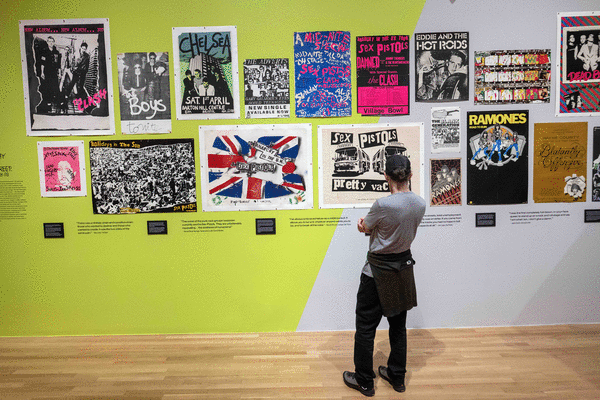
ANAHEIM, Calif. — A massive photograph of the Ramones playing the Hammersmith Odeon in London, shot by photographer Sheila Rock in 1978, looms over the entrance to the Skirball Cultural Center’s new exhibit, “Outsiders, Outcasts, Rebels + Weirdos: Punk Culture 1976-1986.”
There’s a literal Weirdo on the wall to the left, a towering Melanie Nissen photograph of John Denney of the Los Angeles punk band the Weirdos in 1977.
Step into the gallery, and the Skirball’s exploration of the history of punk unfolds through photographs and posters of artists from the Sex Pistols and the Clash to Black Flag and the Bags, and magazines and zines such as Punk, Slash, Search & Destroy, and Kill Your Pets.
A fashion gallery displays vintage clothing from London punk shops such as Seditionaries, BOY, and Kitsch 22, much of it designed and sold by Vivienne Westwood and Malcolm McLaren.
There are scores of gig posters from venues across the country, including L.A.’s Hong Kong Cafe and the Masque, Orange County’s Cuckoo’s Nest, San Francisco’s Mabuhay Gardens, CBGB in New York City, and the 9:30 Club in Washington D.C.
Tying it all together, and providing a cool freebie to take home, are 14 stations with zine-like pages designed with the punk aesthetics of the era that identify many of the artifacts that line the gallery walls and fill its display cases.
“At the Skirball, we are really interested in the relationship between Jews and counterculture, Jews and popular culture, and how that weaves into a larger story of the American experience,” says Cate Thurston, the Skirball’s chief curator and co-curator with graphic designer Michael Worthington of the punk exhibit.
“One of the main things was looking at the initial kind of scene in New York and how the Jewish diaspora is really, really involved and central to that scene,” adds Worthington, founding partner of the L.A. graphic design studio Counterspace and, since 1995, a member of the CalArts graphic design faculty.
“It kind of opened a doorway, if you like, as the starting point,” he says. “Trying to track chronologically and geographically how that affected punk, filtered and changed throughout different locations and different time periods.”
Different cities and scenes revealed different kinds of connections, Thurston says.
‘In New York, there’s this Jewishness of place,” she says. “In the U.K, that’s much thinner, but it’s still very meaningful. You have Malcolm McLaren, manager of the Sex Pistols, and Bernie Rhodes, manager of the Clash, both of Jewish origins, who are really pushing the two bands with the broadest reach out of the U.K.
“And then that interesting sort of ‘schmatta business’ [Yiddish for ‘the rag trade’] for [clothing stores] Sex and Seditionaries, BOY and Acme,” Thurston says. “The quite literal Jewish thread creating the look of punk in the U.K.”
The Jewishness of New York was only one reason why young people found their way to punk in its early years, Worthington said.
Jewish connections to the punk family tree, and that cultural heritage was just one of the reasons punk grew in those early years, Worthington says.
“There’s a lot of people who are rejecting their culture and their heritage as a way to become a punk and to choose that culture,” he says. “We’ve deliberately tried to include different voices where there’s people that are basically saying, ‘It didn’t matter to me being Jewish. What mattered to me was being a punk.’
“[We’re] trying to embrace all of those different points of view,” Worthington says. “Using that Jewish thread, but also applying it to lots of other cultures, lots of other races, lots of other socio-economic backgrounds who were basically kind of outsiders.”
In an interview edited for length and clarity, Thurston and Worthington talked about the collectors who loaned artifacts and ephemera to the exhibit, the graphic design of punk, their favorite items in the show, and more:
Q: So you’re saying that some Jewish punks were not necessarily rebelling against their Jewish heritage, but from other things in their world?
Cate Thurston: The way I would frame it is there’s sort of a traditional Jewish museum story, and it is we came, it was hard, it got better. And this exhibition is not that. We’re talking about people like Tommy Ramone, who is the child of Holocaust survivors.
We’re talking about people whose parents were immigrants, and they’re sort of pushing the traditional expectation for children of immigrants to go to college, be successful, become fully American in sort of an American Dream trajectory. And they’re challenging that. They don’t fit into that model. They’re creating a world where they do fit in because they don’t fit in anywhere else.
Michael Worthington: I think it’s really different for individual people. One of the reasons the show has such a long title is that those four groups are people’s ways of kind of stepping away from mainstream culture. They’re either forced out of it or they choose to drop out of it and rebel against it.
There’s multiple threads going on in the exhibition that try and look at all these different rationales why people might be punks and what they might be rebelling against or running towards.
Q: People argue about when punk started. Patti Smith, the Sex Pistols, the Ramones and others had formed earlier than 1976. How’d you pick that year?
Thurston: You know, periodization is always where you can start knife fights. We chose 1976 because it’s the release of the Ramones’ first self-titled album. It’s the same year that the Ramones travel, 10 weeks after the release, to the U.K.
And even though what would become punk already existed there, it was a catalyst for it and gave it a name and a momentum in a new way. It felt like a moment that was cleanly the start of something, even if that is messy.
Worthington: Also, you know, we’re trying to acknowledge, even though the date is ’76, pre-punk, proto-punk, things that created an overlap, especially in New York, where there really were blurry boundaries around naming and genre.
We’ve also deliberately looked at how the terms punk and new wave were kind of interchangeable. In a way, the first group of new wave bands that got labelled punk, maybe one out of five were actually punk.
Q: Talk about the organization of the exhibit: How did you choose the different chapters of that story to explore?
Worthington: The main thread initially was this idea of cross-pollination in terms of geography and chronology. So it made sense to go from New York to London to L.A. to D.C. to track that kind of history. But then we discovered there were threads we wanted to pull out in order to highlight them.
So there’s a section about anti-establishment and anti-fascism, where it’s looking at pushing back against the right wing that we wanted to highlight. There’s a section of female photographers of that time that we thought had been underrepresented or underexposed, pardon the pun. So those were pulled out from the central spine that was the chronology.
Thurston: If you come into this and you don’t know anything [about punk], then those thematic topics are something you can build on top of. You can’t understand the relationship between punk and art if you don’t know what punk is.
Q: Let me ask about the art and graphic design of punk, which really stands out in the exhibit. What made it work for that culture?
Worthington: Part of it was this DIY aesthetic, which came out of having no budget, having no record company money, playing small venues at weird places, and having to make things yourself. At the time, the cutting-edge technology was the photocopier. You’d cut and paste things by hand, you’d use rub-down type.
What’s interesting is that you see that professionalized when it reaches London, and you start to have record companies involved and real graphic designers involved. Then you suddenly see some people develop that aesthetic, develop the ideas behind it. You look at somebody like Jamie Reid [designer of albums and singles, including the Sex Pistols’ debut album and the “God Save the Queen” single].
Really great artist, really great graphic designer. He’s looking at the Situationists and putting those kind of ideas into the design. Or Barney Bubbles, who did a lot of stuff with Stiff Records. His stuff is incredibly visually literate. He’s looking at artistic historical movements, using that kind of pastiche and quotation that wasn’t really being done by people who were just doing the DIY thing.
Q: I read that much of the material in the exhibit was loaned by punk collector Andrew Krivine?
Worthington: Most of the larger-scale posters come from Andrew’s collection, which is a massive archive he’s built up over 50 years. His cousin was John Krivine, who was one of the founders of BOY, which was an early punk rock clothing company. Andrew would travel from New York to London in ’76, and he just continued to collect that stuff from when he was a really young teenager.
But the show kind of shifted and we wanted to involve other people and other themes for it to be more relevant to Skirball and L.A.
Thurston: Particularly L.A., the West Coast and D.C.
Worthington: A lot of the Vivienne Westwood-Malcolm McLaren clothing belongs to Malcolm Garrett, who’s actually the designer who designed a lot of the Buzzcocks records, and amongst other things. And Duran Duran. Then Bryan Ray Turcotte lent us the artwork pages from Slash magazine.
He used to work at Slash magazine and then Slash Records, and when the magazine closed, they were throwing things away, and he just grabbed all the original artboards for the magazine, which is kind of spectacular.
Thurston: We loaned from the California Photography Museum at UC-Riverside. And Kareem Kaddah really contributed materially to the West Coast flyers.
Q: This might be hard, but can you point to your favorite things in the exhibit?
Worthington: My favorite piece, there’s a screen-printed poster of Joe Strummer that was produced by this studio in London called X3. They used to make silkscreen prints and sell them out of the back of their van at gigs.
It’s originally a Jill Furmanovsky photograph, and as a kid, I loved her photographs and live photos in the music press. And the Clash was my favorite band as a kid. It hits every kind of button.
Thurston: It’s tough. Going into this, I assumed it would be any of the very cool, and in some cases rare, Joy Division posters in the exhibition. Joy Division was the band that, growing up in the Valley, my best friend and I thought maybe there’s a bigger world than the San Fernando Valley
But I would probably say my favorite piece is a poster from Minor Threat’s last show. They’re playing with a band called Trouble Funk, which is a go-go band that developed out of D.C.’s Black community. So in this last show, they’re bringing together the punk rock of the D.C. suburbs and the go-go music of D.C. to enjoy music and community.
Worthington: There’s a nice echo with that with the stuff we have from Rock Against Racism, where a lot of those concerts were deliberately putting together reggae bands and punk bands as a way to get the two audiences to interact and create commonality and community.
———
‘Outsiders, Outcasts, Rebels + Weirdos: Punk Culture 1976-1986’
When: Now through Sept. 6
Where: Skirball Cultural Center, 701 N. Sepulveda Blvd., Los Angeles
How much: Admission to Skirball and all exhibits except for Noah’s Ark is $20 for adults, $15 for seniors, full-time students with ID, and children 2-17. Free on Thursdays and for members and children under 2.
For more: For information, hours and tickets, see Skirball.org.
———
©2026 MediaNews Group, Inc. Visit ocregister.com. Distributed by Tribune Content Agency, LLC.







Comments