Commentary: Lupita Nyong'o can't play Helen of Troy? That's odd
Published in Entertainment News
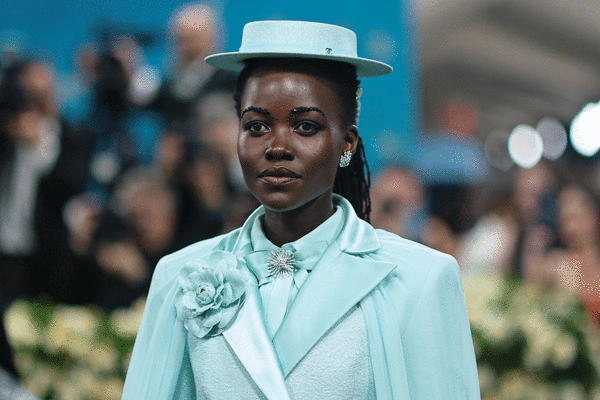
Elon Musk, steadfast guardian of all things truthful and scientific, has once again criticized director Christopher Nolan.
Months after saying Nolan had “lost his integrity” following speculation that the director selected Black actress Lupita Nyong’o to play Helen of Troy in his forthcoming epic, "The Odyssey," Musk returned to the subject on X. “Chris Nolan desecrated the Odyssey so that he would be eligible for an Academy Award,” he wrote, gesturing toward the long-held belief that awards shows’ progressive politics incentivize diverse casting choices.
The comment followed confirmation that Nyong’o would portray both Helen of Troy and Clytemnestra in the film and rapper Travis Scott is playing a bard — a traveling Greek storyteller — and reports that trans actor Elliot Page is appearing in an unspecified role. Musk is part of a growing chorus of people who’ve decided to comprehensively define the ethnic and cultural parameters of ancient Greece.
Yet their definitions are only as accurate as the European exceptionalism that created them. And their objections seem rooted less in rigorous historical analysis and more in a desire to prop up a fantasy of the past. After all, films about ancient Europe have ignored historical technicalities for as long as the sword-and-sandal genre has existed.
Scientific research on the ancient DNA of Bronze Age Aegean populations — which includes the ancestors of the ancient Greeks of Homer’s era — suggests they were genetically closer to modern Mediterranean populations than to steppe-derived groups associated with Northern Europe. Matt Damon, who plays Odysseus in Nolan’s new film, wouldn’t tidily fit this description, but his Whiteness is deemed to be close enough, and he hasn’t experienced the same racial panic. Neither did blonde-haired, blue-eyed Brad Pitt when he portrayed Achilles in 2004’s Troy.
While Musk and others have suggested that Nyong’o’s appearance is a disqualifying factor, it’s worth noting that the physical features of the characters she portrays were never as concrete as they imagine. Although Helen of Troy is typically described as being fair-skinned with golden hair, Homer never explicitly described what she looked like (1). Any portrayals are, strictly speaking, an educated guess. Which is to say, maybe it’s okay to take some creative license when portraying a being supposedly born from a god’s giant egg. For the white actors, those creative liberties are permitted because they aren’t treated as creative liberties.
The reasons why are a tale as old as Eurocentricity. Western art and media have historically centered European features and aesthetics as the default for beauty, heroism and divinity. It’s the same reason that, in many portrayals of Jesus, he has blue eyes — a feature unsupported by the Gospels and historically unlikely given his birthplace and lineage.
Through decades of producing artwork by and for white people, Hollywood helped turn that sort of unreality into a false cultural baseline: Whiteness is treated as a neutral, default starting point rather than an ingredient to be mixed in. With the industry being a lucrative force in global entertainment, it also had the power to export that notion worldwide, which only reinforced a tradition of institutional entitlement and cultural misinformation — a lineage Musk seems to subscribe to.
Over time, though, there was a shift, and people of color and differing genders began to be cast in prominent roles. As institutional changes set in, the industry, like the world beyond it, has had to reckon with notions of physical beauty and gender identities that also deviated from America’s prescriptive norms. That led to R&B singer Brandy playing the lead role in the 1997 live-action adaptation of "Cinderella," and the prince she married was played by Filipino actor Paolo Montalban. Years later, in 2023, singer-actress Halle Bailey played Ariel in the remake of "The Little Mermaid."
If Nolan were casting strictly for appearance, the result would be more than arbitrary cultural gatekeeping. He would’ve forfeited an opportunity to challenge audiences’ imaginations with Nyong’o, Page, and Scott. In the process, he would’ve lost out on working with another Academy Award winner, another Academy Award nominee and a world-class live performer whose tours have generated hundreds of millions of dollars.
Had the logic of appearance-based selection been applied consistently — that is, keeping out Damon — it would also mean the absence of an entire cast that would make the movie worth watching.
All because they don’t look like characters who never existed in the first place.
____
(1) Homer described Helen of Troy as being "white-armed" and little else. That did not mean "white" in the racial terms we speak of today. It was a way of saying that women had precious skin. The fair skin and golden hair descriptions came from later Greek poets like Sappho, who called her xanthê, which has been translated as "golden" or "fair-skinned."
____
This column reflects the personal views of the author and does not necessarily reflect the opinion of the editorial board or Bloomberg LP and its owners.
Peter A. Berry is a culture journalist with bylines in XXL, Variety, COMPLEX, Rolling Stone, Okayplayer and more. He also writes the "Rate It Or Love It" newsletter on Substack.
©2026 Bloomberg L.P. Visit bloomberg.com/opinion. Distributed by Tribune Content Agency, LLC.











Comments