With Stephen Colbert's exit, what's next for the Ed Sullivan Theater?
Published in Entertainment News
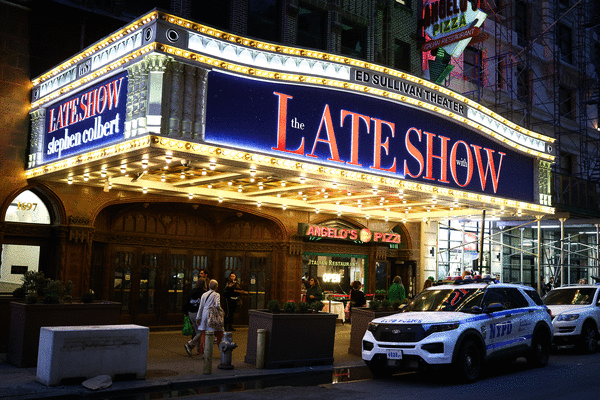
NEW YORK — The demise of “The Late Show With Stephen Colbert” inevitably gives rise to the question of what will become of the Ed Sullivan Theater, which in its latest incarnation has hosted decades of “Late Night” under David Letterman and Stephen Colbert.
As of Thursday, CBS’s plans for the historic theater were as buttoned up as the guest list for Colbert’s final show, but questions from the Daily News about the Ed Sullivan’s next chapter went unanswered.
We can be reasonably sure the 13-story building won’t get sucked into a voracious green wormhole and morph into a teeny tiny snow globe, as depicted Thursday in the closing moment of Colbert’s final show. Beyond that, the historic theater on Broadway between West 53rd and 54th streets may well be shuttered for the foreseeable future.
Speculation as to the theater’s fate began swirling almost as soon as Colbert’s cancellation was announced last year around this time. After Paramount merged with Skydance Media, a rep told The Wrap that the new company would be reviewing all its real estate holdings going forward, seeking potential savings.
There are whispered hopes within the theater community that the Ed Sullivan could once again host Broadway shows as it did during its first nine years.
The theater was built by songwriter, dramatist and playwright Arthur Hammerstein to honor his father, Oscar Hammerstein I, and opened as Hammerstein’s Theater in 1927. Its first production was a musical play, “The Golden Dawn,” notable mainly for starring one 23-year-old Archibald Leach, who would become movie star heartthrob Cary Grant. In 1931 Arthur Hammerstein went bankrupt during the Great Depression and was forced to sell.
CBS signed a long-term contract on the building in 1936 and outfitted it for radio broadcasts. In 1950 CBS converted it into a television studio, CBS-TV Studio 50, according to the theater’s website. “The Ed Sullivan Show” took up residence there in 1953, making history with performances by Elvis Presley and, famously, showcasing the Beatles in their U.S. debut in February 1964.
In fact, Sir Paul McCartney on Thursday presented Colbert with a photo of the Beatles onstage as a parting gift and played the show off with the Fab Four’s “Hello Goodbye” alongside the Late Show’s Louis Cato and the Great Big Joy Machine, former bandleader Jon Batiste and another famous Elvis (Costello).
In 1967, New York City Mayor John Lindsay was on hand for the official name change to the “Ed Sullivan Theater.” The city Landmarks Preservation Commission designated the building and its gothic interior as a historic landmark in 1988, regulating what can be done to it, and how. The theater is also on the National Register of Historic Places.
CBS in 1993 bought the 30,000-square-foot building outright for about $4 million to house Letterman’s show. When Colbert took over in 2015, he envisioned a restored Ed Sullivan theater in keeping with its history. His exploration uncovered a treasure trove of original fixtures and plasterwork that everyone told him had been lost, as he detailed in a recent set tour for Architectural Digest. Once the underlying structures and artistry were found intact, Colbert and CBS had them brought back to life.
The building and its history are inseparable, which hints at what the next permutation could be. Colbert in his video tour demonstrated this by seamlessly connecting past to present, architectural marvels to personal show memorabilia, and overall reverence for the space with what it represents. He noted the restored stained glass, peopled with images of musicians and artists rather than saints, and the original plasterwork in the dome, which had been covered by air ducts and sound buffers.
All was brought up to date while retaining artistic integrity. Acoustics specialists crafted special sound and lighting apparatus that would capture the sound correctly without obscuring the ceiling.
Among the Easter eggs hidden in the Colbert set: American flag colors subtly woven into the backdrop and lighting; mini homages to CBS, with subtle logo displays; the original “elephant columns” built under the stage in the 1950s to keep the live elephants that Sullivan brought on from Barnum & Bailey Circus from crashing through the floor. An elephant painted onto the wall between the columns marks the spot.
Much of Letterman’s set was notoriously and unceremoniously tossed into dumpsters within 24 hours of his last show taping in 2015, though some was later rescued. The theater was also immediately gutted, the audience chairs yanked out and flung into a pile in the middle of the studio. The marquis followed a week later.
Such a fate will not befall the Colbert set, at least. It will be donated to the Museum of Broadcast Communications in Chicago, where the entertainer launched his comedy career, CBS News reported Thursday.
As for the Ed Sullivan Theater, separated from yet another storied set, the future remains uncertain.
“Because we’re not being replaced by a late night show, I don’t know what’s going to happen to The Ed Sullivan Theater,” Colbert told Architectural Digest. “But something should happen. In my opinion, it’s the best broadcast space in New York City. And the fact that nothing’s going to come in here breaks my heart. But someone will figure something out, and I wish them all the luck in the world. ’Cause they’re gonna love it.”
©2026 New York Daily News. Visit at nydailynews.com. Distributed by Tribune Content Agency, LLC.











Comments