Maryland Folk Festival pause makes Salisbury a rare outlier
Published in Entertainment News
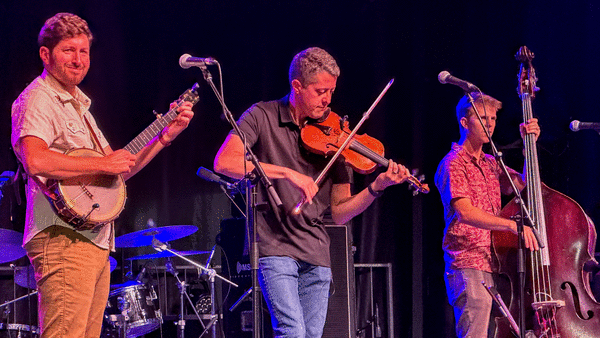
BALTIMORE — “Stories have different chapters — they don’t necessarily end,” said Blaine Waide, executive director of the National Council for the Traditional Arts.
But Salisbury’s chapter with the Maryland Folk Festival appears to be on pause.
City officials announced last week that the free, large-scale cultural festival will not return in 2026 after a difficult sponsorship and grant cycle created funding challenges for the event, which has become one of Salisbury’s signature annual gatherings.
The National Council for the Traditional Arts, which has overseen the National Folk Festival since 1934, typically spends three years helping a host city build a major festival centered on traditional music, dance, crafts, food and storytelling before transitioning the event into a locally run celebration shaped by the community’s identity.
In most places, that legacy has endured. Lowell, Massachusetts, hosted from 1987 to 1989, and its local festival is nearing its 40th anniversary. Johnstown, Pennsylvania, hosted the festival from 1990 to 1992, and it continues. The festival in Richmond, Virginia, is entering its 22nd year and draws about 200,000 people annually, Waide said. Butte, Montana’s festival is entering its 18th year and draws about 180,000. Greensboro, North Carolina, which hosted before Salisbury, is entering its 12th year.
Salisbury hosted the National Folk Festival beginning in 2018 before it became the Maryland Folk Festival in 2021.
Mike Dunn, president of the Greater Salisbury Committee, said the festival’s opening night showed Salisbury what it could be.
“Day one, night one of the National Folk Festival was one of the most electric moments I’ve ever seen in this city,” Dunn told The Baltimore Sun.
Former Gov. Larry Hogan joined then-Mayor Jake Day for the opening ceremony, Dunn said. A New Orleans jazz band led a parade from one stage to another, and crowds showed up in droves — even on a rainy Friday night.
“It’s something I will never forget. I had chills,” Dunn said. “One of the reasons that Mayor Day wanted to do this was to get the people of Salisbury to believe in themselves, to believe that this city could do something like this and that it deserved something like this. It was a big deal.”
Each year, the festival fills downtown with national and international musicians, food vendors, merchants, regional artists, artisans, storytellers, and cultural demonstrations. With up to five stages over three days, it was part concert, part street fair and part traveling cultural museum.
Salisbury officials said they’re already bracing for the economic impact of losing their largest annual event.
Bill Chambers, president of the Salisbury Area Chamber of Commerce, said the loss will be felt by restaurants, hotels and retailers that counted on festival traffic.
“It’s a bitter pill to swallow for our local businesses who have come to count on festival visitors and their discretionary spending,” Chambers said. “Once an event of this importance leaves a jurisdiction, it is almost impossible to build momentum to replace it with something else.”
Salisbury officials said they are exploring future community-centered programming and what a new fall event could look like.
Waide said the Maryland Folk Festival’s legacy in Salisbury remains — and the door is open for it to return in some form in the future.
“I’m sure Salisbury will continue to be a part of that story,” he said. “The festival may come back, it may not. But the impacts will continue to be there.”
©2026 Baltimore Sun. Visit baltimoresun.com. Distributed by Tribune Content Agency, LLC.







Comments