Remember This Banger: Ricky Martin's 'María,' remixed
Published in Entertainment News
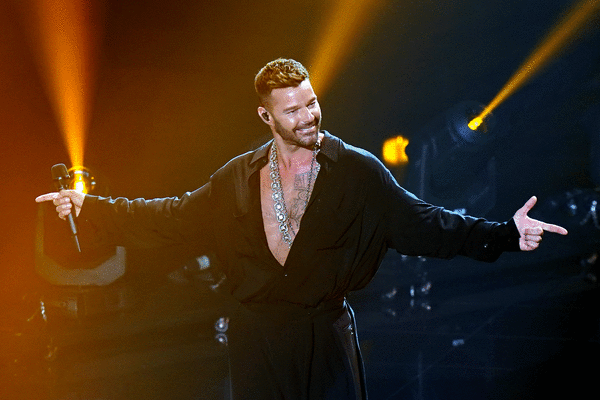
Do you remember Ricky Martin’s first international hit?
Here’s a hint: It had nothing to do with superstitions, black cats or voodoo dolls.
Before the Puerto Rican singer crossed over into the English-language mainstream with hits like his 1998 FIFA World Cup anthem, “La Copa de Vida,” and 1999’s “Livin’ La Vida Loca,” there was already one song that rocked the international charts: his 1995 track “María.”
The slow-burning silky flamenco was composed by Draco Rosa — a fellow Menudo member who, alongside Martin, wooed teen fans throughout the ’80s, but then sought to entice adult audiences in the ’90s. Written with a raw quejío-style opening, the signature track was a single from Martin’s third studio album, “A Medio Vivir,” released in September 1995. A month later, it was distributed as a CD single by Sony Music Mexico.
Later that year, DJ Pablo Flores and sound engineer Javier Garza would remix the tune — supplementing it with distinctly Puerto Rican cries of “wepa” — to make it more suitable for a club environment. After speeding up the vocals, adding Brazilian percussions and blending it all with house music, the resulting song was a work of techno-samba that set the foundation for Martin’s international stardom.
As Flores simply put in a 2025 Instagram post celebrating the song’s 30-year anniversary: “[The] ‘María’ remix is one of the rare instances where the remix is more successful than the original song.”
By summer of 1996, following the release of Martin’s “Maria (Remixes)” EP — which included six tracks dishing on an enchanting woman named María, who “condemns her lovers like a mortal sin” — the song would make its debut on the Billboard Hot 100, peaking at No. 88. This became Martin’s first entry on the United States music chart, with the CD single alone selling 5 million copies.
But the infectious tune — also known as “Un, Dos, Tres” — was initially met with resistance by label heads, who proclaimed that it would be the end of his career. Recalled Martin in a 1999 interview with Rolling Stone: “You do ballads, and now you’re doing Latin sounds. The album is not going to work,” the label told him.
Angelo Medina, who managed Martin at the start of his music career, did not agree that an uptempo track would be a career-killer, or botch any crossover attempts. In a 2009 interview with Billboard, the music executive explained that in the same way that songs like 1989’s “Lambada” or 1993’s “Macarena” had piqued the interest of non-Hispanic audiences, the electric-fused track “María,” too, could attract listeners. “I thought that for it to be valid and really make a crossover, it had to be done in Spanish,” said Medina.
“A Latin act can’t cross over making the same music Americans make,” he added. “It has to be something with roots.”
Medina’s logic was simple: If Martin could find his way into the European market through his authentic Latin flare, perhaps there was room to wedge him into the American mainstream too. “With Ricky, we went market by market,” Medina said.
Martin’s bet on “María” paid off. The song would be a hit in over 20 countries, including non-Spanish-speaking nations like Germany, Netherlands, Australia and France (where it was certified diamond). According to Richard Ogden, senior vice president of marketing at Sony Music Europe, “María” was the company’s second-biggest selling single in 1997.
In 1998, Martin received a request from the Fédération Internationale de Football Assn. (FIFA) to write a World Cup theme song, resulting in his subsequent bilingual hit “La Copa de Vida,” which fans know in English as “The Cup of Life.” One energetic performance of the cheerful song at the 1999 Grammy Awards and Martin was fully primed for his mainstream ascent.
By March 1999, he released his surf pop jam “Livin’ La Vida Loca,” ushering in what would become a Latin explosion, a controversial phenomenon in which Latin pop stars like Jennifer Lopez, Marc Anthony and Shakira “crossed over,” or found commercial success in the anglophone corner of the music industry.
For Martin — who would eventually pivot back to his Spanish-speaking audience following the fading Latin explosion in the early 2000s— he credited “María” for giving him logic and direction, he said in a 1998 interview with Billboard.
“‘María’ is a song I am going to be singing for the rest of my life,” he added.
While “María” proved to be the crucial pasito p’alante for Martin’s worldwide success, it also served as a reminder of Latin music’s global potential. Earlier this month, the Recording Industry Assn. of America reported that Latin music reached $1 billion in revenue in 2025 alone, outpacing overall music market growth.
But the success of “María” also begs the question: If Martin managed to reel in global outsiders with his native tongue, would Latin music be as powerful today if he stayed in this lane?
---------
©2026 Los Angeles Times. Visit at latimes.com. Distributed by Tribune Content Agency, LLC.










Comments