Review: 'Windfall' at Steppenwolf Theatre is a protest play about life, death and police payoffs
Published in Entertainment News
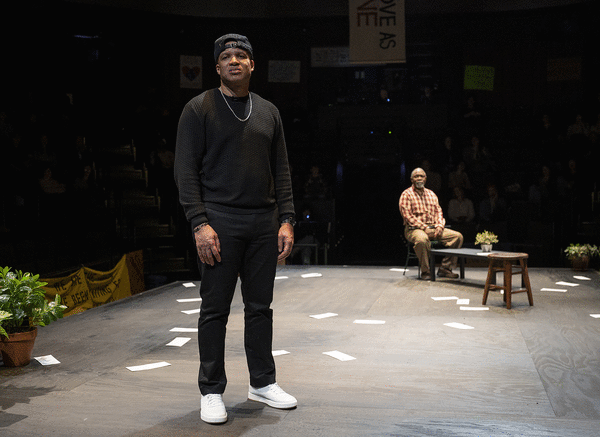
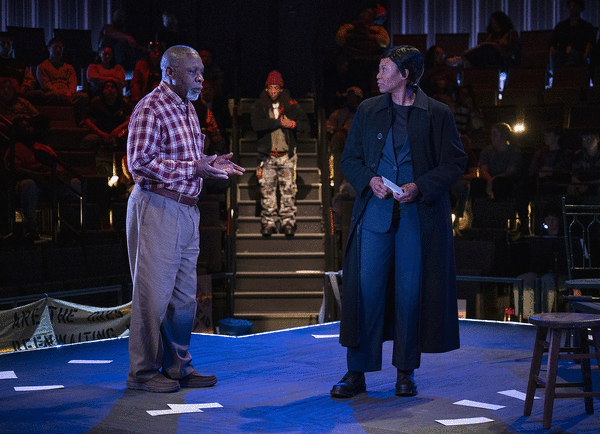
CHICAGO — When police settlement payments make the news in Chicago, it’s invariably due to the massive size of the checks, a hefty and growing portion of which go to attorneys working on a contingency basis. But an entirely different perspective can be found at the Steppenwolf Theatre, where the lyrical playwright Tarell Alvin McCraney has written a play arguing that the checks are little more than blood money, a cash-obsessed society’s way of sweeping harm to Black bodies under a rug and avoiding societal change.
“Windfall” is a sprawling and impassioned protest play that reflects, I think, the growing frustration that many current activist, anti-capitalist writers such as McCraney, now artistic director of the Geffen Playhouse in Los Angeles following a career teaching at Yale, feel about the limitations of writing a play and hoping that it will affect social change in the face of the drastic U.S. shift away from the protest movements of five years ago and the arrival of a second term for President Donald J. Trump. That’s not a new problem for an artist, of course, especially one working in high-end establishment institutions, but it’s striking here how hard McCraney and his highly creative director Awoye Timpo work to lead the audience where they want them to go.
In a prologue, they take on the inuring aspect of phones, asking the entire audience to turn on their flashlights, not for some cool visual effect as at a concert but to persuade them that they have latent power in their hands, should they choose to use it for the right kind of political action. The characters in the play break the fourth wall — a strikingly common thing in Chicago and New York theater this spring — and make their cases directly.
At another point, pressure mounts to stamp one’s feet in protest at injustice and police misconduct. And since “Windfall” is produced in the round, it’s a fascinating social experiment to watch who is and isn’t stomping and with what level of fervor. On opening night, you could see eyes darting around, trying to figure out what everybody else is doing.
If you don’t care to be led like that, even with a cast stacked with formidable actors speaking lines penned by a dramatic poet of the highest order, “Windfall” probably is not your show. Although you can, of course, watch it from whatever level of detachment or impassioned commitment you prefer.
Those who have seen McCraney’s prior work will not be surprised to learn that he has created some haunting characters, most notably one Henri “Mr. Mano” Tamaño (the excellent Michael Potts), a man who has been told his child has been killed by police and who is continually admonished by a succession of city emissaries (all played by Alana Arenas) to accept a very large check as compensation.
There is no such thing when it comes to the loss of a child, of course, and Mr. Mano, who knows loss all too intimately, tries to hold out, even as he talks to his adopted son, Marcus (Glenn Davis), a character no longer alive but whom McCraney has written as a kind of liaison with the audience, someone who can contextualize not just Mr. Mano’s dilemma, but the action of the play’s young ensemble of protestors, played by Namir Smallwood, Jon Michael Hill and Esco Jouléy, who is extraordinarily good here. Smallwood also plays a police officer with a monologue designed to make clear, I think, that it is the system McCraney is protesting, not the individual officers.
This writer’s long-standing strength has been his ability to forge deeply empathetic characters and, just as importantly, to make you believe in a higher spiritual plane where, for example, people do not necessarily stay dead. All of those skills are on display in “Windfall,” especially in its lovely two- and three-person scenes where McCraney can really show his talents. There is one between Hill and Jouléy, respectively playing a coroner expecting a body and a stubbornly living person, that is just wonderful. Similarly touching are the scenes with Davis and Potts, and then Davis and Jouléy, scenes wherein two people who care about each other try to cross a breach.
No activist play has any obligation to be balanced but it’s worth pointing out, I think, that turning down money is not something that many people impacted by violence easily are able to do, even if they always know it is not bringing anyone back to life. Seeing cash in that way is always easier when you have enough talent and education that you are not lurching from crisis to crisis, which is a problem Steppenwolf rarely has confronted in its history of stomping its feet.
Here, though, we have the work of a gifted poet wrestling with problems so large as to have not yet fully found a clear theatrical roadmap through them; I mean, who has? That said, I’m always up for a McCraney trip, because he creates the most fabulous fellow travelers, empowers them with the most beautiful language and always conveys that his heart is in the right place.
Review: “Windfall” (3 stars)
When: Through May 31
Where: Steppenwolf’s Ensemble Theatre, 1646 N. Halsted St.
Running time: 2 hours, 10 minutes
Tickets: $20 (with code 20FOR20) to $148.50 at 312-335-1650 and steppenwolf.org
------------
©2026 Chicago Tribune. Visit at chicagotribune.com. Distributed by Tribune Content Agency, LLC.








Comments