Q&A: Kevin Smith on his 'relevancy chase,' Jay and Silent Bob's future
Published in Entertainment News
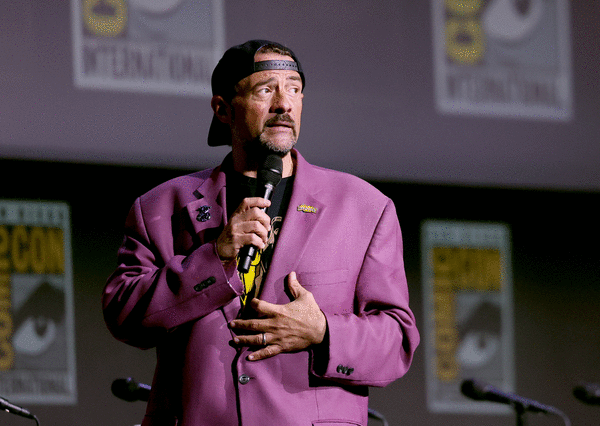
DETROIT — Kevin Smith is a first-rate, grade-A talker.
The filmmaker and Gen X poster child has used his voice to build and sustain a fan base for more than three decades, following "Clerks," his breakthrough black-and-white 1994 comedy about a couple of foul-mouthed New Jersey convenience store workers and the world they inhabit.
His universe expanded with follow-ups "Mallrats," "Chasing Amy," and "Dogma," all of which feature Smith as his trench coat-wearing Silent Bob character, and his sex-crazed stoner bud Jay, played by Jason Mewes. His world outside the movies grew as he became an early adopter of both blogging and podcasting, and he's been a fixture in the world of comic books and fan conventions since before the Marvel Cinematic Universe was a thing.
Smith will be at Astronomicon April 10-12 at the Ann Arbor Marriott at Eagle Crest in Ypsilanti, where he'll meet fans and lead a panel on all things Kevin Smith.
We talked to the 55-year-old about his career, the state of Hollywood and his unassailable sense of ambition. He talked a lot, and we did our best to keep up. (This conversation has been edited for length and clarity, and to clean up a lot — but not all — of Smith's cuss words.)
Q: Question: You're headed to Metro Detroit for Astronomicon. What's your dream venue for speaking engagements? How big of a venue do you think you could fill?
A: It's so f—ing funny you say that, because I've always wondered that. Putting asses in seats is a lot of what I do on a daily basis, whether that be making a movie and hoping people come, or, more literally, in the case of Astronomicon, where I want as many people to show up as possible. So I spend an inordinate amount of time thinking about that. And there have been moments where I'm like, how long would I have to take myself or me and Jay out of the marketplace to sell out X, Y, and Z? When we did the "Red State" tour years ago, it was the first time where I was taking my movie out myself, and we kicked off the tour at Radio City Music Hall. That's a 6,000 seater, and we did like 3,000 people, which was the orchestra level. The balcony was empty as s—. I often wonder, could I ever sell it out? What would I need to do to sell it out? Because sometimes you feel like, "Oh man, I've got unfinished business. I didn't sell out Radio City Music Hall!" You have these little breadcrumbs in life, and it's like, I still have yet to do that to my satisfaction. It sounds dopey to say, and it doesn't mean that I'm suicidal or anything. But it gives you a reason to wake up in the morning and try again.
Q: What drives that sense of 'unfinished business' for you?
A: I've realized the main thrust of my entire f—ing existence is this relevancy chase, this hunt for nonstop relevancy. My job every morning is to wake up and make a bunch of strangers care about what I think and what I'm doing. And so I built up this little cottage industry doing just that. And it's a tender trap, man. It was beautiful, the prospect of getting paid just to be me. Oh my god, I've won. I've cracked the code! But that means you then have to figure out how to make people give a f— about you from now until the end of time. And I've been doing that for 32 years now. And let me tell you, it doesn't get any f—ing easier.
But I've somehow stretched this into a three-decade journey, so, no complaints there. But once you've been doing it this long, then you're like, well, f—, I don't want to stop. Like now what, go back to Quick Stop? F— that. So, you know, welcome back again, my friends, to the show that never ends. And you try to figure out how to add one more link, let the tail grow a little bit longer. I never saw that s— coming when I began this journey.
Q: How has your perception of relevance shifted during that time?
A: There's no f—ing manual for any of this, right? So let me give that as a heads up to any artist out there who's like, "I want to make myself part of my art." Just know that's the cost that comes with it. And some people, where they're standing, it's like, "f—, I'll pay that cost," but you don't know. I went crazy a few years ago, and I think the core of it was like, "Jesus, what would life have been like if I didn't have this incessant f—ing need to make people give a s— about my thoughts?" But then again, I would have been on the outside looking in going, "Oh, what if I had done this? What if I could be somebody like that?" Like, I already know what it's like to be on the inside. And you think once you're in, f—. But then there's another inside. And then there's another inside, inside of that.
So I've still got my nose pressed up against the glass. There are people behind me, looking with their noses pressed up at the glass, wishing they were where I was. But I've still got my nose pressed up at the glass going, "Oh, f—, that'd be cool to be over there." And I guess that's ambition, something that my father was never cursed with. He was very happy to just have a job to pay for his wife and kids; he didn't give a s— about a career. He worked at the post office, he's like, "This'll do." But, you know, his dopey ass f—ing third child was cursed with ambition, and that ambition just don't f—ing stop. There's no finish line, there's no sense of, "now, I am full." It's not necessarily that you want more, like you're greedy, but ambition just don't let you go to sleep, and it wakes you up at night.
And that's the only thing I'd warn a young Kev about. Like, "Hey man, just know that if you're lucky and you get in, it's not going to end." And I bet you I wouldn't have changed a thing. All I would have heard was, "What? I get to make movies?" That's all that would have mattered, not the cost that comes along with it. That all being said, the cost is minimal, the gains are immense, and I'm not just talking about monetarily. I'm talking about waking up and feeling, like, "I'm heard." One of the greatest gifts you can give a human being is feeling like they've been heard. That's why everyone's all over social media, people want to be heard.
Q: Was that sense of ambition in you before you made "Clerks," or did it kick in after?
A: It really kind of kicked in after. It's not like I was one of those kids like Spielberg, running around with the Super 8 camera in his backyard. I just loved movies, right? But it never occurred to me to make one. My old man sat next to me, watched movie after movie, and never once said, "You could do this." We weren't a part of that world, and he wasn't part of that generation where you tell your kids, "Son, you could do anything." He was part of that generation that was like, "See that mountain? Never climb it. You'll f—ing fall." So I sat next to a dude, movie after movie, never once said, "You should do this for a living." Movies were something other people did and we consumed, and that was that.
So growing up? No ambition, man. My greatest ambition was like, well, I've worked at a lot of delis. I know how to make a sandwich. Maybe I can own the deli one day! And then I go see Richard Linklater's "Slacker" on my 21st birthday, and suddenly it all clicks. Then I'm like, wait, because I'd never seen anything like it. I was entranced, because I was like, "Oh s—, if this counts as a movie, I think I could make a movie, too." And then suddenly I get interested in filmmaking.
I can pinpoint it to the day. My ambition kicked in August 3, 1991. We went to a midnight movie, so by 2 a.m., I'm at the Post-Holland Jersey turnpike toll entry, and I turn to my friend Vincent Pereira and I was like, "I think I want to be a filmmaker." And that's where the journey begins, that's where the ambition begins. Prior to that, it was more subsistence. I worked at a series of convenience stores and stuff. When I was in high school, I wanted to be a writer for "Saturday Night Live," but I didn't go to Harvard, so that was never going to happen. I had no idea how to actualize what I thought I was gonna be.
Q: Did anyone help you at that time?
A: It was my sister that led me there. She was always pushing me, like, "You're meant for more, Kevin. Why are you selling yourself short?" So when I saw "Slacker" and decided I wanted to be a filmmaker, I said to my sister, "I saw this movie in New York and I think I want to be a filmmaker," and she goes, "Oh my god, great. Be a filmmaker. Don't want to be a filmmaker, be a filmmaker, in your head and heart with everything you do." Powerful words. Magic words, man. You're a filmmaker, you just haven't made your film yet. Boom. And then I just had to convince people along the way, and we all made ("Clerks") together, and we were off to the races.
Q: Did you always have this incredible gift of gab? Where did that come from?
A: I was just listening to myself speak and I was like, Christ, I sound like I'm on cocaine. But this is 32 years of this. If you ask my sister, she'll tell you I was a very quiet kid. My brother, too. Because I had to compete for screen time with two older siblings, right? So even though I was the baby and I definitely got favored, preferential treatment, my parents had already been through two kids. So they knew, maybe we don't have to be so uptight about it this time. Like, you know, "It don't matter if he's home by five, we can trust this one." So I think because of that, I got some preferential treatment, and since "Clerks," I've publicly received the same preferential treatment that my parents gave me at home. I've realized I've just been trying to replicate my childhood experience until the day I die. So yeah, I've loved the sound of Kevin Smith's voice my whole life. I can listen to him endlessly. But it ain't just today. This s—t's been going on for decades.
Q: When you appear at cons, what's the the thing you hear the most from fans?
A: It is generally a five- to 10-minute story about the powerful role that I played in their life. Whether it's because it's something their parents shared with them and now their parents are gone, or it's because they found me at the same time they were starting to date and they took their future wife to see "Mallrats" and so they always had these references together.
This is the best part of the job, because this is where you meet the boss. This is your job report. Like, I don't have a very traditional structure to what it is I do, and I don't report to anybody except the audience. When you work for the audience, as they say, you'll never work a day in your life. So when you meet your boss, you're f---ing gracious, because that's where the check comes from. And if you're lucky, you actually like your boss. I like my bosses because they're Kevin Smith fans. We have a lot in common.
So this is like the State of the Union. This is where I get to collect more than just cash — and don't get me wrong, cash is definitely part of it, especially in these lean times where the movie business is falling apart. Thankfully, I get to live off nostalgia at this late stage of my career. But it's not so much the money as everything is a constant, non-stop hunt for relevancy. It's a constant reminder that I'm breathing rarefied air, that I can still go to a con and collect a line in front of me.
Q: You've been to Astronomicon several times. How do you feel about the atmosphere there?
A: Doing Astronomicon is lovely. The Detroiters have always treated us f—ing well. While we didn't have an auto industry, there's something very similar between New Jersey and not just Michigan, but particularly Detroit. We're very kindred spirits, cut from a very similar cloth. And I've been f—ing with Astronomicon now for the last few years. We grew a friendship and started working hardcore together. And so I'm delighted to be going back, man. It's still one of the best venues for a comic-con, ever.
Q: Growing up, what was your impression of Detroit from the movies, and how did coming here differ from what was in your mind?
Dan Aykroyd was not there, and I was looking for "Doctor Detroit." I was not looking for "Robocop." But the first time I went in was for "Chasing Amy." I remember that was my first trip into the area, and the thing that blew my hair back was they brought me to a hotel in, what, Dearborn or something? Like, they wouldn't bring me into Detroit. And I was like, aren't we going to Detroit? They're like, "Nobody goes to Detroit, man." They're like, "We'll go in tomorrow for one interview, but then we're going to get right out." So I went into the city and I saw the big f—ing Joe Louis fist, and I didn't understand what the big deal was. I grew up next to Manhattan, like in the '70s it was nothing but muggings and crimes and our parents wouldn't even let us go to the city. So, I don't know, the Detroit that I first encountered when I went there was not as scary as they were saying it was. I was like, this seems safer than New York. So I don't know if it was because of the similarities in our ethos, but they have always embraced us, so I embraced right back.
Q: Do you vote for the Oscars? Are you a member of the Academy?
A: Yeah, I have been since '97. After "Chasing Amy," I got in. But my mom died in December, and my head was up my ass, so I didn't even vote this year. I totally spaced and boom, it all passed. Let's make it clear: I vote when it's important. But in the passing of my mom, everything went to s—, and so the thinking of like, "Hey, what was the best picture of the year?" was not at the forefront of my mind.
But the Oscars are always a very vivid reminder that while I work in a movie industry, I am not of that movie industry. Like, I've never been to the Oscars in my life. And I don't think I would go unless I had like a reason, and I don't think I'll ever have a f—ing reason. So even when "Good Will Hunting" was nominated, which Scott (Mosier) and I were co-executive producers on, I didn't go because I was like, well, it's Ben and Matt's movie. So for me, I figure I'll get on the Oscars when I'm dead and they'll put up a clip of my stuff — if I'm lucky.
When I watch it, there are some people who I'm like, "oh, I've worked with that person, I've worked with that person," but mostly they're as foreign to me as they are to most people that kick back and watch the Oscars. And then honestly, it really sends you into like an existential thought process where you're like, "all right, well, I know these people's movies. Do they know mine?" It's a weird filter. You wonder if other people whose self-expressions you appreciate have appreciated your self-expression. So, it's weird. It always leads to the ambition kicking in. Even if it's something where I'm like, "I don't want to win an Oscar," seeing all these people makes me go like, why am I watching all these people's dreams come true? Go downstairs and make your own dreams come true! Start writing, conclude a project, finish a book, like, there's a zillion things you could be doing to make your moment, and instead you're watching a bunch of people make theirs. It doesn't have the same entertainment value for me.
Q: You mentioned the downturn of the movie industry. Do you think Hollywood can pull out of this? Are movies going to get smaller? What is happening to this industry that you are very much a part of, even if it feels like you're somewhat removed from?
A: Um, oof, I don't know. It seems harder and harder to get a thing done. I used to think that was just me, but it seems like that's across the boards. As the studio system contracts, there are fewer places to actually get a thing done, but to be fair, I wasn't working at most of those places anyway. Those places stopped f—ing with me a long time ago, if they ever did. So if big studio movies are facing an existential moment like that, that only affects me as a moviegoer, really.
It's tough not to agree with everybody that like, oh my god, the whole thing is collapsing. They are making stuff, not as much, but they are making stuff. So long as you hold on to your soul, why not take another turn at the craps table that is the entertainment industry?
Q: What's that next turn at the table for you?
A: We're waiting for our last $500,000 so we can go make "Jay and Silent Bob: Store Wars." Fingers crossed. It's the next Jay and Silent Bob movie, which it's crazy that there's still money out there for Jay and Silent Bob, but it's still happening. It's been written for a red-hot minute. We were building toward doing it by the end of the 2025, but then that got pushed to the beginning of this year, and now we're hoping to start preproduction in late April. But when we started this process, there wasn't a world war happening, so, you know, that makes people go like, "well, wait a second," you know? So unless I'm paying it for myself, I'm usually at the mercy of the financiers, whoever's putting money into this affair.
And I love my career, but there are times when I've kicked myself going like, "Man, you should have been more about the money when you were a kid." Because if you were about the money, you'd have your own f---ing money now, and you wouldn't necessarily be out there going like, "hey, brother, can you spare a dime?" to make your art. That's the only reason I regret not being a financial success, not being a hitmaker, because it would seem that it's easier to get things going if you've got that in your corner.
But I came up as an outsider artist, an indie Cinderella story. So I didn't have exposure to that aspect of the business. I made my own thing, and then I was welcomed with open arms and rewarded for making my own thing, and they were like, "Keep making your own f---ing thing, man!"
Q: Well, in the '90s, making money wasn't the goal; it was part of the Gen X ethos to sort of reject that corporate mentality, right?
A: You've got to remember, we all wanted to sell our art. I remember Edward James Olmos being at the Independent Feature Film Market in 1993, when I was there with "Clerks." He was very passionately insisting to all of us emerging young artists, all these f—ing wannabe filmmakers in this room, "Own your negative." He's going, "no matter what you do, you've got to own your negative. You made that art." Well, it fell on deaf ears because I was like, "buddy, we're all trying to sell our negatives." But with years and distance and age and wisdom, yeah, he was absolutely right. Like, I'll never own "Clerks" again in this lifetime, man. Disney bought it in perpetuity, and then when Disney sold Miramax, Miramax has shifted hands so many times. My movies are owned mostly by Paramount, oddly enough, and have been for a few years.
Q: "Clerks" hit me right at the right time. I was 16, and the '90s indie movie wave was just starting to boom. Did you have any idea what your movies would mean to teenagers at the time?
A: When I started my journey, I was not thinking about you. If anything, I was thinking about my contemporaries. I thought I was making movies for people in their 20s. Which is so f—ing strange, because I had grown up watching movies that were aspirational, right? Like, I'm a kid in grade school and high school watching "Animal House." That's not about my life experience; that's about the next stage of life. So if I could go back in time and correct one thing, I would tell myself, "It's teenagers, b—h. You are making movies for f—ing teenagers." And "Mallrats" absolutely f—ing solidifies that. So it's only within the last 10 years that I realized it was high schoolers watching "Clerks." Like, what could you possibly get out of "Clerks" being in high school? And yet it makes total sense. It's the next stage of life. I don't understand how a kid could identify with "Clerks" today, so it must just seem like some sort of historical document. But you are the reason I'm still working today. It ain't my age group, it's the people who were behind my age group who caught up with s— on home video. You guys have kept it going, so I appreciate that. Thank you.
©2026 The Detroit News. Visit detroitnews.com. Distributed by Tribune Content Agency, LLC.










Comments