Q&A: Patti LuPone discusses her live shows and dogs at the theater
Published in Cats & Dogs News
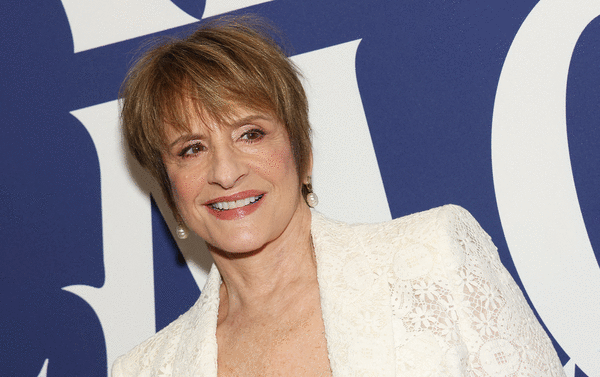
ANAHEIM, Calif. — When actress-singer Patti LuPone released her album “Matters of the Heart” in 1999, she wasn’t interested in simple songs about falling in and out of love.
The record, and the run of concerts that followed it in 2000, mixed songs from Broadway musical theater, where LuPone won Tony Awards for “Evita,” “Gypsy,” and “Company,” with pop songs by Paul McCartney and John Lennon, Randy Newman, and more.
It was her intent, then and now, as LuPone continues the 25th-anniversary Matters of the Heart Tour.
“I mean, it’s everything,” LuPone, 76, says of how she defines the title of the tour and album. “You know, who’s ever had a perfect love affair?
“Well, I’m sure there’s tons of people out there that have had a perfect love affair,” she continues. “And then there’s tons of us who haven’t. What’s that expression – I kissed a lot of frogs before I found my prince?
“So basically it’s the frogs in the first act,” LuPone says, and laughs. Among songs such as “Love Makes the World Go ‘Round” from the musical “Carnival” and “The Air That I Breathe” by Albert Hammond, the first act also includes Joni Mitchell’s “The Last Time I Saw Richard.”
“Scotty [Whittman, LuPone’s director] came up with the [song by] Joni Mitchell, who I think is equivalent to Stephen Sondheim as far as storytelling goes,” she says. “I just love the idea that this is a confused or heartbroken or misguided woman. There’s so many ways we can interpret that song, and I still don’t know what the ending means.
“I like the fact that there is a variety [of songs and emotions],” LuPone says. “The first act is the conflict; the second act is family.
“The first act ends with “Being Alive” [from Sondheim’s “Company”]. And that makes sense, you know. Regardless of how much pain we suffer in life, we’re lucky when we have somebody. We’re lucky to be alive.
“You know, somebody to hold me too close, somebody hurt me too deep,” LuPone says, paraphrasing the lyrics of “Being Alive.” “Fill them with confusion, make me feel alive.
“And the second act ends with ‘Hello, Young Lovers’ [from the musical “The King and I”],” she says. “Basically, I’ve been loved like you. Don’t cry because I’m alone.”
In an interview edited for length and clarity, LuPone discussed how Broadway and its audiences have changed over her 50 years on stage, why she’s glad she never got typecast, and what scares her in bed at night.
Q: So tell me about deciding to celebrate 25 years of “Matters of the Heart.”
A: Well, my concert agent suggested it. Basically, if you want to stay on the performing arts circuit, you have to come up with a new show every year. And last year, our new show was “A Life of Notes, and so at one point I said, “What am I going to do now, Matthew?” [She laughs.]
Q: And here you are.
A: We had all the original charts from Dick Gallagher, which I inherited when Dick passed. So we had all the original orchestrations, all the original charts. Then I looked and I had my original lyric book with [director] Scott Wittman’s notes from 25 years ago.
Everything was in place. My stage manager, who I’m out with now, has the original book from Lincoln Center. It was like, what’s going on? It was meant to be. All the elements were in place.
I started listening to the Lincoln Center performance, and I went, “I’m not touching this.” The dialogue needed to be edited; Scotty wanted to put new [songs] in it. I said, “You don’t know how perfect this show is, Scotty.”
I have another performance of “A Life of Notes’ in June, and I know I’m going to have to rehearse that, because I don’t remember the lyrics now. But the lyrics from Matters of the Heart came back so quickly.
Q: Let’s talk about the kinds of enjoyment you get from working in theater, concert stages, TV and movies.
A: I’m lucky to be working, quite frankly. And I’m extremely lucky that I have been given the opportunity to apply my craft in the different media. So doing this on the concert stage is as great as filming a television show, which is as great as being in a straight play on Broadway.
I love the fact that because of the years of the diverse things that I’ve done I can still get hired. I always bemoaned the fact that wouldn’t get jobs because I wasn’t typecast. But then I’d say you’ll be lucky you’re not typecast, because you just do everything, not just one thing. I’m still viable, I’m still getting hired.
Q: You’re known partly for characters with big personalities and voices like Eva Perón in “Evita” or Mama Rose from “Gypsy.” What’s it like to become that kind of person?
A: It all depends on the director, because basically I’m a hired hand, and if the director is inspired, he’ll inspire his cast. And if the director directs by rote, then we have a very dull and boring production. It always depends on the director.
I mean, some of the roles I didn’t want, or rather, I didn’t go after. People said, “Oh, you’ve got to play that one.” And some of the roles – well, I didn’t want to play Evita. I didn’t like the music when it first started. I thought it was horrible. [She laughs.]
But I knew that eventually I would have to work with [Broadway producer] Hal Prince, and I had been told by enough people that I should audition for that role. [LuPone originated the role of Eva Perón on Broadway in 1979.]
People said I should play Mama Rose, and I never understood why. Because I played Louise [Rose’s daughter in “Gypsy”] when I was a kid, and I remember the woman playing Rose. I remember to this day, the dressing room scene, and me looking up at her while she’s berating me, going, “What is she talking about?”
Q: I’m sure you’re glad you took those roles.
A: For some reason, I’m cast in those roles, and believe me, I love playing them once I understand them. For instance, I never expected to play Nellie Lovett in [Stephen Sondheim’s] “Sweeney Todd.” When I was offered Nellie Lovett with the New York Philharmonic, the first thing I said to my agent was, “Does Steve know?”
Because I thought Steve didn’t like me or didn’t want me to be in his music. And I was approved by Steve, so all was good. That was the concert version, but the inspired production was the John Doyle [2005 revival] on Broadway. Of course, that was a run that wasn’t just, “Learn the role and then do three performances with an orchestra, and figure out how you walk between the tuba and the bassoon.”
It depends on the director, and if the director is as brilliant as John Doyle, then it’s easy to create a character under their leadership. And of course, your leading players, who you play opposite. You can’t do this alone.
Q: You had Mandy Patinkin as Che for “Evita.”
A: I surely did. He was my rock. He’s been a lifelong friend. We both had our trials in “Evita.” It was a moment for both of us because they plucked these unknowns out and trusted us into the first really mega-hyped musical. I mean, I can’t remember a musical before that that had that much hype behind it.
Q: Speaking of hype, I want to ask you about how Broadway productions and audiences have changed in your 50 years on stage.
A: It’s changed tremendously. I think the worst change is when they made Times Square a pedestrian mall because it took the focus off the theater district. It was a literary entertainment district, and now it’s just people taking selfies and, you know, ratty Elmos walking around.
Which breaks my heart. And the worst of it is that it’s not affordable for a regular punter to go to the theater. You want to encourage kids to go to the theater. I remember when I was young, you would see people rushing to the theater from work with bagged dinners. And they eat the bagged dinner in their seats. God bless them, they were done before the show started.
But they were there to be a part of a theatrical experience. That hasn’t changed. And there’s been some pretty great theater on Broadway this season alone. Plus, some not so good, but that’s to be expected. What’s changed is the audience.
Q: How so?
A: It’s interesting because you go to some plays and you go, “Oh, yeah, that’s a Broadway audience,” but that’s because it’s a different type of entertainment. Then you go to something else, and you go, “Oh yeah, this is for the tourists,” because it’s – it’s hard for me to judge it.
Except I’ve got to say, now we’ve got dogs in the theater.
Q: You mean actual dogs?
A: First it was phones, then it was cameras with video, and then it was liquor. I mean, drinks, and then it was drinks and food. And now we have dogs in the theater! I don’t understand what’s going on. Twice, I went to the theater on consecutive nights, and two different people had dogs stuffed in their pockets.
Q: Really?
A: Yeah, they’re calling them emotional support dogs. I’m going, like, the dog needs emotional support the way you’re stuffing them in your pocket.
Q: That is … something.
A: I don’t know whether anybody knows they’re bringing them in, but people feel now that they have every right to bring dogs to the theater. It’s ridiculous. It’s a circus in the audience, quite frankly. Not for every show, but enough of them where you go, “What happened?” [She laughs.]
Q: So you have a reputation as one of the last Broadway divas, though I’m sure you see yourself differently than the public does. How do you think people consider you and how do you consider yourself?
A: I think it’s because of the roles that I’ve played. I also do still have this voice. I mean, I was born with a voice, and so I belong on the stage. And having a stage persona, you know, there’s certain stuff that just goes with stage personas, that’s just inherent in it.
But I’ve always said this: I’m fearless on stage, I’m scared to death in my life. I still think the boogeyman’s under the bed, and I have to get my feet on top of the bed before I can turn out the light, because I think there’s a boogeyman under the bed.
So people have misconceptions about me, left and right, but what can you do? They’re going to make up their mind. They’re going to perceive you the way they want to perceive you.
Q: Maybe you need an emotional support dog under your bed.
A: [She laughs loudly] Well, I need something under my bed to keep the boogeyman away! Yeah, literally it’s crazy. I’m like a 2-year-old or a 3-year-old. Somebody must have scared the bejesus out of me when I was a kid.
I actually thought of her name. Mrs. Morrison was our elementary school librarian. And we used to go into the library, and she read to us. I can still recall some of the stories were scary, which was great. I mean, she really awakened imagination in children. She was brilliant. But I’m thinking something she read has never left me.
Q: Mrs. Morrison did this to you.
A: Exactly!
Q: I shouldn’t go before I ask you about the news today that you’re appearing in “Candide” [the Leonard Bernstein operetta] at LA Opera this fall.
A: I did it with the New York Phil, and I’m very happy to be back in my opera company – I’m a member of the Los Angeles Opera – I’m thrilled to death.
Q: How long has it been since you’ve done a production there?
A: The last one I did was “The Ghosts of Versailles,” 10 years ago maybe? And I did “[The Rise and Fall of the City of] Mahagonny” with them. And now “Candide,” which is pretty great.
©2026 MediaNews Group, Inc. Visit ocregister.com. Distributed by Tribune Content Agency, LLC.






Comments