Q&A: Grammy Awards honcho Harvey Mason Jr. discusses AI, DEI, the Dalai Lama and more
Published in Entertainment News
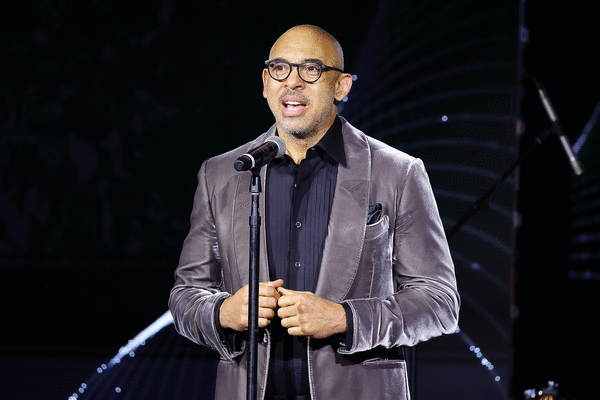
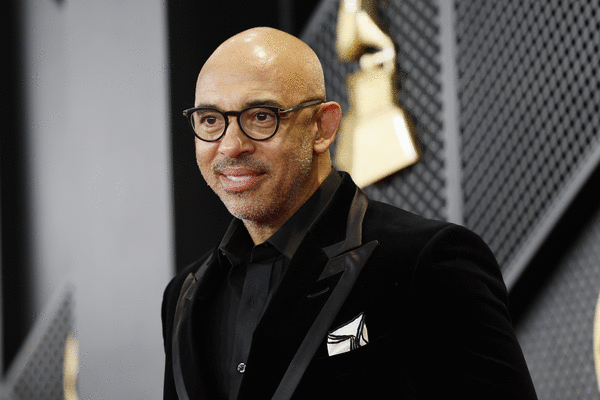
SAN DIEGO — A slew of executive orders from the White House have fueled a dramatic decline in diversity, equity and inclusion programs nationwide. But not at the Recording Academy, under whose auspices the 68-year-old Grammy Awards are presented.
“The evolution of our membership and voting bodies is extremely important for us,” said Recording Academy President and CEO Harvey Mason Jr., who is now in his sixth year heading the Los Angeles-based nonprofit. “And our voting membership, and who votes, is going to continue to evolve and change. It’s not a stagnant number. We don’t reach a certain threshold and say: ‘Great, we’re done.'”
The academy’s 40,000-strong membership now includes nearly 15,000 voting members — up from 11,000 in 2020 — with 2,000 new members joining last year alone. Of those new members, 49% are 39 or younger, 60% are people of color, and 30% identify as women.
Moreover, 28% of the new members identify as Hispanic or Latin. That can be at least partly attributed to the invitation Mason extended last year to members of the Latin Recording Academy — under whose auspices the 26-year-old Latin Grammy Awards are presented — to join the Recording Academy and vote for the Grammys. A thousand of them did.
Since 2019, the academy has added more than 3,000 women voting members. Nearly 9,000 new voting members have joined in that same period.
“Harvey has been an incredible asset to the academy,” said Grammy-winning banjo player and La Jolla High School alum Alison Brown. She is the president of the Nashville, Tennessee, chapter of the Recording Academy, the co-founder of Compass Records and is on the adjunct faculty at Vanderbilt University’s Blair School of Music.
“The academy is definitely evolving,” said Brown, who will opens a West Coast tour with her band on Feb. 26 at Carlsbad’s Museum of Making Music.
“The academy is always looking at the best way to represent the way the music industry is now, and they are very attentive to diversity and inclusivity. The academy has engaged everybody and made sure nobody is marginalized. I’m not speaking on behalf of the academy; this is my perspective.”
Agent of change
Bringing about change and nurturing growth and diversity are driving principles for Mason.
In his first two years in office alone, he appointed two co-presidents, added the academy’s first chief diversity inclusion officer, launched a songwriters and composers wing, formed a partnership with GLAAD to advance LGBTQ+ representation in the music industry, and implemented sweeping measures to increase the transparency of the Grammy nominating and voting process.
“Over the last four or five years, 66% of our voters are all new voters,” said Mason, who was keenly aware of past charges that Grammy voters were too old or out of touch with current music trends.
The impact of such a large influx of new voters is easy to quantify.
Last year saw Beyoncé — who has the most wins in Grammy history — receive her first Album of the Year victory, for “Cowboy Carter,” after having earned four previous nominations in that category without a victory.
In December, Puerto Rican-born superstar Bad Bunny became the first Spanish-language artist in Grammy history to earn simultaneous nominations for Album, Song and Record of the Year. This is also the first time K-pop artists have become Song of the Year nominees.
The Boston-born Mason is himself a five-time Grammy nominee. His credits include collaborations with everyone from Michael Jackson, Whitney Houston and Elton John to Beyoncé, Ariana Grande and John Legend. As the head of the Recording Academy, he also plays a key role in MusiCares, the Grammy charity organization that has raised more than $100 million since 1989 to aid musicians in need, including $15 million for more than 3,000 victims of last year’s Los Angeles devastating wildfires
Mason, 57, recently spoke to The San Diego Union-Tribune from his Los Angeles home office. This interview has been edited for length and clarity.
Q: Do you mind if I begin with a question you hopefully have not been asked before?
Mason: (chuckles) I’m gonna be curious to see if you can do that.
Q: Me, too! With Trevor Noah stepping down as the Grammy host after six years, has any thought been given to having the Dalai Lama — who is a nominee this year in the Best Audio Book, Narration, and Storytelling Recording category — host next year’s show?
Mason: (laughing) You have done it! You’ve accomplished the impossible! You asked the question I haven’t been asked. Trevor has been an amazing host for us. We’ll be sad to see him go, but he’s given us six great years. I’m not sure about who the next host is yet, but the Dalai Lama is a very interesting suggestion. So, thank you! We’ll look into that.
Q: Be sure to credit me if that happens. On a more serious note, you have been a major agent of change at the Recording Academy. What are you proudest of accomplishing, and what areas do you still need to buckle down on?
Mason: Well, I definitely wouldn’t spend any time in this interview talking about what I think I’ve done right, or what I’m super proud of. I would say there have been things that I’m very glad we got done, and that I think made a big impact. The evolution of our membership and voting bodies has been extremely important for us. And it’s allowed us to do a lot of the work that we’ve done and make some of the changes that you mentioned. During my term, we have totally changed the makeup (of the membership) and of who is in that group.
It comes from genre diversity and gender diversity. The membership is now younger and more relevant. That’s something that we worked very hard on, and I’m really pleased we are where we are. A lot of people ask me: “Are you happy? Are you content?” I’m pleased, but there’s always going to be more work to be done.
We are going to watch what’s happening in music. We’ll see what new genres appear and which genres become more prevalent, and we’re going to continue to adjust and flex our membership around that. Of the many accomplishments we’ve made over the last five years, that might be one of the most important — making sure we get that membership right, because so much of what we do stems from that.
Q: In our 2024 Grammy preview interview, you told me: “You always want to have the right voters, voting in a knowledgeable way, with an understanding of the genres.” This may be hard to quantify, but do you think Kendrick Lamar’s “Not Like Us” would have won for Song and Record of the Year in 2025 without your having expanded and diversified the voting membership?
Mason: It’s hard to (say) how much the new voters affected that, versus how much popularity of that artist or the genre has grown or changed over the years. It’s probably some combination of both.
Q: No exclusively Spanish-language artist has ever won for Album, Song and Record of the year before. How significant will it be for you if Bad Bunny wins any or all those categories? How significant will it be if he goes home empty-handed?
Mason: I think it’d be very cool, because it would signify and represent what’s happening in music right now. That’s the role of the academy and it’s my hope we can continue to do that — to reflect and amplify what’s going on in music and in culture. And, obviously, Bad Bunny has had a massive year. He’s made important music.
So, I could see a world in which he absolutely does win. And it does touch on the fact that music is becoming more and more global. I think listeners care less about where you’re from, or what language you speak, or maybe even — to some degree — what your beliefs are. They’re more concerned with: Do they feel the music? Do they hear the message? Do they believe the artist, and does it mean something to them? So, yeah, I think that would be a great possibility if he were to win one of those (three) categories.
Q: To what degree do you think the influence of new voters has impacted not just the voting, but the viewership of the Grammys telecast?
Mason: The new voters absolutely have an impact. Because as they vote, they change the nominations, they change the winners and the outcomes, and change what we put on our stage on our show. And that changes who watches, how many watch, and whether they love the show or think it could have been better… But it really starts with the voting.
Q: The Bandcamp music-streaming website recently announced it is imposing a ban on AI-created music. AI is nothing new, and I know talented musicians who use it in varying degrees. Where will the Grammys draw the line, in terms of AI-assisted music and music created entirely, or almost entirely, by AI?
Mason: The Grammys, for now, are not going to be awarding or nominating any music that is written by AI In the songwriting category. Furthermore, we will not be awarding a Grammy to any AI artists who perform songs in any performance categories.
Having said that, AI does not disqualify someone from entering. If an AI artist sang a song that was written by a human, and it wins, we’ll give the human a Grammy for the songwriting. And vice versa: If AI writes a song and a great singer sings the heck out of it and deserves a Grammy, they will be awarded one.
Q: The Grammys have been on CBS since the 1970s. What prompted next year’s move to ABC, Disney+ and Hulu, and what do you hope to accomplish with this move?
Mason: We’ve had an amazing partnership, a great run, a long run, with CBS, and they’ve been wonderful to work with over the years. We are excited about the next chapter, and — as content evolves and how people consume and watch entertainment evolves — we saw the opportunity to partner with ABC/Disney as the next chapter for us as an organization.
We always are going to want to reach more music people and more fans of music. And we also acknowledge and recognize that music is global. Our ability to serve music, and to amplify the message of music, is going to need to continue to expand and grow. This new partnership gives us that chance. It’s also the chance for us to work with a company whose culture revolves around artists and creativity, and has since its inception. (Disney’s) founder was someone who was in service to creatives and I love that ethos. It mirrors what we try to do at the academy. So, I’m looking forward to this partnership.
Q: The second time I covered the Grammys was in 1990. It was the year the vocal duo Milli Vanilli won for Best New Artist and then had their award revoked (for not singing on their album). This year, Fab Morvan — the surviving member of Mill Vanilli — is a nominee in the Best Audio Book, Narration, and Storytelling Recording category, which is an intriguing, full-circle Grammy moment. Are there any full-circle Grammy moments for you?
Mason: Yes, because I’ve been nominated before and I remember my first nomination. I remember coming to the show, looking around, and being so surprised I was there. I had to catch my breath. I couldn’t believe I was in the room! Now when I’m in the room, it’s a similar feeling. But obviously, I’m looking at it from a different perspective. So, being at the Grammys and at all the Grammy week events starts me thinking about my first time, what that felt like and the pride I had in being nominated by my peers.
Because what makes our show so different is that it is a peer award. And when I was starting to be a creator and write music, that was what I wanted. I wanted the respect of all the people that I looked up to and admired. And when I first came in the room and I saw some my mentors and my idols, and they said: “Hey, congratulations on the nomination,” and they knew my work, I was like: “Oh my gosh, this is my room! These are my people.” So that full-circle moment of now being a part of hosting this event — and bringing all these people together to give them that same feeling — is really cool.
Q: After six years heading the Recording Academy and the Grammys, do you find there are any prevailing misconceptions? Or do you feel you’ve been able to provide clarity?
Mason: There have been moves towards clarity, but I don’t think it’s across the board. There are still people that perceive our organization as one that just gives awards. And that’s the narrative I would be very pleased to try and change. We want to make sure people understand the awards are part of our process and a very important part of who we are as an organization.
The bigger picture is we are an organization to serve music and all the people who make it, 365 days a year. I would love it if people recognize and understand that MusiCares is such an integral part of what we do, and that the money that’s raised every year goes back to music people so they can do what they do, which is so important.
We can talk about the education work that we’re doing. We can talk about the advocacy work we do, fighting for the rights of music creators to be able to make a living doing the work we do, which in turn allows us to be able to create art that inspires people. Those are some of the things we’ve worked very hard to share and get across to consumers — and even some people in our own industry. But we’ve made good progress, and I’m always going to try and make more.
Q: We live in fraught times when music and art seem more relevant and more imperiled than ever. I’m curious if that will affect the tone of this year’s Grammy’s telecast in any way?
Mason: We always try and make sure we set the right tone. And there have been times in the past where we’ve had to change the tone, whether it was because of COVID, the (2025 Los Angeles) fires, or other natural disasters.
But to me, right now — barring any change in the next week — the tone is going to be a coming together, around music, to celebrate the excellence, talent and creativity of all the people who made music this year. And music is more important now than ever. So, my hope is that the Grammy show and events around it can serve to bring people together and bring positivity and unity. We could all use a bit of that now.
———
The 68th annual Grammy Awards
Hosted by: Trevor Noah
Featuring performances by: Pharrell Williams, Clipse, Sabrina Carpenter, Addison Rae, Alex Warren, Katseye, Leon Thomas, Lola Young, Olivia Dean, sombr, the Marías and more to be announced.
When: 5 p.m. PT Sunday, Feb. 1, on CBS and Paramount+
———
2026 Grammy Awards Premiere Ceremony
When: 12:30 p.m. Sunday, Feb. 1. on live.grammy.com and the Recording Academy’s Grammy YouTube channel
———
©2026 The San Diego Union-Tribune. Visit sandiegouniontribune.com. Distributed by Tribune Content Agency, LLC.






Comments