'Aqua' author Chiara Barzini traveled California to write about LA water
Published in Books News
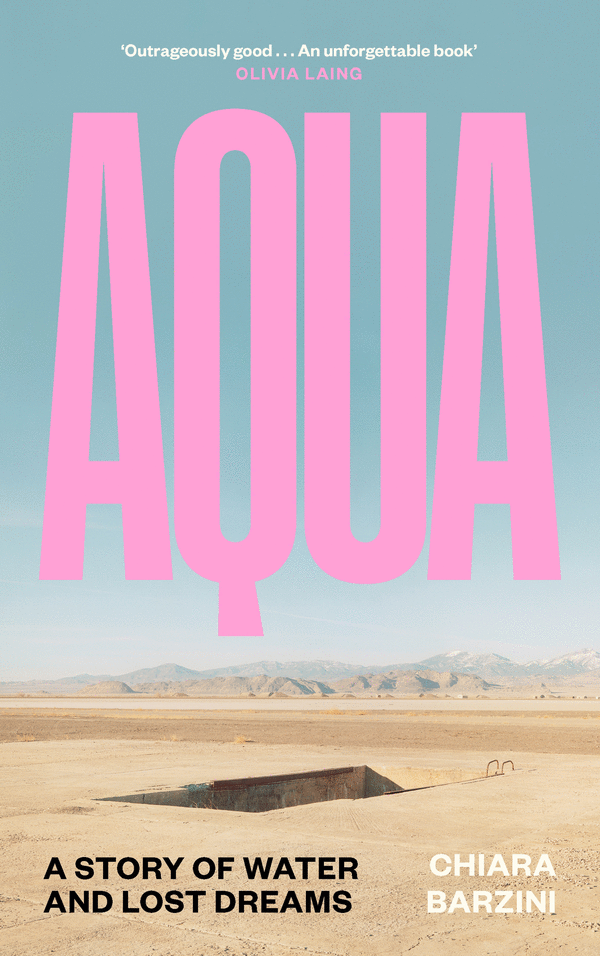
In April, Chiara Barzini appeared at North Figueroa Bookshop with Matthew Specktor to talk about her book “Aqua.” Barzini, a journalist, translator and the author of the short story collection “Sister Stop Breathing” and the novel “Things That Happened Before the Earthquake,” discussed her time growing up in Southern California and her current life in Rome.
Once back home, she responded via email to the Book Pages Q&A.
Q. Please tell readers about your new book, “Aqua: A Story of Water and Lost Dreams.”
“Aqua: A Story of Water and Lost Dreams” is a book about Los Angeles, infrastructure, desire, and the stories we build in order to survive. It moves between memoir, cultural history, travel writing, and reportage, tracing the strange relationship between water, fantasy, and the making of Hollywood. At its core, it’s a book about longing: the desire to control nature, to reinvent oneself, and to continue believing in chimeras and mirages even when the landscape begins to reveal their cost.
I wanted to explore whether it’s still possible to dream expansively in a world where abundance no longer feels sustainable. The monumental infrastructure of California — the aqueducts, reservoirs, dams, and engineered landscapes — speaks to a time of enormous ambition and collective imagination. But what happens after the dream has cracked? Are there other forms of romanticism, beauty, and desire that can emerge from what increasingly feels like a crumbling empire?
To ask these questions, I traveled along the Los Angeles aqueduct while drawing parallels between California and ancient Rome. Having grown up among the ruins of another fallen empire, I felt strangely equipped to understand the emotional codes of this historical moment, the feeling of living among grand narratives that once promised permanence and are now presenting us with a very high bill.
The book is also deeply personal. It became, unexpectedly, a memoir about female friendship, artistic identity, and my own complicated relationship to fantasy and disillusionment. I’ve always been fascinated by the seductive power of California, the way Hollywood and the desert landscape encourage all kinds of projections and delusions. Writing the book forced me to confront not only collective illusions, but also the private ones I still cling to.
Q. Your research took you across Southern California… what places stayed with you?
Southern California is full of strange, almost mythic locations, places where human ambition collides with the limits of the environment. I was both blown away and terrified by the shores of the ecological catastrophe of the Salton Sea.
One early morning, I walked along the beach there with Tao Ruspoli, the founder of the Bombay Beach Biennale, while he told me stories about the massive fish die-offs. I remember hearing this crunchy sound beneath my shoes as we stared out at the hypnotic water. I assumed it was pebbles, but it was actually thousands of tiny fish bones compacted together along the shoreline. It felt post-apocalyptic and strangely beautiful at the same time.
The Alabama Spillway also stayed with me. I had seen so many archival photographs of it overflowing dramatically with water, but when I finally visited it, the site was completely dry and abandoned-looking: a discarded tire off to the side, a flimsy American flag above it, almost no sign of movement or life. The whole thing felt monumental and slightly absurd.
During the book trip, I spent time in reservoirs, aqueduct sites, desert edges, spaces that are usually overlooked, even though they are essential to how the region functions. Those landscapes changed the way I saw this land. As a child, Southern California felt endless and natural to me. Now I see how deeply engineered, fragile, and strained it really is. Seeing these structures weakened or emptied out gave me a feeling strangely similar to watching the images of firefighters drilling into the aqueduct during the Los Angeles fires, one of those images you really cannot unsee afterward. There was something frightening there: a sense of surrender, of a land on its knees. The systems that I once imagined as invincible suddenly appeared vulnerable and exhausted.
Q. Is there a book you always recommend?
I tend to recommend books that change the way you see a place, but also books that alter the way you see yourself, books that create a sudden sense of recognition, where readers might unexpectedly find versions of themselves hidden inside. The books I return to most are usually the ones that genuinely shift my perception of the world or send me off on a detour I didn’t anticipate.
While writing “Aqua,” I was living in Rome, and one of the fastest ways for me to reconnect with the California state of mind — the psychic entity of California that I needed to remain in dialogue with — was returning again and again to the 2002 anthology “Writing Los Angeles” edited by David L. Ulin. Since it came out, that book became almost like a portable Los Angeles for me. I would dip into Aldous Huxley’s “Los Angeles. A Rhapsody,” Bertolt Brecht’s “Landscape of Exile,” Truman Capote’s “Hollywood,” Salka Viertel’s “The Kindness of Strangers,” Robert Towne’s reflections around Chinatown, and Mary Austin writing about the land itself. The anthology is so well-curated and such a love declaration to the city. It captures so many of the city’s contradictions: the paradise and scam, the dreams, the glamour, and the collapse. When I sit with it, I can almost smell the ocean breeze and the smog.
Later, I found myself returning often to “Always Crashing in the Same Car” by Matthew Specktor, a writer whose voice I deeply admire and trust. I know he puts in the research and emotional labor and manages to have fun with the ghosts of the city. His book felt like a deeply contemporary continuation of that same conversation that Ulin had ignited about Los Angeles early on.
Q. What are you reading now?
I’m currently reading the absolutely thrilling “Baby Driver” by Jan Kerouac, Jack’s daughter. As lovers of California literature, “On the Road” was, of course, a staple in my hippie parents’ household. But I often felt a kind of nausea around Jack Kerouac’s overwhelming presence and the reverence that seemed to follow him everywhere.
I went to school at the University of California, Santa Cruz, and spent so much time in Big Sur in my twenties. The entire coast felt saturated with his voice, almost like an altar to Kerouac at times. I had missed both the original publication of “Baby Driver” and the later reissue from New York Review Books. But when I came across it at Book Soup two weeks ago, the day before returning to Rome after a book tour, it immediately pulled me toward it. My suitcase was jam-packed with books already, and I had promised myself no more! But the introduction by Amanda Fortini was so incredible that I had to go for it.
It was gripping and felt strangely intimate, almost like receiving a long email from a brilliant friend who knows your obsessions and is insisting with urgency that you read this book immediately because it will alter something in you. Before I even started the novel, she had already created a sense of emotional companionship around it. She helped me understand that what makes the book extraordinary is not its connection to Jack Kerouac, but the fact that Jan resists becoming a footnote to him. She was so right! The book moves through fragments of Jan’s chaotic life: unstable relationships, addiction, temporary jobs, motel rooms, deserts, cities, and long periods of wandering. It has a restlessness to it that makes you feel empathic and exhausted at the same time. Terrible and wonderful things happen to Jan, but there’s no Beat mysticism to lean upon and no performance. She is the real deal.
Q. How do you decide what to read next?
It’s a mix of instinct and coincidence. If I’m deep in a research phase, the universe usually starts handing me the books I need in strange and almost psychic ways. While I was researching “Aqua,” Lili Anolik mailed me a copy of “Out of Sheer Rage” by Geoff Dyer. I had already read “White Sands” and many other Dyer books, but somehow had missed that one.
Reading it was such a joy because of the way it wanders. The digressions, detours, and false starts slowly become the real subject of the book. In some ways, “Aqua” began with a more investigative purpose, but somewhere along the way, I realized it was also becoming deeply personal. Reading Dyer at exactly that moment gave me permission to loosen my grip a little and allow my own digressions into the work.
I also believe books are a kind of totem. I love wandering into bookstores, especially used bookstores, without looking for anything specific and seeing what calls out to me. I follow threads, but also trust accidents and recommendations from people whose taste I admire. Sometimes the right book arrives exactly when you need it. Like the incredibly touching “Where The Girls Were” by Kate Schatz, which explores the hidden history of California’s homes for unwed mothers in the 1960s. I read it as a work in progress, and it seemed to go hand in hand with the kind of historical excavation I was doing for my own research on hidden California histories.
Right now, I’m doing a lot of work around 1950s Rome and rediscovering older or lesser-known works by writers I already love. That’s always exciting to me: taking side streets away from the canonical path and finding unexpected corners. Elsa Morante, Alberto Moravia, Pier Paolo Pasolini, and Natalia Ginzburg are especially present right now. I love drifting away from the monumental versions of literary history toward the stranger side streets.
Q. Do you remember the first book that made an impact on you?
I remember being very young and realizing that books could create entire worlds that felt more vivid than reality. I have a specific memory of my father sitting beside me, reading aloud from “The Baron in the Trees” by Italo Calvino. It was written with sophisticated, adult language, but I never experienced it as a purely adult book because it spoke in a humor and emotional register that I instinctively recognized as a child. There was something so playful, strange, and alive in the voice.
The premise itself was irresistible for a young reader: a boy, Cosimo, climbs into the trees after an argument with his family and decides never to come down again. Suddenly, the entire world reorganizes itself. The trees become roads, hiding places, libraries, kingdoms. There are dogs, bandits, romances, political revolutions, philosophical debates. It has the tenderness of a fable, but at the same time, it’s also a deeply philosophical novel about fantasy and solitude. All themes that are dear to any writer’s heart.
Q. Is there a type of book you’re reluctant to read?
Every time I’ve declared that I would never read a certain kind of book — usually something like a cheesy romance novel, dated sci-fi, or self-help — I’ve almost immediately managed to prove myself wrong. I’ve learned to distrust my own literary snobbery. What matters in the end is less the category than the voice. A book can belong to almost any genre and still surprise you with intelligence and emotion. I’ve had profound reading experiences with books I initially dismissed, which has made me much more open and curious as a reader. I won’t give examples because I’d be shamed!
Q. Can you recall a book that felt like it was written for you?
In 2022, I had a bad accident and broke my knee. For a long time, I was trapped inside a very rigid body, moving through different variations of pain and struggling with the inner voices that constantly oscillated between “I can do this” and “I will never heal.” I had difficulty concentrating then and couldn’t seem to get to the end of anything I started reading.
Somewhere along the way, an editor friend recommended “Everybody” by Olivia Laing, and I was transfixed. The book seemed to demand my full attention. It felt like being spoken to directly. I carried it around everywhere. The book moves through the lives and bodies of figures like Susan Sontag, Kathy Acker, Ana Mendieta, Nina Simone, and Malcolm X, thinking about the body as political, artistic, and liberated. Reading about all these bodies and how expressive, wounded, rebellious, and free they were, while confined inside my own broken one, felt like I was being let out of a cage. The book gave language and shape to experiences I couldn’t yet articulate myself.
Honestly, I think it may have accelerated my healing more than the five hours of physical therapy I was putting myself through every day.
Q. What’s something that has stayed with you from a recent reading?
I just read a wild, hypnotic new memoir by Eleni Sikelianos called “Memory Rehearsal,” edited by City Lights Books. It’s a prose poem and a family archive all in one, impossible to categorize in a satisfying way, which is probably one of the reasons I loved it so much. Her writing is mysterious, sensual, funny, and immersive. I didn’t know her work before, and now I’m absolutely turned on.
I happened to read it over a weekend after visiting City Lights Booksellers and then spending time with a dear friend in these nudist thermal springs upstate. The heat, the sunlight, the wildness of the landscape immediately locked me into the Greek atmosphere of the book. The California hilltop where I was reading and the Greek landscapes Sikelianos describes started to feel like the same psychic place. It completely reconnected me with so many of the atmospheres I love most in both writing and life.
I adored the structure of the book, too. It refuses a straightforward chronology and works in the way that memory actually works. So generations fold into each other, grandparents appear young alongside the young people of the present, and everything is punctuated by a stunning collection of old black and white family photographs. Honestly, I would buy an entire photo book based on that family archive alone. Beneath all the sensuality and beauty, there’s also a lingering melancholy that feels very familiar to me. I also come from a large family with strong artistic personalities, and I understand how intense it can be to live among the ghosts of the past while still trying to invent yourself. The book captures that emotional inheritance so beautifully.
Q. Do you listen to audiobooks?
Occasionally, especially when traveling or driving for long stretches. I’m very sensitive to the voice of the narrator. When it works, it can deepen the experience, but when it doesn’t, it becomes distracting very quickly. What I love most is listening to authors read their own work. There’s something intimate and revealing about hearing the cadence, humor, or emphasis they imagined while writing it. We are lucky to have that option now.
Most recently, like many other people, I listened to Lena Dunham read her memoir “Famesick” and absolutely loved it. Her voice is so sharp, funny, and self-aware. It made me want to revisit “Girls” immediately. When the author’s personality is inseparable from the texture of the writing itself, it’s a wonderful feeling.
Q. What genre do you read most — and what would you like to read more of?
I read a lot of nonfiction and hybrid writing, books that blend memoir, reportage, criticism, and essay in fluid ways. I usually counterbalance that with very short, experimental fiction. Recently, I loved the short stories or prose poems from an upcoming English-language collection by Italian writer Sara Reggiani, as well as “Good and Evil and Other Stories” by Samanta Schweblin. I’m drawn to compressed, uncanny writing that can really grip you in just a few pages. So I am really looking forward to Catherine Foulkrod’s debut novel, “Don’t Cure Me,” and Diane Williams’ upcoming story collection, “I Liked Rex.”
What I would really like to read more of, though, are of course the classics. I always fantasize about allowing myself the luxury of a deep, immersive dive into Russian literature. That infamous summer of catching up… I’ve been threatening to do that for years and somehow never fully commit. I suspect I may carry that ambition with me to the grave.
Q. Are you someone who must finish every book?
No. I think it’s important to give a book a real chance, but also to recognize when it’s not the right time, or when you may not be the right reader for it in that moment. Letting go can be part of the reading process, too. I’ve learned not to feel guilty about abandoning books because sometimes they return to you later in completely different ways.
There are also books I’ve read over very long stretches of time, almost intermittently, as if they were accompanying me through different phases of life. “The Magus” by John Fowles is one of them, as well as the “Collected Stories” by Nabokov. The same thing happened with “City of Quartz” by Mike Davis that I kept circling back to it over time, reading parts of it in different emotional states and at different ages. Each time it seemed like a different book. Maybe certain books aren’t meant to be consumed at once.
Q. What’s a memorable book experience?
I remember reading “Thy Neighbor’s Wife” by Gay Talese cover to cover on a flight from Rome to New York and feeling almost euphoric when the plane landed, simply because the author of the book I had just read was somewhere in that city. I had underlined passages obsessively and was overflowing with questions for him. Part of me was amused and slightly envious reading about him lounging around naked with beautiful women and calling it “research,” but another part of me recognized something deeply important in his method: the idea that writing requires total immersion, that you have to physically and emotionally enter the world you’re trying to understand.
That book became enormously important to me later while writing “Aqua.” Eventually, Talese and I did meet, and before my very first trip along the California aqueduct, he gave me writing advice I’ve never forgotten. He told me I had to figure out a way to enjoy myself, to drive a very expensive car, basically to fake it until I made it. It sounds funny, but it genuinely changed something in me. He gave me a kind of self-assurance and permission to inhabit the role of a writer more fully than I had before. And because of that confidence, I eventually managed to interview Robert Towne, the screenwriter of Chinatown, in what became his last major live interview. Looking back, it all strangely connects to that flight and to the feeling of possibility that Talese’s book opened up for me.
Q. What’s your comfort read?
I inherited from my mother what I consider the ultimate comfort reads: celebrity memoirs and biographies. I am such a sucker for them. Demi Moore, Sharon Stone, Carrie Fisher, Cher, Al Pacino, Diane Keaton, Kim Gordon, Dolly Parton, Jane Fonda… endlessly, truly endlessly. I love them all. And so many more.
I’m drawn to memoirs by performers and artists specifically because I love origin stories, how someone invented themselves, failed, transformed, became visible. Beneath all the glamour and mythology, they’re often books about loneliness, ambition, family wounds, and a will to survive. You end up learning as much about an era, a city, or a cultural mood as you do about the individual person.
A book that really did that for me lately is Guy Trebay’s “Do Something.” It’s ostensibly a memoir, but also an extraordinary portrait of downtown New York in the 1970s and ’80s: dangerous, artistic, chaotic, dirty, and glamorous. I loved the way Trebay writes about becoming himself within that world, moving through fashion, nightlife, queerness, and survival with both irony and tenderness.
Q. What do you look for in a book?
The voice comes first. Then control over the language, vision, a certain degree of insanity, and great poetic images. I’m drawn to books that create their own atmosphere and that have an internal logic that you begin to inhabit them physically. I admire writers who can balance precision with wildness: books that feel formally controlled but dangerous underneath. I want to feel a singular consciousness at work, someone seeing the world in a way I couldn’t have arrived at on my own. I want a book to alter my perception a little bit. Even a sentence can do that.
Q. Do you have a favorite bookstore?
I adore the Almost Corner Bookstore in Rome. It’s a hole-in-the-wall place, so the books must be carefully selected. The great Iranian-American poet Jahan Khajavi curates their selection, and since I adore his wild and romantic poetry, I also admire his reading references and recommendations. Jahan is also an incredible performer, so I sometimes like to go and see if there might be an impromptu reading of his poems happening.
Q. What’s something about your book that no one knows?
Well, I guess you will know it now since I said it earlier, but I wrote most of it while I was on crutches between knee surgeries. It’s funny that a book about travel and movement in California was written from the confines of a bedroom and a semi-immobile body in Rome.
Q. If you could ask your readers something, what would it be?
Could you please buy it so I can write more books! I would also ask what resonated most since there are so many different parts to it. Is it the memoir, the travel, the history, the humor, the doom?
Q. Do you read books in translation?
Yes, very much. Growing up between languages made translation feel natural to me. I wholly believe that Ferrante was able to find such a wide audience in the U.S. because of the extraordinary work of Ann Goldstein, so I actually enjoyed reading both the Italian and English versions of those books.
©2026 MediaNews Group, Inc. Visit ocregister.com. Distributed by Tribune Content Agency, LLC.

Comments