George Takei's book chosen for 'West Coast's largest book club'
Published in Books News
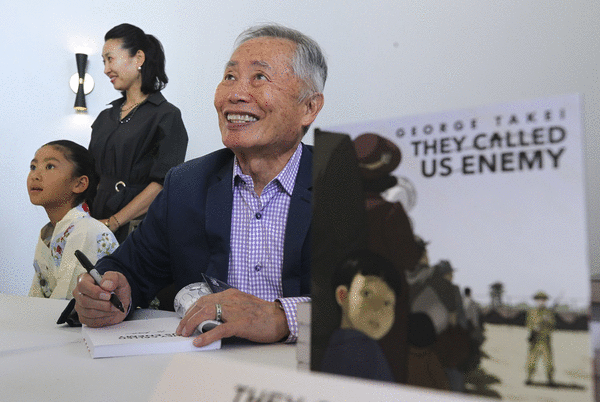
SEATTLE — George Takei was 5 years old when he heard U.S. soldiers, who carried rifles with bayonets, pounding on the door of his home in Los Angeles.
In 1942, following the signing of Executive Order 9066, soldiers instructed his parents to quickly pack their belongings and vacate the house. His family could “take only what we could carry and nothing more,” Takei said, as they and other Japanese Americans were jammed into buses and sent to live in horse stables at Santa Anita Park in Arcadia, California. Takei, his younger brother and parents were later moved to the Rohwer War Relocation Center in Arkansas, enclosed within layers of barbed wire fences.
“We were all categorized just, arbitrarily, as ‘enemy alien,’” Takei told The Seattle Times in a recent interview. “There was no due process, no trial.”
Takei’s childhood experiences of living in incarceration camps during World War II, he said, are burned into his memory, inspiring the 2019 graphic novel “They Called Us Enemy, by Takei, Justin Eisinger and Steven Scott, and illustrated by Harmony Becker. Now, patrons of more than 190 library systems, over 50 of them in Washington state, will read the work as part of One Book, One Coast, billed as "the West Coast’s largest book club.
“I'm always delighted to have people read my book,” said Takei, the actor, activist and social media influencer best known for portraying helmsman-turned-captain Hikaru Sulu on “Star Trek.” “I'm still a little shocked when I learn that there are other Americans that know very little, if anything, about the imprisonment of innocent citizens of Japanese ancestry simply because we happen to look like the people that bombed Pearl Harbor.”
The wartime experiences of more than 120,000 Japanese Americans stand at the forefront of the first One Book, One Coast, which started April 1. Partnering libraries — including those under The Seattle Public Library, King County Library System and more — will host educational activities and programs that supplement “They Called Us Enemy.” LA County Library in California, which organized One Book, One Coast, chose the book for participants to read because it covers a “critical yet overlooked chapter of American history” and promotes inclusion and justice, according to the library system. The reading program will close with an author talk with Takei at East Los Angeles Library, with a livestream available on Zoom on May 31 and watch parties at several local library branches.
Starting this month, The Seattle Public Library is hosting several events with Japanese American historical preservation nonprofit Densho and local authors Frank Abe, Tamiko Nimura and Scott Kurashige. The public can expect to learn more about the personal accounts of incarcerated Japanese Americans and the history of anti-Asian violence in the U.S., said Stesha Brandon, the literature and humanities program manager at SPL.
One Book, One Coast grew out of One Book, One County, which LA County Library initially launched with 18 neighboring library systems across Los Angeles County in 2024. While planning for this year’s One Book program, the library system said it aimed to extend the reading program to partners across the West Coast.
Though LA County Library has led the organization of One Book, One Coast, SPL helped expand it and offered insights from its past citywide reading programs. In 1998, Seattle became the first city to host a One Book, One City program called If All of Seattle Read the Same Book — now Seattle Reads — a concept that has spread across the country and internationally, allowing community members to engage in literature through reading and discussion.
“Seattle has voracious readers,” said Kai Tang, director of library experience and engagement at SPL. “We are one of two UNESCO cities of literature in the U.S. We have some of the highest readership in the country, and so we get a really robust response when we have programs like (One Book, One Coast).”
From April 1 to June 6, all participating library systems will have unlimited digital copies of “They Called Us Enemy” available on the Libby app by OverDrive, according to Heidi Daniel, executive director of King County Library System. KCLS and SPL will also offer digital copies through Hoopla. Patrons can place holds on physical copies or see where physical copies are located on their local library’s online catalog, Daniel said.
“Whether you're in Timberland Library, Tacoma or in Seattle … we're having the same conversation, and I just think that there's power in that,” Daniel said.
For Densho’s event with SPL on April 4, the organization, which celebrates its 30th anniversary this year, will cover the importance of protecting the oral histories of incarcerated Japanese Americans “in an increasingly more contested political environment in which history is being actively distorted or erased,” said Naomi Ostwald Kawamura, the executive director.
The programming of One Book, One Coast “localizes the incarceration story,” said Abe, co-author of the graphic novel “We Hereby Refuse: Japanese American Resistance to Wartime Incarceration.” On April 8, Abe will discuss works written by incarcerated Japanese Americans at the Central Library, pulling from “The Literature of Japanese American Incarceration,” an anthology he co-edited.
“It was the West Coast that was the exclusion zone for the forced removal of Japanese Americans during World War II. We were defined by our residence here in Seattle, Portland, San Francisco and L.A.,” Abe said. “So it's the perfect choice by LA (County Library) to … focus on not only just the geographic experience that encompasses all three states, but also choosing a work about incarceration.”
Abe helped organize the very first Day of Remembrance in Seattle in 1978, calling attention to what happened to Japanese Americans during World War II and demanding an official apology from the U.S. government. Ten years later, President Ronald Reagan signed the Civil Liberties Act, in which the government issued an official apology, acknowledged the events as a “grave injustice” and paid $20,000 to every surviving U.S. citizen or permanent resident of Japanese ancestry who was incarcerated.
Now, Abe said, he sees the U.S. reverting back to old patterns, instilling the same fear against immigrant communities. For Abe, it’s imperative for people to “feel like you belong to this country in order to fight for it,” and he hopes One Book, One Coast encourages these conversations.
“I'm glad we can unite as one coast to help readers see that we can't stand by while all around us — the nation — is once again targeting people based on their differences,” Abe continued. “And that, I think, is the takeaway from this program.”
© 2026 The Seattle Times. Visit www.seattletimes.com. Distributed by Tribune Content Agency, LLC.




Comments