Chuck Schumer is facing a tough Senate leadership race: What to know
Published in News & Features
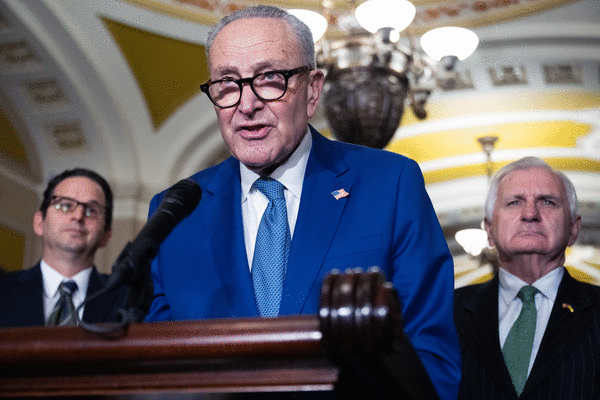
Sen. Chuck Schumer is facing a potentially tricky Senate leadership vote this coming week that could turn out to be one of the toughest tests of his long career in Congress.
Even though Democrats just won a historic landslide midterm victory, the five-term Brooklyn lawmaker suddenly finds himself in an unlikely horse race against Sen. Chris Van Hollen of Maryland to become Democratic majority leader for the next two years.
Unlike Rep. Hakeem Jeffries, who is on a glide path to become House Speaker, Schumer faces a real opponent in Van Hollen and real questions about his leadership style, age and his low popularity ratings.
The stakes are high as ascendant Democrats plan their strategy to push back against President Trump in his final two years in the White House, and jostle for their own 2028 White House nomination.
Here’s what to expect when Democratic senators gather on Tuesday to pick the next majority leader.
Closed-door, secret ballot
Democratic senators who will serve in the next Congress meet behind closed doors on Capitol Hill. They will vote by secret ballot, so the public will only learn who voted for whom if senators or groups of senators announce their picks.
Van Hollen, 67, has seven open supporters, mostly progressives, but says he has about 15 other supporters for the 28 votes needed.
Schumer has announced the names of 16 backers and says enough other colleagues have privately pledged support to ensure his victory.
“Schumer is going to have the votes because he’s delivered for Senate colleagues in substantive ways that have helped each do their jobs better,” a longtime Capitol Hill Democratic aide who worked with legendary Senate leader Harry Reid told the News. “Schumer has a track record. A real one.”
Why could Schumer be in trouble?
On the face of it, it’s hard to see why Schumer would be in any danger.
He’s been the leader of the party’s caucus for a decade. He helped Democrats pick up a remarkable haul of nine Republican seats after personally recruiting several of the winners of races in red states that were considered extreme long shots.
But politics is often about the future — and Schumer’s is hazy.
He just turned 76, and many insiders think he won’t run for a sixth term in 2028, potentially giving him less leverage over wavering colleagues and less perceived muscle in the certain coming fights with Republicans and the Trump White House.
“Loads of bright young congressmen and senators were elected, brimming with new ideas and new ways of communicating,” said Larry Sabato, a University of Virginia analyst. “And what do the Democrats place on the leadership table at Thanksgiving? Old, tired, hard-bitten New Yorkers who are as dry and tasteless as many overcooked Thanksgiving turkeys.”
Who’s with him, who’s not?
Schumer’s support is soft with two groups who will help decide his future: progressives and newly elected senators.
The party’s left wing, led by Sen. Bernie Sanders, says Schumer is too cautious and was too quick to cave to Trump at a crucial moment.
“I like Chuck, but I think there has not been the sense of urgency to address the enormous, enormous crises facing working families,” Sanders said on MS NOW.
Several just-elected senators ran on explicit promises not to back Schumer, who is perceived by many voters as an aging fixture of the Democratic old guard. But some could just abstain or vote for a third candidate, which would probably be fine with Schumer.
Many returning senators, including those believed to be in Schumer’s camp, have remained tight-lipped or sought to hedge their bets by criticizing both him and Van Hollen, who is 67, for being too old or from coastal Democratic strongholds.
Sen. Cory Booker, D-N.J., who is considering a 2026 presidential run, said the Senate needs younger and more diverse leaders.
“It’s time for new generations to step up and lead,” Booker said. “That time is coming.”
Tellingly, he didn’t rule out voting for Schumer.
Adam Carlson, a Democratic pollster and strategist, warned against thinking of the race as a “popularity contest.”
“It’s about making pragmatic decisions that keep all wings of your caucus rowing together, taking heat from the public to protect individual senators, and doing whatever it takes to protect or grow the majority in 2028 and beyond,” Carlson said. “And Schumer — love him or hate him — has proven himself on all those fronts.”
One Brooklyn guy too many?
The sweeping midterms win mostly brought elation and a sense of political possibility for Democrats as they won 56 seats in the Senate and at least 259 seats in the House.
Although Democrats won nearly everywhere, they built the landslide on the back of massive swings among Latino voters and in the heartland, including in red-trending states deep in the heart of Trump country that many in the party had given up as lost causes.
So it’s not a great look that both Democratic congressional leaders, Schumer and Rep. Hakeem Jeffries, are from New York City, and in fact live just over a mile apart in Brooklyn.
“You think I was listening to somebody that lives in Brooklyn when I was deciding to run for United States Senate?” asked Sen.-elect Scott Colom, D-Miss., who shocked the political world by becoming the first Black person to win statewide since Reconstruction.
Jeffries, who shares a similar moderate ideological profile with Schumer, overwhelmingly won a vote of his Democratic caucus to become the first Black House Speaker, losing only a handful of votes from progressives, including newly elected NYC lawmakers Darializa Avila Chevalier and Claire Valdez.
Some analysts say Jeffries has several advantages over Schumer, including his relative youth, the fact that he hasn’t held the post before and the perception that he is a better representative for an increasingly diverse national party.
“The midterms … featured a broad anti-incumbent sentiment that privileged youth and generational shifts over ideology,” said Basil Smikle, a Columbia University professor and Democratic strategist. “Jeffries has a smoother path because, his politics notwithstanding, he’s still viewed as a relatively young, Obama-era leader.”
What about those A-listers?
Several progressive Hollywood celebrities have made headline-grabbing attacks on Schumer, including Jane Fonda, Robert DeNiro and Marisa Tomei.
“Avengers” star Mark Ruffalo drew criticism from anti-semitism watchdogs when he recently said Schumer had “entrenched religious beliefs and loyalties,” a clear reference to the Jewish lawmaker’s long-standing support for Israel.
The celebs’ stance mirrors Schumer’s deep unpopularity with the American public. He’s sitting on an approval rating in the low-20% range with about half of those surveyed disapproving of him.
He’s even underwater among Democratic voters in deep-blue New York.
But congressional insiders say most senators are far more concerned with scoring plum committee assignments and campaign fundraising than what movie stars think about Schumer.
“The Senate leadership race is smaller than a papal conclave,” said Jacob Rubashkin, an analyst with the non-partisan group Inside Elections. “Hard to say how much of the outside noise really matters when the only 56 very unique people get a vote.”
_____
©2026 New York Daily News. Visit nydailynews.com. Distributed by Tribune Content Agency, LLC.





Comments