Spanish right-wing bloc set to win majority in general election
Published in News & Features
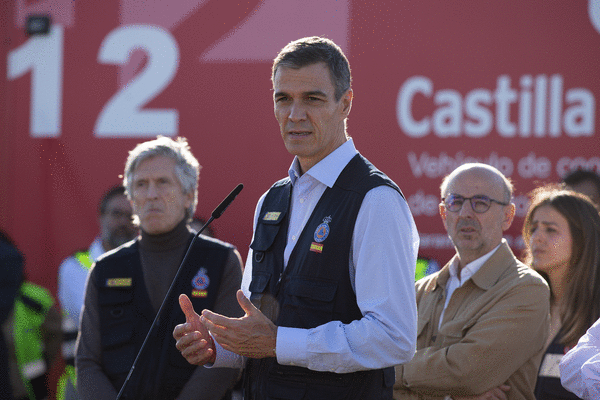
A right-wing bloc is poised to win a narrow majority of seats in Spain’s snap election, according to an initial poll released Sunday, indicating a likely end to Socialist Pedro Sánchez’s eight-year run as prime minister.
The conservative People’s Party, the far-right Vox and a third junior party are expected to win as many as 184 seats, according to a Sigma Dos poll for the public broadcaster RTVE released as voting ended. That would give the two parties, which said during the campaign they’d be willing to form a coalition, more than the 176 lawmakers needed to control the 350-seat lower house of parliament.
Sánchez’s Socialists were expected to win between 119 and 124 seats, compared with 121 in 2023.
If the initial poll results hold, People’s Party leader Alberto Núñez Feijóo would be poised to become the new prime minister, having promised to restrict migration, cut taxes for the middle class, expand nuclear power and usher in a new era of fiscal discipline. It would also mean that the Socialists would have just two leaders in the European Union, potentially ushering in a further shift to the right in EU policy.
The worst outcome for the PP and Vox would be 175 seats, according to the Sigma Dos poll, which included 19,501 interviews between Nov. 12 and 28 with a 1 percentage point margin of error.
Negotiations to form a new government could stretch into January. After parliament next convenes on Dec. 23, King Felipe VI will consult with the political parties and nominate a candidate for prime minister, who will seek enough support in the lower house to form a government.
Even though Spain is the fastest growing major economy in the euro area, Sánchez’s tenure has been marked by a slate of problems. He’s been forced to deal with corruption scandals, major crises including two deadly rail disasters this year, a surge in migrant arrivals over the summer and a blackout last year.
Vox has yet to confirm whether it would join a government with the People’s Party, though the two groups already govern together in four regions, arrangements that may serve as a model for negotiations in the coming weeks.
The campaign was marked by polls that mostly showed the right-wing bloc ahead. Surveys made a similar call in 2023, however, when the two right-wing parties fell four seats short of a majority and Sánchez forged complex agreements with more than eight parties that allowed him to remain in office.
Sánchez, however, failed to pass a single budget.
Spain’s GDP is forecast to expand 2.6% in 2026, according to Bank of Spain estimates. That is almost three times the 0.9% growth forecast by the European Central Bank for the euro area as a whole.
The deficit stood at 2.2% of GDP in 2025, below the 2.5% target agreed with the European Commission. Debt, which reached 124% of GDP during the pandemic, fell to 100.7% at the end of last year.
Under Sánchez, Spanish stocks have almost doubled, with the IBEX 35, the country’s main gauge, gaining about 97% since June 2018. The benchmark reached a record in August and is on course for a fourth consecutive annual gain. It’s up about 10% this year, making Spain one of the best-performing major European equity markets in 2026.
The risk premium investors demand to hold Spanish bonds over German debt has fallen sharply, with the 10-year yield gap narrowing to around 60 basis points from about 100.
During his current term, Sánchez has faced a series of crises, including two high-speed rail accidents that killed 115 people. The latest occurred on Oct. 27, after the election had already been called. The two crashes became a central theme of the campaign, with the opposition repeatedly attacking the government over them.
Sánchez, for his part, warned that a change in government would lead to sweeping cuts to public services and diminish Spain’s current role in the world.
The Spanish election also kicks off a series of elections across the continent that could reshape the political balance of power in the EU. Far-right candidate Marine Le Pen is leading polls ahead of a French election in the spring, and there are additional ballots in Italy and Poland.
During his time in office, Sánchez has emerged as an antagonist of U.S. President Donald Trump, opposing a target of spending 5% of GDP on defense within NATO. He has also criticized Israel over what he has called a “genocide” in Gaza and maintained a policy of engagement with China, in contrast with countries advocating a tougher stance to address the trade deficit.
_____
(With assistance from Thomas Gualtieri, Andrés González and Macarena Muñoz.)
_____
©2026 Bloomberg L.P. Visit bloomberg.com. Distributed by Tribune Content Agency, LLC.






Comments