Kalshi pours money into California politics as its state, federal critics multiply
Published in News & Features
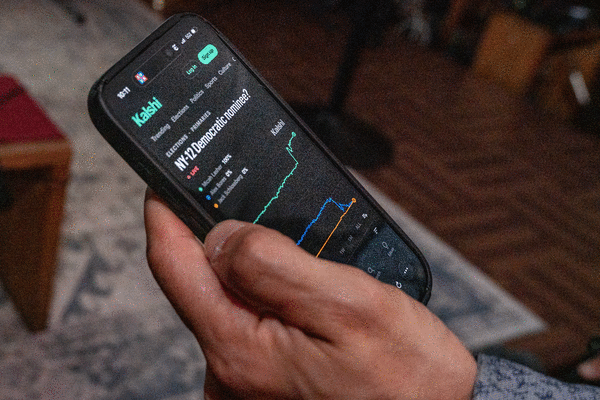
SACRAMENTO, Calif. — The prediction market company Kalshi is making major inroads into California politics as the industry comes under increasing scrutiny by regulators, courts and Democratic politicians.
Last month, Kalshi gave $2 million to the California Democratic Party, tied for the largest check the party deposited in the current two-year campaign cycle and the second largest in the past five years. The company has contributed to the campaigns of more than three dozen lawmakers and candidates from both parties since March and hired Attorney General Rob Bonta’s former chief of staff, Evan Corder, as its lobbyist last year before bringing him on staff in October.
On Monday, Kalshi’s 30-year-old CEO, Tarek Mansour, is set to visit Sacramento to announce a $3 million donation to WellSpace Health, a nonprofit community health system.
The moves come as Kalshi and its top rival Polymarket face an increasingly icy reception from key Democrats after two years of close ties to President Donald Trump. Congressional Democrats, fresh off their sweeping midterm wins, have pledged to step up oversight of the platforms. And under pressure from tribal groups, Gov.-elect Xavier Becerra returned Kalshi’s maximum donation to his campaign earlier this year.
Kalshi’s entrance into California is part of a broader push into state politics. The New York-based company hired lobbyists in 41 states as of September, according to the campaign finance tracker OpenSecrets.
The company began lobbying in California last year. Since then, it has spent more than $162,000 lobbying Bonta’s office, Gov. Gavin Newsom’s administration and the Legislature on prediction markets and bills. It hired Corder’s firm, Redwood Public Affairs, in April 2025 and hired him on staff in October, according to Corder’s LinkedIn. The company currently employs the Weidman Group as its lobbyist.
“Like many U.S.-regulated companies, we support candidates on both sides of the aisle,” said Kalshi spokesperson Jacki McGavick in a statement. “Regulation that keeps prediction markets safe for consumers and allows them to grow in America isn’t a partisan issue, and our contributions reflect that.”
McGavick declined to comment on the company’s $2 million donation to California Democrats.
The party does not accept contributions from a range of controversial donors, including fossil fuel companies, for-profit prisons and colleges, and the payday loan industry, but does not have policies specifically related to prediction markets.
Party spokesperson Robin Swanson declined to directly address Kalshi’s donation.
“Contributions to the California Democratic Party helped us elect Democrats up and down the ballot, defeat the Trump-backed Prop. 39 and exponentially expand our robust voter protection programs across the state,” she said in a statement, referring to the unsuccessful state proposition focused on voter ID.
Trump regulators take on state attorneys general
Prediction markets like Kalshi and its top rival, Polymarket, have exploded in popularity across the country. They allow users to trade on everything from the future price of gasoline to the outcome of this weekend’s Sacramento Republic FC soccer game.
Critics, including both Democratic and Republican state attorneys general, have argued elements of the platforms violate state and federal gaming restrictions. A case related to predictions on sports may be heard by the U.S. Supreme Court next year.
Kalshi and Polymarket cultivated tight relationships with President Donald Trump. Both companies hired one of his sons, Donald Trump Jr., as an advisor in January 2025. The president’s son reportedly told GOP attorneys general in March their attacks on prediction markets helped gambling companies and other “vested interests,” according to the New York Times.
Kalshi, which compensated Trump Jr. with shares initially worth $300,000, announced last week it had parted ways with Trump Jr. because of his heavy investments in its rival.
Under Trump, the Commodity Futures Trading Commission has taken a permissive view of prediction markets and argued it has exclusive jurisdiction over regulating them.
That view has led to a slew of lawsuits involving Kalshi, Polymarket, the CFTC, tribal groups and state attorneys general.
Bonta hasn’t brought any cases himself, but has signed at least 11 amicus briefs in support of states’ efforts to regulate prediction markets, according to his office. California is one of 44 states whose attorneys general signed a letter to the CFTC in July.
Battle between tribes and prediction markets
In California, Kalshi and its ilk face stiff resistance from many — though not all — tribal groups that view prediction markets as a threat to their gaming business. James Siva, chair of the California Nations Indian Gaming Association, said a study commissioned by his group estimated a 5% impact on the tribes’ gaming revenue.
“We firmly believe that they are engaged in illegal activity,” Siva said. “The sports event contracts that they offer under the guise of a financial trading tool is nothing more than illegal online sports betting.”
Kalshi disputes that reasoning, arguing it offers federally regulated “events contracts” that are distinct from sports bets.
When Kalshi made a maximum $39,200 contribution to Becerra in May, Siva said tribal groups mounted a “large pushback.” The Democrat ultimately refunded the check “and made sure that every tribe was aware of that — that he stood with tribes on this issue.”
Becerra sent the tribes a letter pledging not to accept money from companies like Kalshi and Polymarket, according to Siva.
A spokesperson for Becerra did not respond to a request for comment.
The Legislature considered a few unsuccessful bills this year designed to regulate elements of prediction markets, but nothing that attempted to prevent Kalshi from operating in the state.
Representatives for several legislators did not comment when asked about the donations.
Siva said CNIGA viewed anything other than a total ban as a tacit enforcement of the business model. Still, he said tribal groups were focusing most of their attention on the national court fights.
Not all tribal groups see Kalshi as an existential threat.
Last month, three California tribal nations — Kletsel Dehe Wintun Nation, Greenville Rancheria and Alturas Indian Rancheria — entered into an agreement with Kalshi to launch their own prediction market apps using the company’s technology. Several representatives for the tribes told the news outlet 500 Nations that the move could provide revenue streams for groups that aren’t well positioned to host casinos.
____
©2026 The Sacramento Bee. Visit at sacbee.com. Distributed by Tribune Content Agency, LLC.






Comments