Trump, while wielding veto threat, sees possible deals with incoming Democratic majority
Published in News & Features
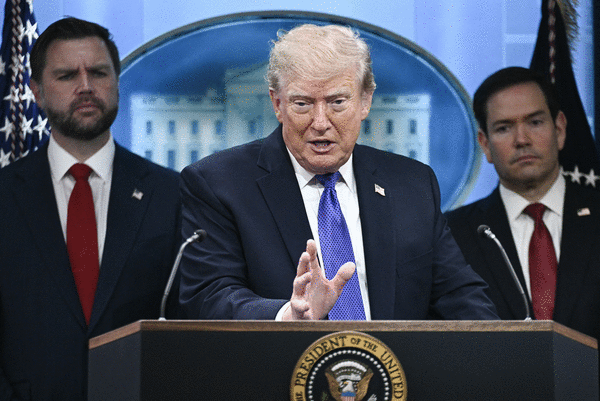
WASHINGTON — President Donald Trump said Friday he might get more accomplished with Democrats running the House and Senate than he did in a Republican-led Congress, but his legislative to-do list differs significantly from the incoming majority party.
After previously suggesting he could strike a bipartisan immigration deal with Democrats, Trump on Friday added several items to his wish list after returning Thursday night from a swing across Asia, including several that have support with Democrats with whom he’s bitterly clashed before.
Speaking in a stuffy James A. Brady Briefing Room for just shy of 90 minutes, the GOP president contended, without naming a single Democratic leader or lawmaker, that members of the opposition party have called him “about two things in particular,” pointing to health care and immigration.
“What's happened is I've been called by a lot of Democrats,” he said of the 17 days since Democrats gained dozens of seats across the two chambers. “But people that matter, people that have a lot to do, and they want to talk to me.”
But Trump also reminded Democrats that he is more than willing to veto legislation he doesn’t agree with, calling it one of the “extreme powers” of his office and one he might use to bring them to the bargaining table.
“So they’re going to send things my way, and I’m going to veto them. And then they’re going to send more things, and I’m going to veto them,” he said. “I think, after a month or so, they’re going to send things, and I’m going to say, ’I’m going to veto, unless you want to do this and this and this.”
He predicted House Minority Leader Hakeem Jeffries, D-N.Y., the likely new speaker of the House, and Sen. Charles E. Schumer, D-N.Y., expected to become majority leader, would seek deals because both are “smart.” He would not say if he’d spoken to either leader, but called Jeffries “streetwise,” while noting he had once made a donation to Schumer earlier in their careers.
Trump went as far as to suggest working across the aisle on health care “may be easier than the Republicans trying to ram it through in reconciliation,” a reference to a fast-track process that allows sprawling bills to pass each chamber with a simple majority — legislation typically needs 60 votes to advance in the Senate.
The sports-loving president added the Senate-approved “Protect College Sports Act” to his list, and repeated his support for legislation to make Hollywood production companies more competitive. House Majority Leader Steve Scalise, R-La., reportedly said on Thursday he would instruct several outgoing committee chairs to make “narrow” changes to the college sports measure before bringing an amended version of the Senate bill to the floor for an uncertain vote.
“We have to pass that bill,” Trump said. “Every college is going to go bankrupt if we don't get a bill because they're going crazy.”
The Senate’s “Protect” bill would establish the first federal regulatory framework for college athletics, setting national rules for name, image and likeness deals and compensation, as well as installing limitations on agents. It would put in place standards for NIL agreements, create guidelines for schools making direct payments to athletes and provide targeted antitrust protections to certain governing organizations.
He said the Senate bill has “tremendous bipartisan support,” but its path in the House remains unclear, according to lobbyists who have worked on the issue. That’s because some House conservatives oppose it and the Congressional Black Caucus has said its members would vote “no.”
The CBC has linked it to GOP efforts to redistrict majority minority districts in states the group, with its nearly 60 House members, contends would benefit most from the bill. The CBC is expected to be even larger in the next Congress, further complicating the “Protect” bill’s path to Trump’s desk.
Trump also pointed to the Motion Picture, Television, and Entertainment Revitalization Act as another possible bipartisan bill. The legislation would establish a federal tax credit to encourage film and television productions to shoot in the United States rather than overseas. Some countries offer American film companies lucrative production incentives to shoot on their soil.
In a twist, Trump noted Sen. Adam B. Schiff — a longtime foe from the California Democrat’s days probing the president’s alleged ties to Russia as House Intelligence Committee chair during Trump 1.0 — supports that measure.
“It’s running its way through Congress, and it has unbelievable support. I tell you what, Adam Schiff said, ‘Wow, we love that bill.’”
But the president’s vision of a 120th Congress bipartisan agenda differs from what Democrats have promised.
Many Democratic incumbents and candidates promised voters they would pursue legislation to lower consumer prices, pare health care costs and end Trump’s Iran conflict, which the president again on Friday acknowledged hurt his party by increasing prices.
Jeffries, during a press conference in Washington on Nov. 4, pointed to reversing the administration’s Medicaid cuts, reviving the Affordable Care Act credits, ending the war and lowering costs as his conference’s “North Star” priorities. This week he also said he would seek to move an immigration-related bill “immediately,” and that the House would “hold the crooks accountable,” a nod to aggressive oversight both chambers are likely to engage in.
On Iran, reporters pressed Vice President JD Vance over his post-midterms X post blaming the war for the GOP wipeout. One reporter pressed Vance, a potential 2028 Republican presidential hopeful, whether he — like Trump — would start the conflict again. Vance sidestepped as he approached the lectern from behind Trump’s right shoulder, but did not give a full-throated endorsement to go to war again.
“The president has said he would do it again,” Vance replied. “And my view is that my goal is, and my job is to support the president of the United States.”
In a potential 2028 GOP primary preview, Secretary of State Marco Rubio — who has gained ground in some polls since the midterms — was expressionless as he stood a few feet away, positioned behind Trump’s left shoulder.
‘Tremendous tax’
Trump’s midday press conference marked his first since voters handed Democrats at least 258 House seats and 56 in the Senate come Jan. 3. He again contended the outcome would have been different “if I were on the ballot,” and floated vague conspiracy theories about some falling prices since Democratic candidates bulldozed across the country.
At one point, he decided to make an announcement that he claimed he had not warned his staff about by floating a threat to U.S. companies that want to build data centers overseas.
"We're going to put a tremendous tax on them, if they do it," he said, continuing his advocacy of erecting the unpopular facilities across the United States and willingness to use executive powers.
As he returned to Washington Thursday night, the White House touted on social media what it called $17 billion in new deals secured with Asian countries this week. Trump on Friday claimed he told Philippine President Ferdinand Marcos Jr. his country would begin buying “100 percent” of its oil from the United States — and Marcos had said, “Yes, sir.”
White House aides handed out a one-page “declaration toward peace” before Trump arrived that he later said he had reached with Russian leader Vladimir Putin and Chinese President Xi Jinping.
The three leaders agreed to ramp up production of petroleum products, pursue unspecified changes to the United Nations and a statement that a “nuclear war cannot be won and must never be fought,” according to the White House’s description of the declaration.
It also included a line about agreement on the “principle of state consent and respect for immunities of state officials,” an apparent show of support to Putin being targeted by international criminal entities over his conduct of his war with Ukraine. The U.S. president on Friday said such entities have “fake power.”
‘Footsie with Putin’
Trump called the declaration “formal,” as he lauded Chinese cities he was driven through this week as extremely “clean.” He compared them to some Democratic-run U.S. cities and states he described as “so embarrassing” and “dirty.” He dubbed Xi, considered by many Republican and Democratic lawmakers to be a dictator, a “great man.”
Some Republican lawmakers who will return for the 120th Congress said they have some reservations about Trump meeting with his Chinese and Russian counterparts, doubting Putin’s and Xi’s sincerity about changing course on a number of issues.
Retiring Rep. Don Bacon, R-Neb., went further Thursday.
“Traditionally, Republicans stood up to Russia and to China. And we stood up for freedom, and we stood up for countries that shared our values,” Bacon, who has floated a potential 2028 presidential bid, said during a National Press Club event. “President Trump has been terrible on this right here."
“He has played footsie with Putin, he’s even blaming Zelenskyy for why the war started,” he added, referring to Ukrainian President Volodymyr Zelenskyy. “It infuriates me. And Ronald Reagan is rolling in his grave. … And now the Democrats are talking about the bad Russians and the bad Chinese, and we got to be tougher — it’s another role reversal, here.”
_____
©2026 CQ-Roll Call, Inc. Visit at rollcall.com. Distributed by Tribune Content Agency, LLC.




Comments