SpaceX catches Starship in novel landing at Texas site
Published in News & Features
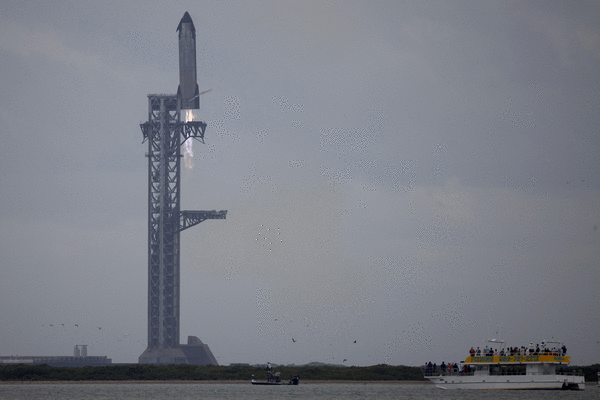
SpaceX successfully caught its Starship rocket as it returned to the Texas launch site from orbit, a novel engineering feat and major step toward Elon Musk’s goal of developing a fully reusable system.
Starship descended from the sky over SpaceX’s Starbase facility in South Texas after 3 p.m. local time on Saturday, lowering itself belly first before flipping upright to land next to the vehicle’s launch tower.
The tower’s two outstretched mechanical arms caught the massive vehicle, stopping its fall — with raucous cheers and applause erupting at SpaceX sites across the country.
“Can you believe it? Mechazilla has caught the Starship,” SpaceX launch commentator Dan Huot said on the webcast, with the rock ballad Baby Come Back playing as a background theme song. “We’ve been waiting to hear that for a long time.”
The midair capture serves as a major proof of concept for Starship, long-envisioned by Musk as the world’s first fully reusable orbital vehicle.
With Saturday’s mission, Musk has captured both sections of the launch system during different missions. But the company fell short of its goal of returning and catching both pieces to the launch site during this most recent flight. No rocket operator has ever recovered the entirety of one of its orbital rockets after launching to space before.
Starship is the tallest and most powerful rocket ever built, according to SpaceX. Musk’s company plans to use Starship to launch upgraded satellites for SpaceX’s Starlink service and a fleet of as many as a million spacecraft to serve as data centers for artificial intelligence. Ultimately, the vehicle is supposed to take humans to the moon and eventually start a settlement on Mars.
SpaceX launched Starship on Friday, sending the spacecraft to orbit, where it deployed a batch of Starlink satellites. The spacecraft then spent roughly a day lapping the Earth before returning to its launch site for the landing.
The company aborted an attempt to catch Super Heavy, though, which Musk blamed on a “slight underperformance of engines on this flight.” However, he said the failed landing “does not change our timeline to reach high volume, fully reusable Starship flights.”
During a tour of Starfactory with reporters Friday, SpaceX officials confirmed that it takes four weeks to build one Super Heavy booster and two weeks to build a Starship spacecraft.
Returning the spaceship component is especially challenging since it must brake from orbital speeds and survive scorching temperatures as it travels through the atmosphere.
SpaceX’s Falcon 9, the company’s current workhorse rocket, is only partially reusable as some of its hardware is still destroyed after launch.
©2026 Bloomberg L.P. Visit bloomberg.com. Distributed by Tribune Content Agency, LLC.






Comments