Honduran deportee sues over alleged racial profiling arrest during Operation Metro Surge
Published in News & Features
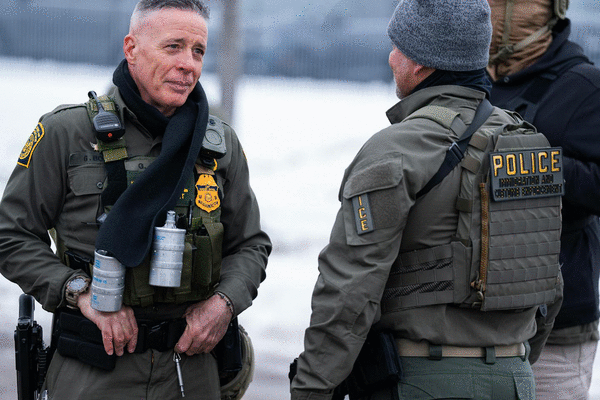
MINNEAPOLIS — A man deported from Minnesota to Central America is alleging that U.S. Immigration and Customs Enforcement agents, with commander Greg Bovino in charge, beat him unconscious during a January arrest.
The accusations are in a lawsuit filed Thursday in U.S. District Court by Honduran national Orbin Mauricio Henriquez Serrano, 28, who is seeking more than $1 million in damages in connection with his well-documented apprehension during Operation Metro Surge on Jan. 11 at a Speedway gas station near Snelling and Summit avenues in St. Paul. Henriquez Serrano filed the lawsuit from his home country of Honduras.
Bovino, while U.S. Customs and Border Protection commander at large, was the ever-present face of the Trump administration’s federal immigration crackdown in the Twin Cities. Along with participating in Henriquez Serrano’s arrest during the height of ICE activity, Bovino showed up many other times in Minneapolis and nearby communities, surveying agents on the ground carrying out immigration enforcement operations.
The personal injury lawsuit contends that Bovino was overseeing agents as they “racially profiled, assaulted and beat Mr. Henriquez Serrano to unconsciousness in front of horrified witnesses.”
During the arrest, the lawsuit continued, “agents shattered his car window, hit him with a hammer, pulled on his neck, twisted his knee [and] carried Mr. Henriquez Serrano’s unmoving body into a black SUV.”
The Minnesota Star Tribune has reached out to federal immigration officials for a response to the suit’s allegations.
The lawsuit included news images of the arrest. One captured a seemingly startled Henriquez Serrano staring through his shattered driver’s side window at an agent gripping a hammer. Another showed three masked agents dragging a seemingly unconscious Henriquez Serrano, his head gone limp, along the pavement.
Bovino announced his retirement in March, as Operation Metro Surge was winding down in Minnesota.
Bovino’s tenure ended soon after the fatal shooting of Alex Pretti in January by agents in Minneapolis. Bovino alleged that Pretti seemed to want to “massacre” agents at the scene. Soon after, Border Patrol officials released an initial review of the encounter that did not support that view. Bovino soon departed Minnesota after White House border czar Tom Homan took over the operation with a less combative approach.
Henriquez Serrano, who came to the United States six years ago, was working as an assistant manager and a line cook at a tavern, according to the lawsuit, and was heading to his job when he stopped at the gas station for an energy drink.
Once Henriquez Serrano was back in his vehicle, the lawsuit said “Bovino came not with a few agents but nearly twenty, [who] had no plan or orders other than find [to] Hispanic looking people and to antagonize Minnesota residents into retaliating against the agents. ... Agents had no idea who Mr. Henriquez Serrano was when they began their encounter with him, merely that he looked Hispanic.”
A Minnesota Star Tribune check of court records found no criminal history for Henriquez Serrano beyond his immigration status. Henriquez Serrano was seeking asylum in the U.S., the lawsuit said.
A crowd began to gather, and over its objections, “Bovino and several of his agents began to push back on the witnesses and threaten them in an attempt to escalate the situation,” the suit continued.
One agent uttered an insult at Henriquez Serrano in Spanish and others swore at him while “Bovino failed to maintain proper supervision. Instead, he was ‘snarling at protesters,’” the suit quoted one media account as reporting.
From the gas station, Henriquez Serrano was taken to the Whipple Federal Building, ICE’s Twin Cities immigrant processing center, transferred to a federal detention facility in El Paso and returned to Honduras, “the country from which he was seeking asylum,” without ever having access to an attorney, the suit noted.
The suit summed up that “racial profiling was a necessary and expected part of Operation Metro Surge. Mr. Bovino specifically targeted Hispanic-looking individuals.”
_____
©2026 The Minnesota Star Tribune. Visit at startribune.com. Distributed by Tribune Content Agency, LLC.




Comments