Rejection of Minneapolis police chief nominee prompts anxiety over department's future
Published in News & Features
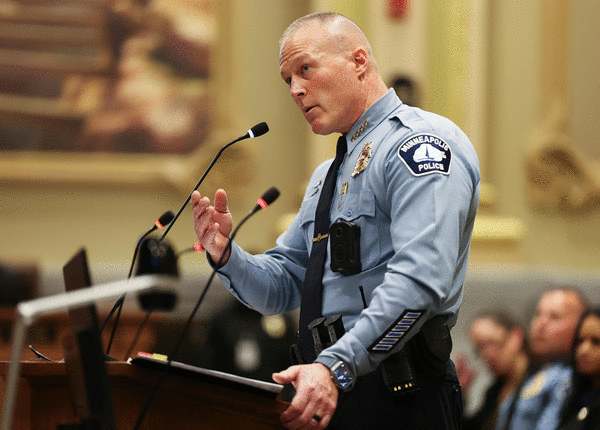
MINNEAPOLIS — Supporters of Bill Peterson’s bid to become Minneapolis’ next police chief felt optimistic Thursday morning.
Top Minneapolis police supervisors, gathered behind closed doors, declared that the interim chief had the votes to secure the job.
But by mid-afternoon, following hours of scrutiny from skeptical City Council members, Peterson’s chances suddenly turned gloomy.
The council ultimately rejected the 31-year department veteran in an 8-5 vote, throwing the agency’s long-term leadership into question. It also marked the first known rejection of any Minneapolis police chief nominee by the council in modern history.
Peterson has signaled to colleagues and city officials that he will take the weekend to consider next steps, and whether he wishes to remain in the running for the job. Doing so risks a second demoralizing repudiation from the 13-member council, which already dealt a similar blow to the reappointment of Community Safety Commissioner Todd Barnette — Mayor Jacob Frey’s other top public safety pick — earlier this year.
Should Peterson choose to walk away, Frey will be forced to select another candidate he believes can garner majority support from the council. Given the mayor’s rocky relationship with the city council’s progressive majority, and the charged politics of public safety in Minneapolis, what comes next is likely to be messy.
Communities United Against Police Brutality, a police accountability group in Minneapolis that led the charge against Peterson’s appointment, called on Frey to reopen the search process to external candidates with a proven track record of changing department culture.
But starting the national search anew will be both costly and time-consuming. And many wonder who will want to apply.
“This is the hardest policing job in the country,” Council President Elliott Payne said Thursday, mirroring comments from Peterson’s staunchest advocates.
The city still lives in the shadow of 2020, when George Floyd’s murder in police custody triggered an unprecedented breakdown of public trust, a mass exodus of officers and a state consent decree.
“[Minneapolis has] faced pretty much every challenge you can think of in policing,” said Chuck Wexler, executive director of the Police Executive Research Forum, a think tank based in Washington, D.C.
“Someone coming in is gonna have to understand the trauma that both the police department and the community has faced,” he added. “It needs stability.”
Bloomington Police Chief Booker Hodges, who sat on the chief candidate interview panels, called on the Minneapolis mayor and council to sit down and have honest conversations about what they desire in a police chief and what comes next.
“They’re looking for a diamond in the rough — and I don’t think they’re going to find it,” he said of the council.
Convincing qualified law enforcement executives to leave comfortable jobs elsewhere and take on culture change in Minneapolis, he said, becomes exponentially harder in this fraught political environment.
“All these fights just give the appearance that no one gets along,” Hodges added. “The consensus is that Minneapolis is dysfunctional.”
Support not secured
Peterson’s nomination was derailed when he couldn’t name a specific instance where he witnessed racist, sexist or homophobic slurs in his 31 years with the Minneapolis Police Department, despite its well-documented history of discriminatory policing.
Normally, Frey could count on two more moderate Democrats, LaTrisha Vetaw and Pearll Warren, to vote for his preferred candidate. Warren initially told Peterson she would support him, but said she changed her mind after learning of two open misconduct complaints against him. She also didn’t like what she took as an inability to acknowledge MPD’s issues.
“Be honest enough to admit that you have seen or witnessed or experienced racism or discrimination,” Warren said in a news conference after the council meeting. “Make that be the torch and the reason why you are seeking this role and position in leadership, that you want to be the instrument of change.”
Cam Gordon, who served on the City Council for 16 years, said typically a mayor should figure out where the votes are in advance. Past mayors spent a lot of time trying to find a good fit who would get council support, he said.
But that was before the strong mayor ballot measure passed in 2021, eliminating the executive committee that would work together on nominations.
Frey said that he did speak with Council members, but most of them did not want to say how they were going to vote prior to the confirmation hearing.
Several council members said they weren’t asked their position by Frey’s staff beforehand. Five from the Council’s more progressive bloc publicly declared their preference for an external candidate this fall, but others wanted to hear Peterson’s answers to their questions before making a final decision.
Payne said he was “really interested” in Peterson until Council Member Robin Wonsley’s inquiries about MPD’s past.
“It really took me aback that, you know, a veteran of 30 years in the Minneapolis Police Department couldn’t recall a moment of somebody doing anything racist like that; that’s a really challenging thing for me,” Payne said. “And if I’m looking for a leader that’s going to bring this department into the future, to the place where we expect it to be, they shouldn’t be embarrassed to be able to say, ‘Yeah, I witnessed some racism in this department.’”
Next steps in limbo
By the end of his three-year tenure, former chief Brian O’Hara, an outside hire from Newark, New Jersey, developed a bad reputation for his short fuse and abusive treatment of front office staff. He was ousted this spring for interfering in an investigation into sexual misconduct.
After Peterson took over as interim in June, morale quickly began to stabilize, according to people familiar with the matter. Although initially resistant to seeking the permanent chief role, Peterson faced repeated calls from Frey and his allies to apply.
He’d won praise for the way he navigated the department’s budget crisis and several high-profile incidents, including a mass shooting near Loring Park that seriously wounded two of his officers.
All external candidates dropped out prior to the final phase of the interview process, once word spread that the interim chief had formally applied.
But Peterson’s decision to jump into the fray after other candidates had already sat for initial interviews — and after publicly stating that he didn’t want the job — led to some accusations that the search was weighted in Peterson’s favor. Frey dismissed those criticisms Thursday, defending what he called a “full and fair process.”
Frey also told reporters that at least one council member has indicated they may be willing to flip their vote if Peterson comes back before the body. But the mayor would require at least two council members to change course in order to get Peterson confirmed.
The mayor has one week to decide whether to veto the council’s decision, which effectively would keep Peterson’s nomination alive.
©2026 The Minnesota Star Tribune. Visit at startribune.com. Distributed by Tribune Content Agency, LLC.



Comments