Korean government is negotiating to fund Westinghouse nuclear plants in the U.S.
Published in News & Features
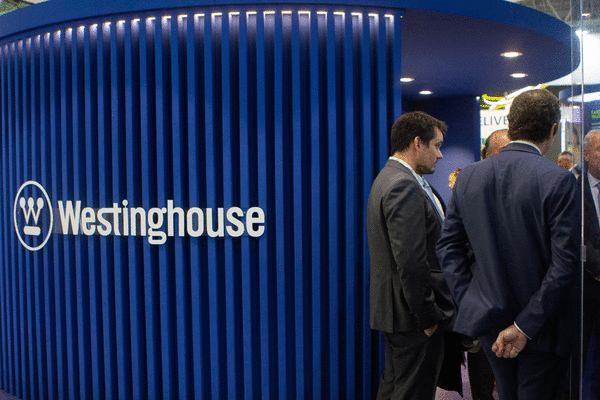
The U.S. government appears to have found a financier for a nuclear building spree in the U.S.: the Republic of Korea.
A non-binding framework announced last week at the White House would provide $120 billion toward the construction of eight nuclear reactors. They are to be built in pairs across at least four federal sites, in Ohio, Tennessee, Kentucky, and South Carolina, according to U.S. Secretary of Commerce Howard Lutnick, who negotiated the agreement.
Included in the deal would be six Westinghouse AP1000 reactors and 2 APR1400 units, a Korean nuclear design that was the subject of years of litigation between Westinghouse and Korea Electric Power Corp., or Kepco.
Some Westinghouse technology is incorporated into the Korean design, and the legal battle over how that technology would be controlled erupted in 2022 as the Cranberry-based nuclear firm was competing with Kepco to build nuclear plants in Europe.
The two parties signed a settlement in January 2025, but no terms were publicly disclosed.
The announcement of Project Power, the name the Trump administration gave the Korean-financed nuclear program, says it would require a one-time waiver of that legal settlement.
As compensation, Westinghouse would receive $2 billion for each of the two APR1400s built in the U.S. while its developers, Kepco and Korea Hydro and Nuclear Power, would get a foothold in the U.S., which is looking to quadruple nuclear power capacity by 2050.
The $2 billion value is derived from an upfront payment, guaranteed work opportunities on those reactors, and long-term contracts for nuclear fuel-fabrication services.
Westinghouse President and CEO Dan Sumner in a statement called it “a defining moment for the future of U.S. nuclear energy and for the longstanding partnership between the United States and the Republic of Korea.”
Sumner stood in the White House’s Oval Office behind President Donald Trump on Wednesday for the announcement of $200 billion in potential funding from the Korean government that includes Project Power; a massive natural gas power plant development in Texas called Project Star; and the more tentative Alaska liquified natural gas export terminal known as Project North.
They are some of the first specific projects announced that would count toward the $350 billion trade deal negotiated with South Korea earlier this year in exchange for lower tariffs on Korean imports.
“They have to invest hundreds of billions of dollars,” Trump said. “For doing that, I reduced their tariffs to 15%. But they had to pay for that.”
The framework also would give Korean companies an ownership stake in Westinghouse that its majority owner, Brookfield Asset Management, placed at between 5% and 10% of the private company’s equity. In a statement Thursday, Canadian-based Brookfield said this would further align “the parties around the long-term growth and deployment of Westinghouse technology.”
Westinghouse’s other Canadian owner, the nuclear fuel company Cameco Corp., assured its investors that the Korean equity stake would not diminish its interest in Westinghouse, which stands at 49%.
But it wasn’t clear how and when the Korean equity stake would be negotiated.
Westinghouse is in the process of becoming a public company. It filed confidential documents with the Securities and Exchange Commission in July. The company will have to make public disclosures when it gets closer to its initial public offering, which is expected this fall.
Westinghouse referred questions to the Department of Commerce. An inquiry sent to the government agency on Friday was not immediately returned.
Paul Murphy, a nuclear industry consultant, said that it’s a “positive sign the deals are progressing” and that there is enough demand for power in the United States to have multiple companies contributing to the build-out.
“It’s nice to see international cooperation,” he said. But he cautioned that “there’s still a lot of work to be done to get the final terms settled.”
Murphy said he sees the benefit of using the supply chain and project expertise of the Korean power companies in getting U.S. nuclear projects off the ground.
But not all of it will translate, he said. For example, the Korean firms have been successful at executing their new reactor projects in the United Arab Emirates by importing thousands of craft workers from Southeast Asia, a strategy that Murphy believes would not be feasible in the U.S.
There are only a handful of companies that specialize in building large nuclear power plants. In fact, it was Westinghouse’s dalliance with managing such construction projects that drove the company into bankruptcy in 2017.
As a way to speed up the process and lower the risk that comes with billion dollar projects, the U.S. government last year pledged to help Westinghouse get 10 AP1000 reactors under construction by 2030.
The assistance offered involves granting permits, clearing siting obstacles and helping to secure financing for construction. If the Korean investment is finalized, that would take care of the financing portion of the government’s commitment.
©2026 PG Publishing Co. Visit at post-gazette.com. Distributed by Tribune Content Agency, LLC.


Comments