Florida families struggle to buy groceries after losing food stamps
Published in News & Features
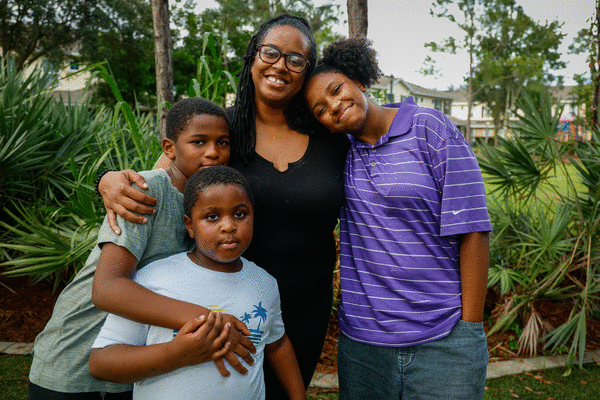
ORLANDO, Fla. — Keaidy Bennett, a single mother of three, relied on $936 a month in food stamps to buy groceries for her family — until the freelance writer was cut from the program last month.
Her efforts to get reinstated, or even answers about why she lost benefits, have so far proved fruitless, with calls to a local office rarely answered.
“I try a couple times a day. I call right before it opens up to be hopefully one of the first ones,” said the Winter Park mother, whose children are 5, 10 and 15.
Without food stamps, Bennett gets groceries from food banks and leans on friends who will cook her family meals.
“You realize you can’t have pride for certain things because you have children,” she said. “And they have needs.”
President Donald Trump’s One Big Beautiful Bill passed last year slashed $186 billion from the nation’s food stamp program, officially the Supplemental Nutrition Assistance Program or SNAP. It was the largest cut in the program’s history, and since then more than 5.3 million people nationwide have been removed from the rolls.
In Florida, more than 570,000 people, Bennett and her children among them, have lost food stamps in the last year, a drop of 19.5%, according to the U.S. Department of Agriculture, which oversees the program.
That’s meant more and more people turning to food banks, which are struggling to meet the increasing demands.
And experts say the problem will likely get worse, as states will soon be responsible for more SNAP costs. If Florida cannot or will not pick up the growing tab, thousands more state residents could be without the help they need to buy food, even as grocery prices remain high.
Currently, about 2.3 million people in Florida receive food stamps, down from 2.9 million last year.
Recipients whose benefits recently were eliminated or reduced say they cannot get answers about why or get help with reversing the decision, despite hours spent trying to get a SNAP representative on the phone.
Florida describes SNAP as “the nation’s most important anti-hunger program.” It is a way to provide food for those with low incomes, including seniors, people with disabilities and families with children, according to the state’s Department of Children and Families, which administers the federal program in Florida.
But the new federal law imposed stricter work requirements for SNAP recipients and new exclusions for some immigrant populations, as it sought to shrink the program’s costs. It also shifted more of the financial burden, once split evenly between states and the federal government, onto the 50 states.
On Oct. 1, the federal contribution rolled back to 25%, a change that could cost Florida more than $50 million annually as it picks up a larger share of administrative costs.
By next year, states will need to pay even more, when, for the first time, they will have to pay for a portion of residents’ food stamp benefits.
The amount each state will have to pay will be determined by its “error rate,” or how much it is overpaying or underpaying SNAP recipients. Florida, with an “error rate” higher than the national average, could be on the hook for close to $1 billion a year.
“States are going to have to make some really tough decisions,” said Crystal FitzSimons, president of the Food Research & Action Center in Washington, D.C., a nonprofit focused on addressing hunger. “Are we going to cut services and programs for people? Are we going to cut our education budget? Are we going to increase taxes?”
Florida’s “error rate” is 12.97%, above the national average of 10.62%. States have until late next year to get their error rates below 6% to avoid having to pay a portion of the benefit costs.
Pressure to reduce that rate and adjust to the federal law’s new requirements are straining the program and disrupting benefits, experts say.
“Many states have upped the amount of verification and documentation that’s required, creating administrative hurdles for households,” said Joseph Llobrera, senior director of research at the Center on Budget and Policy Priority in Washington, D.C., a nonpartisan research and policy institute. “It also creates, in a way, a huge administrative workload issue for state agencies and their workers to process the increased volume of documentation.”
State Rep. Anna Eskamani, a Democrat, thinks it is more intentional.
“The state of Florida is more concerned about avoiding federal penalties on error rates than it is about helping those who do qualify get benefits,” Eskamani said.
The state invested nearly $4 million in an AI tool to review SNAP applications, which she thinks has contributed to the frustrating problems residents are now encountering when they call for help since they are “unable to talk to a real human to address it.”
DCF did not respond to an email and phone call requesting comment.
Key Republican lawmakers overseeing budget committees in the GOP-dominated Legislature also declined to comment, including Republican Sen. Jason Brodeur, a Central Florida lawmaker on the Senate’s powerful appropriations committee.
Sam Levin, a combat veteran who has been unable to work since suffering a heart attack and stroke earlier this year, and his wife, a schoolteacher, recently had their food stamp benefits drop from $300 to $200 a month. They do not know why.
“I went through the VA. I tried everything,” Levin said. “They’re just like ‘Oh, these benefits are just not as much as they used to be. We don’t have as much anymore.”
Levin used to volunteer at Faith United Methodist Church’s weekly food pantry, helping to haul boxes of food that would be given away. Now, he goes to the east Orlando church every week to pick up food for his family.
“Every little bit they’re willing to hand us helps out a lot,” Levin said.
Across the region, there is increased demand for free food, as the cost of food, gas and other items has soared.
Second Harvest Food Bank of Central Florida, which distributes food to about 400 area food pantries, said it was supplying enough food for 150,000 meals a day before the 2020 pandemic. That number shot up to 300,000 meals during the pandemic and hit 330,000 meals earlier this year.
The nonprofit said it cannot make up for significant cuts to the food stamps program.
“For every meal that food banks like ours provide, SNAP provides nine,” said Greg Higgerson, chief development officer for Second Harvest. “So the idea that we’re going to be able to double, triple, quadruple our efforts overnight to pick up that slack is really unrealistic.”
Orlando resident Jason Kerney, who is disabled and not working, and his wife have a blended family with five children and used $1,350 a month in SNAP benefits to buy groceries. They’ve received that payment for the past three years.
But after renewing their application in July, they ran into problems and were told to resubmit. That application is pending, but they are currently cut off from food stamps.
Kerney’s wife works full time at a local smoke shop, but her wages are not enough to keep the family afloat without SNAP.
“We’ve fallen at least a month behind on every single one of our bills,” Kerney said. “We’ve been struggling with electric getting shut off so that we can keep food on the table…with water getting shut off. The stress of it is certainly taking a toll on all of us.”
And efforts to get answers so far have been frustrating. One week, for example, they called 17 times, got disconnected 14 times and on the other three were told there was no update on their renewal application.
Bennett, the mom of three, serves her children modest meals since the family lost their food stamps. Last month, she made “flitters,” a fried bread dish that her mother, a Honduran immigrant, made when Bennett was growing up, serving them with refried beans and sour cream.
She wants to make more elaborate dinners, including her daughter’s favorite steak, but her budget no longer stretches that far.
“At the store everything is so expensive,” she said, with the steak her daughter wanted $54 at Publix. “I can’t do that,” she said, noting the other bills she must pay and her inability to reach someone who can help her get some SNAP benefits reinstated.
“It feels like I’m just kind of stuck. You kind of just get numb to it,” she said.
©2026 Orlando Sentinel. Visit orlandosentinel.com. Distributed by Tribune Content Agency, LLC.






Comments