Miami has universities. Why Ken Griffin bet $2 billion on building a new one
Published in News & Features
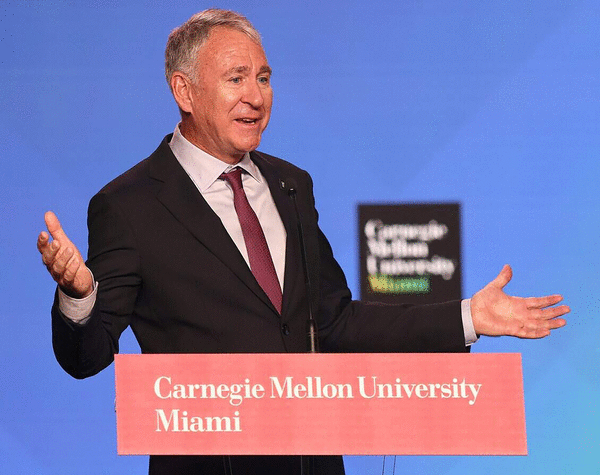
MIAMI — Ken Griffin’s record-breaking $2 billion gift to establish a Carnegie Mellon University campus in Miami’s Wynwood neighborhood was lauded as the single largest donation to a higher education institution in history.
Closer to home, some wondered: why not gift it to one of the established universities in South Florida?
Florida International University is a massive public institution with a reputation for helping low- and middle-income students get ahead and the University of Miami is a selective private institution with a major medical research component.
But neither of them got the $2 billion.
Griffin's gift to Carnegie Mellon University is a striking vote of confidence in Miami’s potential — and highlights that the city’s existing higher education system has not yet produced the kind of workforce Miami’s latest migration of finance and tech companies need.
Observers both national and local point to CMU’s reputation for churning out highly qualified graduates in tech fields, Miami and FIU’s relatively lower pedigree and Griffin’s own vision of higher education and the future of the city as reasons Griffin would build a school from the ground up instead of investing in the local institutions.
The prestige argument is clear: Carnegie Mellon ranks 14th in U.S. News & World Report’s rankings, and is at the top in computer science and artificial intelligence. While UM and FIU have received plaudits in their own right, UM ranks 55th and FIU is tied for 100th.
Griffin is all in on the future of Miami. He’s also made it clear that the best cities have excellent schools. It’s a line he’s used several times, including at a 2025 event at the University of Miami where he complimented the school.
In a quote to the Wall Street Journal, he repeated it again, with an added reference to other schools.
“I believe that all great American cities are anchored by great universities and Carnegie Mellon will bring a great university here to Miami complementary to other universities here in the region,” Griffin said.
Even though the plan to bring in an out-of-town university is unconventional, in hindsight it makes sense according to Amir Pasic, dean at Indiana University’s Lilly Family School of Philanthropy. Griffin and Citadel have been supporting CMU for more than a decade. The Citadel Teaching Commons, a lab and study space, opened on the university’s Pittsburgh campus in 2015.
“I’m sure the University of Miami wished that they had gotten an investment of that magnitude. But the fact is, the reporting shows that Citadel and Ken Griffin’s companies have had a long relationship with Carnegie Mellon, and it was a proven pipeline,” Pasic said.
Miami must attract more top tier students
Gabe Elias is both a product of Miami’s higher-education system and a beneficiary of the city’s tech boom — and he says the city is still struggling to produce the technical talent its ambitions require. The CEO of the Miami-based startup electric battery company Material, he was raised in Miami and graduated from the University of Miami’s College of Engineering in 2010. He’s also hired and worked with graduates from South Florida and elsewhere in his company.
He’s noticed a difference.
“The one thing that Miami lacks is smart people… So, bringing a nice, top-tier university and getting intelligent people to study important things, I think it’s only going to help us. But yeah, we’re not starting from a good baseline — and I can say that as a local, I’m pretty sad to say it,” Elias said.
Having started his professional career at Honda in Ohio, he saw up close how flagship universities that crank out STEM graduates like Ohio State and Purdue work with industry to meet their needs. He said he’s thankful for that experience because it showed him how far behind other engineers he was at the start of his career and the power of those collaborations.
When he decided to start his company, with seven Formula One racing world championships under his belt as an engineer for the Mercedes-AMG Petronas team, he figured he’d try a similar thing at UM. He wanted to hire UM grads, and there were scientists working in his field he wanted to collaborate with.
The school did not make it easy, he said.
“It’s run by people that I can only describe as human cardboard. They have no understanding of what the greater world looks like and how technology is being built, the pace it’s being built, and the collaborative efforts that are being undertaken by top tier universities versus the ones down here,” Elias said.
That experience is a contrast to how Griffin and CMU officials describe the school’s Miami campus: nimble and built around “grand societal challenges” like health, national security, climate and manufacturing.
There’s also the matter of the numbers. Aside from the rankings, Carnegie Mellon also dwarfs both UM and FIU in current and future grants from the National Science Foundation – $303 million to their combined $170 million. CMU’s endowment, which in its most recent annual report totaled $3.5 billion, also far exceeds UM’s and FIU’s endowments, which total $1.7 billion and $380 million, respectively.
Tech boom without a workforce
Miami as a city is lagging behind its peers when it comes to rankings. Of the top 10 most populous metro areas in the United States, the Miami, Dallas and Phoenix areas are the only ones without a university in the top 50 U.S. News & World Report undergraduate rankings — and many metro areas have multiple such schools.
A 2022 analysis of Miami’s tech boom from financial behemoth Moody’s identified that as a major issue.
“Even though Miami’s popularity continues to attract tech firms, there is an imbalance among the tech jobs and tech degree graduates here given that there is a lack of world-class university presence. To compete, Miami must attract more students interested in tech. While the University of Miami is a high-ranking institution, it needs necessary funding to expand opportunities and partnerships that would meet workforce needs,” a Moody’s researcher wrote in the report.
Some of those doubts have filtered into the media narrative about the city, with headlines like “Miami’s tech boomlet fades,” and stories about stalled projects as well as off-putting “crypto bros” trying to “make Miami happen.”
But this move might help Miami quiet those concerns and shirk some of its worst stereotypes: That the city is more of a playground for the rich than a place for job-creation, that its growth is ephemeral and that its “founder” culture is thin and less intellectual.
Griffin said in an interview with the Herald the new university would “augment and strengthen the intellectual fabric of Miami.”
Elias, who is ecstatic about Carnegie Mellon’s move, said it will help separate the committed and serious entrepreneurs from the pretenders.
“It serves to change the narrative because the crypto bros or larpers can’t participate — they wouldn’t know what to do,” Elias said.
Clean-slate intellectual infrastructure
Whoever gives $2 billion to an organization can probably call a lot of the shots. That might have been true if the gift was granted to a South Florida university, but Pasic said that erecting a campus from the “ground up” more than 1,000 miles away from the main campus gave CMU and Griffin even more latitude to fit with Griffin’s vision.
“When you start something new from the ground up, I think it’s easier to be as radical and departing from convention as this campus sounds like it’s going to be,” Pasic said.
The move is reminiscent of Andrew Carnegie, the gilded age Pittsburgh steel magnate, who founded what would become Carnegie Mellon with a distinct technical focus. Nearby was the 100-year-old university that would become the University of Pittsburgh, but Carnegie chose to establish a new institution.
Noah Drezner, a higher education professor at Columbia University’s Teachers College, said Griffin’s choice reflects a “distinct brand of free-market conservatism” that favors disruption over bureaucracy and market-driven competitiveness over orthodoxy.
He wrote in an email to the Herald that a new academic project was the only way to ensure those values were central.
“Creating an entirely new campus allows Griffin to operationalize a long-standing conservative critique of higher education. Simply investing in an existing Miami institution would have meant accepting established departmental silos, entrenched administrative bureaucracy, and traditional academic majors — the very structures he aims to bypass,” Drezner wrote.
“By bringing in Carnegie Mellon, Griffin gets the top-tier technical prestige and elite research horsepower of a world-class institution, while still building a clean-slate intellectual infrastructure,” he added. “A new academic project in Miami is the only way to ensure the orientation is built entirely around market-driven problem-solving rather than legacy academic politics.”
Griffin hasn’t shied away from criticizing left-leaning ideas on college campuses.
In an interview about Griffin’s donation to CMU, CNBC’s Sara Eisen asked the billionaire whether his decision to invest in Carnegie Mellon’s Miami campus had to do with his concerns over college students’ growing interest in socialism. Griffin, a staunch critic of the political ideology, called socialism “economic illiteracy.”
“Why do we think this is worthy to teach in our classes at our universities? We need to get back to basics, back to common sense, back to academic rigor,” Griffin said. “That’s really what Carnegie Mellon represents.”
Strengthening Miami’s momentum
Griffin’s interest in education is nothing new. He’s given more than $500 million to Harvard University, his alma mater, and $175 million to the University of Chicago, where his company was previously based. Griffin stopped donating to Harvard in 2024, citing criticism of the school’s antisemitism policy and a culture that he said was turning students into “whiny snowflakes.”
In Miami, he recently donated $50 million to the New York City-based charter school Success Academy to move into South Florida, and lobbyists tied to him pushed for a law to make it easier for charter schools like it to use underutilized public school space at low cost. He’s also given $60 million to University of Miami health projects, including one gift that led to the creation of the Kenneth C. Griffin Cancer Research Building in Overtown. Miami Dade College received $20 million from Griffin in 2023 and is set to partner with the new campus.
Neither Griffin nor FIU has publicized any gifts to the county’s largest public university.
In public statements, other universities have welcomed CMU to town. FIU President Jeanette Nuñez offered “congratulations” to the school on social media.
“As Miami’s public research university, FIU looks forward to working with you and Ken Griffin on the challenges that will shape our region, from climate resilience and health to national security and advanced manufacturing,” she wrote.
University of Miami’s Board of Trustees said in a statement it was “delighted” to welcome Carnegie Mellon to Miami and looked forward to working together. “This transformational investment further strengthens Miami’s extraordinary momentum and will create new opportunities to accelerate scientific discovery, attract world-class talent and translate innovation into meaningful impact for South Florida and beyond,” the statement reads.
Len Strickman, the retired founding dean of FIU’s law school, said he sees the gift as a big win for Miami. But at least from FIU’s perspective, there’s likely no sour grapes.
“Private universities are kind of in a different world. I wouldn’t think this would affect the publics that much because their strength is the cost for students,” Strickman said.
Carnegie Mellon President Farnam Jahanian framed the news as something of a rising tide that will lift all boats in South Florida’s higher education world.
“Let me be clear: Miami has some great institutions,” Jahanian said. “I suspect that we’re going to form amazing [partnerships] with other universities and colleges in Miami.”
©2026 Miami Herald. Visit miamiherald.com. Distributed by Tribune Content Agency, LLC.





Comments