Amendment 3 divides Central Floridians as vote on property taxes looms
Published in News & Features
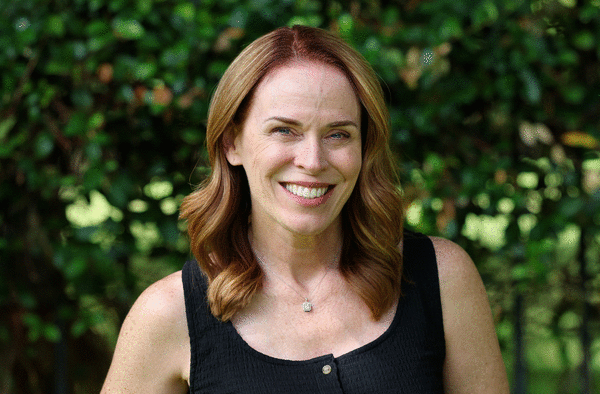
Elaine Parker is fed up with “skyrocketing” property tax bills propelled by soaring home values.
The east Orange County resident is also mad that local governments, even as they take in more tax revenue, have not made significant cuts to spending or lowered tax rates. So she’s made it her “passion” to advocate for Amendment 3, a proposal on the November ballot to reduce tax bills on homeowner’s primary residence.
Sonya Stevenson, who lives on the west side of Orlando, doesn’t buy it.
She thinks that Amendment 3 could save homeowners money on their property tax bills but expects that local governments will jack up fees — charging more for fire service, for example — to make up for lost tax revenue. That could hit seniors on fixed incomes particularly hard, she said.
“You’re not going to save money, because somebody has to pay for it,” said Stevenson, who plans to vote against the measure. “It’s basically a tax shift. You save on one end, but you pay on the other.”
Amendment 3 — which would create a $250,000 homestead exemption on primary homes by 2028 — could become one of the most consequential referendums to appear on Florida’s ballot in recent years, if approved by the required more than 60% of Florida voters on Nov. 3. As local residents interviewed by the Orlando Sentinel show, it is already one of the most divisive.
Increasing the homestead exemption from $50,000 to $250,000 for all non-school taxes could save homeowners thousands on their annual property tax bills. But it could devastate local city and county governments, slashing billions from the pots of money they now use to fix potholes, maintain parks, operate libraries, run police and fire departments and put on local festivals and Fourth of July celebrations.
The measure is backed by Republican leaders in the Florida Legislature and the Florida Realtor’s Association, which has contributed $10 million to lobbying for its passage, arguing that Amendment 3 will provide “meaningful property tax relief” and lift Florida’s housing market out of its slump.
But the proposal is opposed by most Central Florida’s elected officials and Florida sheriffs and firefighters. Even conservative law enforcement officers have called the tax rollback a “train wreck” and “draconian.” Republican Seminole County Sheriff Dennis Lemma said his agency would need to cut 300 positions if it passes.
And it has split county homeowners, some of whom hope for tax relief and others who fear a loss of services or a tax shift that will hurt renters, whose property owners will not benefit as the savings only applies to owner-occupied residences.
Linda Trocine, a Geneva resident who supports Amendment 3, says it’s time to let homeowners keep more of their money, and for government leaders to start cutting out the “fluff” projects from their budgets.
“What’s been their incentive to cut spending until now?” she said of local government officials.
Local officials have long contended that their ballooning budgets are the result of rising costs on everything from public safety salaries to fire trucks to construction materials. And they note all the core services they provide are primarily funded by property taxes.
State economists have projected that if approved, Amendment 3 would reduce local government property tax revenues by up to $12 billion annually by 2031.
Meghan McCollum uses Oviedo’s parks nearly every day and frequently has books delivered to her home from the public library — amenities she fears could be hampered if local budgets are slashed. Pickleball court hours could be reduced and park maintenance curtailed, she said.
“Property taxes are one of the few areas where we have a consistent revenue stream in this state,” McCollum said. “It takes money to run a government.”
She fears her fellow Oviedo residents could face a fire fee as well as higher costs on all sorts of other things, if property tax revenues diminish. Baseball and softball leagues, for example, might have to pay more to use city fields and “then pass those costs to you as part of your child’s Little League fees,” she said.
Even with current property taxes, cities have resorted to fees to fund some core services as costs rise.
But Ken Greenberg, a Winter Springs resident and former city commissioner, said he regularly takes a proverbial magnifying glass to the city’s budget, looking for unnecessary expenses.
“I know for a fact that there is a great deal of waste,” he said in favor of Amendment 3. “Cities have gotten very, very fat. They will spend whatever you give them.”
He downplayed the argument that Winter Springs is in an especially precarious situation if Amendment 3 passes, because it is about 90% residential.
“We’re not going to be closing the parks or eliminating the police department,” Greenberg said. “When you pull out the fluff from the budget, it’s a couple of million that we can easily cut back.”
Although Amendment 3 would give homeowners a tax break on their primary homes, Kevin Eaton fears it could put a strain on renters like him.
“If they’re not getting money that way, then they have to get it from somewhere else,” said Eaton, who works at Walt Disney World’s Animal Kingdom and rents a room in Kissimmee. “I’d have even less money to buy groceries to live. And I already live paycheck to paycheck.”
Rhonda Spencer — who rents an apartment in Orange County and works in food service at Lockheed Martin — agreed Amendment 3 would be bad news for residents like her.
“It would have the rent go up,” she said.
That’s because cities and counties could raise property taxes on commercial and rental properties to help offset the loss in revenues from homesteaded homes, and building owners would likely pass that hike on to tenants. Renters account for roughly one in three Florida households.
“It hurts so badly when you go into a grocery store, and you know what your kids like, but you can’t afford it,” she said. “And you have to tell your kids no.”
But Parker, the east Orange homeowner, is convinced Amendment 3 will help new homebuyers afford their first home. She points out that her daughter and son-in-law recently bought a house in Orlando and were shocked at how high their property taxes jumped compared to the previous owner’s.
“I’m watching young people, like my kids, struggle to afford a home,” she said. “Young people are currently being priced out of the market.”
_____
©2026 Orlando Sentinel. Visit orlandosentinel.com. Distributed by Tribune Content Agency, LLC.





Comments