Pelican Rapids, a turkey plant town of 2,600 in Minnesota, saw itself as welcoming to all. Then came ICE
Published in News & Features
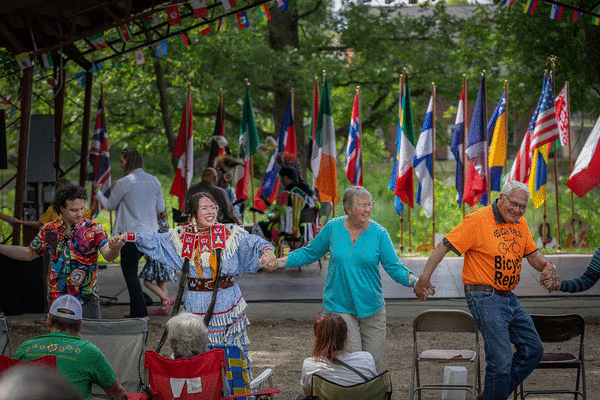
PELICAN RAPIDS, Minn. — Inside city hall in this meatpacking town, a giant banner shows how the immigrant-rich place of 2,600 people presents itself to the world.
“WELCOME TO OUR CITY,” it reads, over a photograph of the town’s 15-foot-tall riverside mascot, Pelican Pete. “SMALL-TOWN WARMTH AND DIVERSE DELIGHT.”
The Otter Tail County town is one of Minnesota’s most diverse spots thanks to the Jennie-O turkey plant, which employs 600 people. Only half the town’s population is white; more than a third is Latino, more than 10% Somali. It’s the type of Midwestern small town where dining options range from Dairy Queen or country-fried steak to birria, sambusas or stewed goat.
There have been bumpy times, but the story Pelican Rapids tells itself is an immigration success story of mutual benefit and neighborly harmony.
Then winter 2026 happened.
The statewide fraud scandal (which directly touched Pelican Rapids) gave the Trump administration pretext for its Minnesota immigration enforcement push. U.S. Immigration and Customs Enforcement detained thousands of immigrants statewide. Some even refused to leave their homes.
And in Pelican Rapids — a no-stoplight town nestled in one of the most conservative regions of Minnesota, an area where ICE-related chaos in the Twin Cities was largely portrayed as the consequences of liberalism run amok — many residents questioned whether their town was as welcoming as they’d long believed.
“We believe we care about all people,” said Staci Allmaras, a Pelican Rapids school board member and longtime educator. “That’s a core belief in this community. But you throw red and blue at it and that changes things.”
The world has moved on since Operation Metro Surge paralyzed Minnesota, but places like Pelican Rapids have been left to pick up the pieces. The ICE operation laid bare divisions in this town — where topics like money and politics are typically handled with Scandinavian reserve — that it had long managed not to confront.
As ICE supporters here dismiss winter 2026 as much ado about nothing, immigrants and their supporters confront an unsettling question: whether Pelican Rapids can still be the small-town immigrant haven they thought it was, or whether the winter revealed something about their neighbors that cannot be easily reconciled.
Immigrants have come here for generations. Rosie Murillo’s grandparents were the first Mexican family in Pelican Rapids, living in dorms next to the turkey plant after World War II. More immigrants followed: from Vietnam, Bosnia, Croatia, Somalia, Ukraine, all over Latin America. Newcomers helped Pelican Rapids grow — its population has increased nearly 40% since 1990 even as rural Minnesota’s population remained flat — while the town offered jobs and opportunity.
Immigrants and their supporters knew Pelican Rapids had been trending rightward: Barack Obama won by 12 percentage points here in 2012, then Donald Trump won by 17 percentage points in 2024.
But they thought their town — where white kids and Hispanics and Somalis grow up together, and where the mayor made multiple visits to immigrants’ hometowns in Mexico — was different.
When ICE showed up, one side cheered immigration enforcement, sometimes online, sometimes face to face. The other side marshaled forces to support immigrant neighbors, from Signal groups tracking federal agents to volunteers delivering groceries, diapers and medication.
“It brought out lots of feelings hidden deep in people’s hearts,” Murillo said. “I couldn’t believe it: ‘I went to school with you!’ ‘I worked with you!’ ‘You came to eat at restaurants where Mexicans or Nicaraguans or Hondurans work!’ And yet you have these thoughts against people like this. My heart was broken.”
Right-leaning folks here viewed winter 2026 differently, as if the panic itself was contagious: Liberals and mainstream media, this view went, primed immigrants to be afraid. Letters in the local newspaper implied ICE was indiscriminately going door to door, further inflaming tensions.
ICE detained fewer than 10 immigrants in Pelican Rapids, according to immigrant advocates in town.
“I didn’t see the things people were claiming,” said Kevin Ballard, a former City Council member who owns a local sanitation company. “There were people locked in their house and didn’t want to leave because they were afraid ICE was in town. Those same people were probably locked in their house and didn’t want to leave because of COVID. You can pick whatever fear. It was a big to-do about nothing. It’s the extremes pushing each other to further extremes.”
People who don’t know small-town Minnesota may presume it’s lily-white.
But pockets of diversity abound, often fueled by meatpacking or agricultural work. There’s Worthington and St. James, Long Prairie and Willmar, Windom and Marshall.
Immigration has brought growing pains to these small towns, but also an economic lifeline.
A 2020 study showed about 10% of all nonmetropolitan counties in the U.S. grew in the 2010s because of Hispanic population increases. A 2012 study indicated Hispanic population growth fueled economic growth in many rural communities whose populations declined in the 1970s and 1980s.
So when unmarked SUVs showed up in Pelican Rapids, some immigrants and their supporters expected a nuanced reaction.
“When ICE came to Pelican, a lot of people got louder, but many people stayed absolutely silent,” said Ivan Olson, who quit his chef job in winter to help area immigrants. “There was so much human suffering, yet a large contingent of people carried on like business as usual. This showed us we were a little more divided than we thought we were.”
Tensions seemed highest on Facebook.
In response to a Pelican Rapids Press story about anger toward the mayor, one woman wrote, “Here legally, no fear!”
“Americans now have to carry their birth certificate and you’re OK with that,” shot back another woman. “Welcome (to) WW2 Germany.”
It was no different from toxic online conversations happening all day, all over America, on all manner of topics.
Except small towns can’t afford anonymity.
“Normally in a small town you can agree to disagree, and you’re still friends,” said city administrator Lance Roisum, who was born and raised in Pelican Rapids. “But it got to an uncomfortable level, where if you don’t agree on something, you can’t be friends.”
“People saying things like all undocumented people are criminals — these are just people trying to go about their life, people who’ve been here forever,” said Nanette Albright, a Pelican Rapids librarian and vocal supporter of immigrants’ rights. “Was I just blind and thought things were getting better?”
State Sen. Jordan Rasmusson, a Republican who represents Pelican Rapids, saw this winter as part of a generations-long story of Minnesota, not much different from his ancestors coming to Otter Tail County from Norway in the 1870s and talking about maintaining Norwegian identity while becoming fully American.
“People in my area, it’s hard to comprehend why local law enforcement wouldn’t honor detainers, why they’d pursue sanctuary policies, why they’d pardon people with criminal backgrounds so they don’t face immigration enforcement,” Rasmusson said. “There were people with fear and concern about immigration action. But a fair amount of that was because of political rhetoric that encouraged people to be afraid.”
A few dozen people packed into Pelican Rapids’ library on a summer night months after the ICE surge upended lives here.
The town had resumed its routines. This Resisters group had not. Meeting attendance had exploded during the surge, and the momentum continued. They spoke of midterms looking good for Democrats.
Olson, the chef who’d quit his job to help immigrant families, tempered his enthusiasm. Both sides believe they are right in this moral crisis, he said, offering little room for common ground.
“There’s such a separation of realities with people’s news consumption,” Olson said. “I’ve always believed in what this town has sold itself on. Somewhere, we let that go. But I know this winter changed me. I’m never going back to viewing the world the same way.”
So much so that he’s running for mayor.
There are certainly extremes within Pelican Rapids: Those who see ICE as pure evil, those who see immigrants as deserving deportation.
“There’s not enough white people in Pelican anymore,” said Barney Nelson, 83 and a lifelong resident.
“I wasn’t ever racist — until all this crap started,” said his wife, Patty. “I think I am now.”
But more of Pelican Rapids rests in the uncomfortable middle. Like the retirees at Pelican Rapids Pool Hall on a recent morning.
Bob Bowers, 82, struck the cue ball while standing next to a replica of the biggest fish ever caught in the county, a 102-pound sturgeon speared in Lake Lida in 1948. Bowers is a disaffected Democrat who voted for Trump. Still, he hated what ICE did here.
“Hispanics here are hardworking people, take good care of their families,” Bowers said. “ICE came in and they were kind of brutal. I don’t have nothing against them people here. I hope they stay.”
“It’s hard to argue if they’re here illegally,” chimed in Steven Zimmerman, 77, a retired teacher, “but it’s our system that doesn’t allow them to become legal.”
Much of Pelican Rapids would prefer to talk about the good things happening: the new $5 million aquatic center, the new coffee shop, the single-home lots under construction to ease the housing shortage.
But immigrants and their supporters see this winter’s scars as slow to heal.
When Maria Cortes Franco, whose family immigrated from Mexico decades ago, thinks about winter 2026, she thinks about carrying her U.S. passport everywhere. She thinks about the 80 or so undocumented Nicaraguans who lost their jobs at the turkey plant. She thinks about churches canceling services for fear of ICE.
“A lot of people came out and shined their true colors,” she said. “A lot of people said it’s awesome ICE is here, that they should target the turkey plant. To me, it was shocking. I’m very grateful for the community who stood up with me. I’d go to Walmart, get people groceries or formula or diapers. I expected our whole community to come together and help out. But the community was so divided.”
“It was really hard to see and hear the cruelty towards our neighbors,” said Albright, the librarian. “It’s going to be a long time before I get over that. I love this town. I want to protect it. I’m hoping our town can heal and grow. We can’t just pretend it didn’t happen.”
_____
©2026 The Minnesota Star Tribune. Visit startribune.com. Distributed by Tribune Content Agency, LLC






Comments