Gov. JB Pritzker accepts suburban teachers union's endorsement while casting doubt on $150M CPS funding push
Published in News & Features
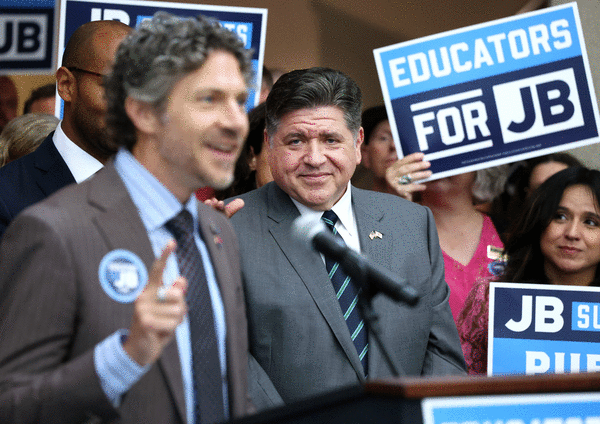
Gov. JB Pritzker accepted the backing of Illinois’ suburban teachers union Monday and then expressed skepticism about another union’s push for more Chicago Public Schools funding — arguing the state can’t afford to help Chicago alone without sending money to schools statewide.
“If you’d like, I can pull the pockets out of my trousers to show you that the state does not have dollars that are just laying around,” the billionaire governor said when asked about the $150 million CPS funding push. “And so, the question is, where can we find those dollars?”
The push for CPS funding is exposing fault lines ahead of the General Assembly’s fall veto session in November and December, setting up a potential fight over school funding when lawmakers return to Springfield.
Pritzker, a Democrat seeking a third term as governor, made the comments after accepting the endorsement of the Illinois Education Association, which describes itself as the state’s largest union and represents educators primarily outside of Chicago.
The IEA’s endorsement came just weeks after the CPS board, under pressure from the Chicago Teachers Union, made a high-stakes gamble in passing its nearly $10 billion budget with $150 million in additional state funding that isn’t currently allocated. The move has raised red flags among observers who have pointed out the state’s own budget for the fiscal year passed months ago.
Any deal to send CPS additional funding — whether through reprioritizing existing revenue or a new revenue source — would also need to be balanced against additional funding for schools statewide, Pritzker said.
“Remember, it’s near impossible to decide you’re going to do that and not also provide resources for schools all across the state of Illinois. So that isn’t just $150 million … Think about multiplying the number by three or four,” Pritzker said. “I don’t know where you find three or four times $150 million and not shortchange a lot of other important priorities within the budget.
“I say all that while recognizing that we are not yet funding our schools properly in the state,” he said.
IEA President Karl Goeke, speaking after the endorsement announcement Monday afternoon, denied that his union’s backing of the governor signaled any kind of political or priority divide with the Illinois Federation of Teachers or the CTU, both led by union power player Stacy Davis Gates, who has been sharply critical of Pritzker.
Goeke described the IEA’s endorsement as a separate process from IFT’s.
“Doesn’t mean that we’re at odds or anything. We’ve got a great working relationship. We’re at this point; they’re at a different point,” he said, adding later: “That’s not signaling a rift.”
Goeke declined to comment on the push for $150 million specifically for Chicago schools, saying, “I don’t know enough about that to be able to comment.”
Any immediate changes to the state’s spending plan would require a three-fifths supermajority in both the Illinois House and Senate, and several lawmakers — including many Democrats — have already signaled skepticism about passing the supplemental budget CPS is requesting.
State Rep. Daniel Didech, a Buffalo Grove Democrat, acknowledged he represents a district with some of the state’s best-funded schools. But he said the Chicago Board of Education, in passing its “unbalanced budget,” was “imprudently relying on the state of Illinois to change our entire budget process to fill the budget hole that they chose to create.”
“It creates a moral hazard, where now every local government, every school district in the state of Illinois, every not-for-profit that does something important, they’re going to pass out-of-balanced budgets over the summer, and force the state of Illinois to upend our entire budget process to resolve a crisis that they created,” Didech said.
Pritzker had already cast skepticism on the CPS proposal the day after the school board’s budget vote, saying: “There’s no revenue currently for what they’ve described.”
The CTU and its allies on the Chicago Board of Education describe the amended budget as a pressure tactic meant to force state lawmakers to act, arguing CPS is chronically underfunded by the state and that the revised amended 2026-27 spending plan would restore hundreds of positions lost to layoffs and shield classrooms from cuts.
Other CPS leaders, including CEO Macquline King, have issued sharp warnings about the risky budget maneuver, which was made shortly after Illinois House Speaker Emanuel “Chris” Welch suggested he’d work for additional funding, though it remained unclear where the money would come from. Welch made his comments as he has tried to shore up political support to stay speaker following questions over how he handled sexual harassment allegations involving former state Rep. Harry Benton, and he’s subsequently said he supports additional funding for schools outside Chicago as well.
Pritzker, in his first comments on the budget move, pointedly and repeatedly kept pressure on Welch, describing the additional state money as “revenue that’s expected that the speaker is planning to have a plan for, but we don’t know exactly how.”
On Monday, the governor reiterated that he had “not heard what the plan will be.”
He added he had not sought CTU’s endorsement and hadn’t been part of an endorsement process with the union.
Pritzker’s opponent in the November general election is Darren Bailey, a Republican who founded a “Christ-centered” private school.
The full Chicago Board of Education has voiced support for lobbying Springfield for additional state money. CPS is funded at just 70% of what it is owed under the state’s own evidence-based funding formula, which is designed to steer revenue toward the neediest districts in Illinois.
But while there’s broad agreement the district needs more funding, there’s far less consensus on how to get it. Some suburban Democrats say any conversation about additional funding should apply statewide, particularly if it’s tied to the state’s evidence-based funding formula.
“I do represent very low-income school districts. So I’m also extremely interested in seeing how we can obtain more money for my school districts, specifically,” said state Rep. Rita Mayfield, a Democrat from the Waukegan area. “Knowing that there will be a conversation in (the fall veto session), I will definitely have numbers for my specific school districts that will be necessary to bring my school districts up to adequacy.”
State Rep. Bob Morgan, a Democrat from Deerfield, agreed it would make sense for the funding efforts to be focused statewide and not just Chicago, saying, “I can’t recall a time in the last eight years where (the) veto session effort was so limited geographically.”
State Rep. Will Davis, a Democrat from Homewood who heads the House Appropriations Committee for K-12 public education, was among those who said the conversation needs to shift to funding all schools eligible for evidence-based funding, not just Chicago’s.
Chicago’s new school board members “should also understand that trying to do something of that magnitude only for them in veto session just doesn’t happen,” Davis said. “I appreciate their (willingness) to serve as an elected member of the school board, but (there are) just some educational pieces that they need to learn, so they understand how these government things flow.”
____
©2026 Chicago Tribune. Visit at chicagotribune.com. Distributed by Tribune Content Agency, LLC.






Comments