Corporate landlords get tax break meant for nonprofits. NC delays closing loophole
Published in News & Features
RALEIGH, N.C. — Lawmakers in North Carolina agree that a state property tax loophole is costing municipalities millions in tax revenue loss, but the legislature has yet to close it. Two state House members say that lobbying of the state Senate has contributed to the holdup.
The tax break is called the “Blue Ridge Housing” loophole, which allows for-profit businesses to avoid paying property taxes by sharing ownership of a property with a nonprofit. In North Carolina, nonprofit organizations are exempt from paying property taxes. However, there is no clear law that states how much of a property must be owned by a nonprofit for it to be considered owned by that nonprofit.
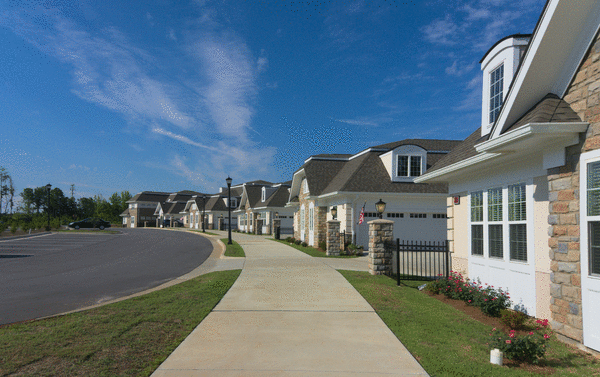
This means that if a nonprofit owns 1% of a property, a for-profit that owns 99% can claim nonprofit status and be exempt from property taxes. This allows private-equity investors to take majority ownership of property that starts out as affordable housing and raise rents, all while avoiding property tax.
Five North Carolina counties, among the most urban, have experienced roughly $60 million in annual property tax revenue loss because of the loophole, The News & Observer previously reported. And there’s been a “dramatic” increase in the number of applications for this exemption across the state, according to a report from the House Select Committee on Property Tax Reduction and Reform.
Although budget writers had the opportunity to include a policy to close the loophole in the state budget that passed in early July, it was left out. Rep. Erin Paré, a Holly Springs Republican and budget writer, said that the provision “didn’t make the cut” during budget negotiations between Senate leader Phil Berger and House Speaker Destin Hall.
Paré, who is also a co-chair of the House property tax committee, added that lobbyists representing “private sector interests” are raising concerns to senators, which may be giving them pause. A bill to close the loophole awaits a vote in the Senate after receiving a unanimous House vote.
“It’s a really good bill,” Paré told The N&O. “There’s a lot of support for it I know (in the Senate) as well. Whether there’s still some outstanding questions about it or concerns, and whether that will change ... the trajectory of passing the bill in the Senate, remains to be seen.”
Paré said that the House, unlike the Senate, had the advantage of having a committee that researched the topic extensively, which allowed representatives ample time to understand the loophole.
This loophole, Paré said, burdens residents by increasing their property tax responsibilities. The tax exemption, Paré said, is intended for “legitimate” affordable housing and not for for-profits.
Rep. Julia Howard, a Mocksville Republican, said the fact that for-profits can exploit this loophole “is just wrong.” Howard, who co-chairs the committee with Paré, said that she will continue to fight to fix the loophole.
“(The current loophole) absolutely ... makes no sense,” Howard told The N&O. “(For-profits) are playing by the current rules, but the rules are wrong right now.”
Paré and Howard said that questions have been raised about whether for-profit businesses that already have the property tax exemption through the loophole could be exempt if the bill passed. Paré said the General Assembly’s legal team determined that that is unconstitutional.
Howard said that she is not hopeful that the legislature will pass the bill before the end of the current session. Now that the budget has become law, lawmakers are likely to spend less time meeting and voting.
But Paré said that she believes there may be a few opportunities to pass it when lawmakers return to the legislature in late July.
The loophole gets its name from Blue Ridge Housing of Bakersville LLC, a for-profit company that received the property tax exemption even though it owned 99% of an apartment complex. It shared just 1% ownership with a nonprofit and also used federal housing tax credits and other forms of federal assistance to construct the compex.
Mitchell County’s tax office overturned the exemption, prompting Blue Ridge Housing to file a lawsuit.
In 2013, the North Carolina Court of Appeals ruled in Blue Ridge Housing’s favor, stating that the law does not designate how much of a property must be owned by a nonprofit to qualify for the exemption.
©2026 The News & Observer. Visit at newsobserver.com. Distributed at Tribune Content Agency, LLC.




Comments