Federal appeals court upholds Illinois assault weapons ban, overturning lower court ruling
Published in News & Features
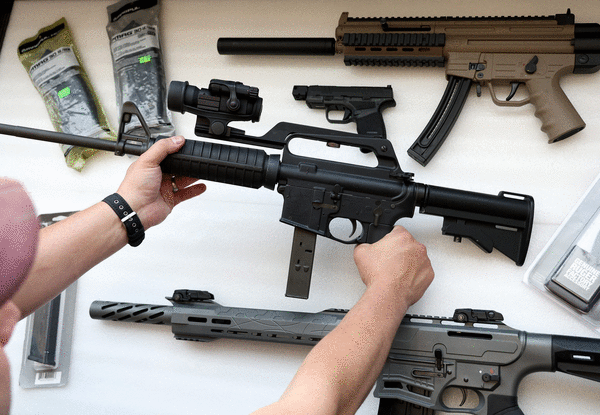
CHICAGO — A federal appeals court in Chicago on Thursday upheld Illinois’ 2023 assault weapons ban, overturning a lower court decision and delivering what could be a short-lived victory to Democratic Gov. JB Pritzker.
In a 2-1 decision, a three-judge panel of the U.S. 7th Circuit Court of Appeals ruled the Illinois law, which also prohibits high-capacity ammunition magazines is “consistent with our regulatory tradition” and does not violate the Second Amendment right to bear arms.
“Whatever else may be contributing to America’s mass-shooting epidemic, the record makes one thing clear: The more people killed, the more likely it is that the killer used an assault weapon and large-capacity magazines,” Appellate Judge Amy St. Eve, who was nominated to the court by President Donald Trump, wrote for the majority.
The majority opinion from St. Eve and Judge Frank Easterbook, a nominee of Republican President Ronald Reagan, sends the case back to U.S. District Court in southern Illinois with instructions to rule in favor of the state of Illinois.
The ruling represents a significant victory for gun control groups and leading Democratic officials, including Pritzker, who pushed for the ban on a long list of high-powered semiautomatic weapons and high-capacity ammunition magazines after a mass shooting at Highland Park’s Fourth of July parade in 2022 that killed seven people and injured dozens more.
The longevity of that victory remains in question, however, after the U.S. Supreme Court indicated last week that it would take up legal challenges to similar laws in Cook County and the state of Connecticut.
The challenge to the Illinois law is based on landmark Second Amendment cases decided by the high court, including the 2022 decision in New York State Rifle & Pistol Association v. Bruen. In that case, the 6-3 conservative majority ruled that modern gun laws must be rooted in the nation’s historical tradition of firearm regulation. Key to that determination is whether gun laws are historically consistent with laws on the books in the 18th century, when the Bill of Rights was ratified.
In its 44-page opinion, the appeals court found it was “appropriate to take a more nuanced approach to the historical inquiry” and that differences between the Illinois law and past rulings cited in the legal challenge were “less material in light of the dramatic technological changes and unprecedented societal concerns that have taken root since the Founding and Reconstruction eras.”
Illinois Attorney General Kwame Raoul’s office, which has been tasked defending against challenges to the gun ban, has argued the prohibited weapons are not considered “arms” under the Second Amendment and that they possess the same qualities as military weapons that are not commonly used for self-defense.
Illinois Deputy Solicitor General Sarah Hunger argued during the September oral arguments that the prohibited guns, particularly AR-15s, should not be typical for civilian use and that if the courts say it’s constitutional for the courts to ban automatic weapons, the same principle applies to semiautomatic weapons.
“Mass shootings are a very specific type of event and this law was enacted to prevent this type of shooting,” Hunger said during the hearing.
In challenging the law, gun rights groups, including the National Shooting Sports Foundation, have cited the Bruen case to argue Illinois’ ban on many semiautomatic guns — requiring the trigger to be pulled once per round — is too broad because it doesn’t protect guns that are commonly used by law-abiding citizens, including AR-15- and AK-47-type guns that are subject to the Illinois ban.
While the Trump administration is not a party to the case, Harmeet Dhillon, the U.S. Justice Department’s assistant attorney general for civil rights, argued before the 7th Circuit in September that the nation has a “strong interest” in ensuring that the Second Amendment’s right to bear arms is “not relegated to a second-class right.” She criticized claims from state officials that certain guns covered by Illinois’ ban are suited more for military operations than routine self-defense.
“The United States position is that AR-15s and similar weapons are clearly ‘arms’ that are protected by the Second Amendment. They are not militaristic,” said Dhillon, who had also been a Fox News personality and is a former vice chair of the California GOP. “The militaristic analysis is not even a correct rule to apply. It is not found in Supreme Court precedent. It is not appropriate historically. And it is not appropriate in the context of today.”
Dhillon’s participation in oral arguments was an indication of just how far the Trump administration is willing to go to fight Illinois’ gun ban. Pritzker, who is running for a third term as governor and has been an outspoken opponent of Trump, has repeatedly defended the law as constitutional, reasonable and necessary.
Aside from the president’s administration inserting itself into the legal fight, Justice Clarence Thomas, whose long been part of the U.S. Supreme Court’s conservative wing, indicated in court papers in July 2024 that the Illinois weapons ban is “highly suspect” and the high court should accept the full case if it comes back for review.
Pritzker, who is also considered a potential contender for the 2028 Democratic presidential nomination, signed into law the ban on so-called assault weapons in January 2023, six months after the mass shooting in Highland Park. The law prohibits more than 100 semiautomatic rifles, handguns and shotguns, high-capacity magazines and other accessories, and requires gun owners who possessed these weapons prior to the ban to register them with the Illinois State Police.
The gun ban has withstood a number of legal challenges.
U.S. District Judge Stephen McGlynn, nominated to the bench by Trump during his first term, granted a motion from gun rights groups in April 2023 to temporarily block the enforcement of the gun ban. His ruling was overturned later in the year by the 7th U.S. Circuit that found in a 2-1 vote “there is a long tradition, unchanged from the time when the Second Amendment was added to the Constitution, supporting a distinction between weapons and accessories designed for military or law-enforcement use, and weapons designed for personal use.”
But at that time, the appeals court noted its opinion dealt only with a preliminary injunction from the lower court and did not “rule definitively on the constitutionality” of the state and local laws at issue.
____
©2026 Chicago Tribune. Visit at chicagotribune.com. Distributed by Tribune Content Agency, LLC.





Comments