Khamenei's funeral concluded amid renewed US, Iran fighting
Published in News & Features
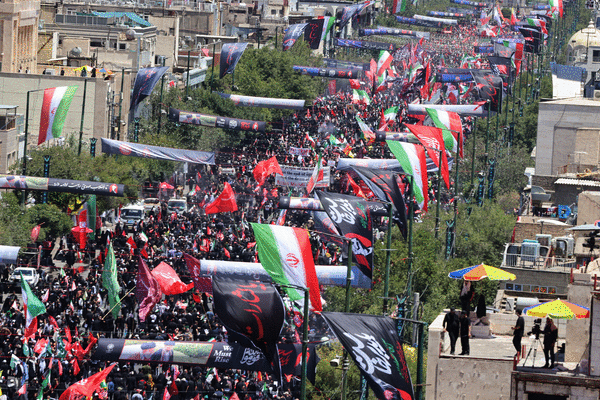
Iran concluded the funeral of its slain Supreme Leader, Ayatollah Ali Khamenei, more than four months after he was assassinated in U.S.-Israeli airstrikes and amid renewed fighting with the U.S.
Khamenei was laid to rest on Thursday in the northeastern city of Mashhad at the shrine of Imam Reza, one of Shia Islam’s most prominent sites, among huge crowds of followers who filled the surrounding streets. The burial tops six days of carefully organized ceremonies and mourning rituals, fashioned as a show of strength and defiance from the Islamic Republic in the face of a war that was intended to topple it.
The funeral procession spanned five cities in both Iran and Iraq and was preceded by a smaller gathering that drew in officials from key backers like China, Russia and India. Some Gulf Arab countries targeted in Tehran’s retaliation early on in the war also sent representatives.
As the ceremony wound down, Khamenei’s son and successor remained in hiding, in a sign of unease as an interim peace agreement between the U.S. and Iran faces its biggest test. Mojtaba Khamenei has not been seen in public or appeared on video since being named as the new leader, sparking questions over his health and involvement in negotiations with the U.S.
On Wednesday night, U.S. President Donald Trump ordered strikes on Iran for a second straight day, hitting multiple sites in the heart of the country after saying he considered the ceasefire “over.” Two railway bridges on a route leading to Mashhad were among the reported targets. Iran fired missiles at U.S. allies in the Persian Gulf in response, including Bahrain and Kuwait.
The tit-for-tat attacks stoked concerns over the potential for a return to a war that’s killed thousands of civilians — the vast majority in Lebanon and Iran — and sent shock-waves through the global economy. It’s unclear whether negotiations between the U.S. and Iran will resume after being halted for the funeral.
Khamenei’s casket traveled across Iran and neighboring Iraq, where Iranian state media said millions of Shia Muslims gathered for processions in the holy cities of Karbala and Najaf.
On Thursday morning, his body — along with family members killed alongside him, including his 14-month-old granddaughter — was flown to Mashhad, his birthplace and one of Iran’s holiest cities. Iranian state TV showed large crowds of black-clad mourners filling the wide boulevards that lead to the shrine.
The heavily organized and televised events underscored the U.S. and Israel’s failure to dislodge the theocratic governance system that the 86-year-old cleric pioneered and presided over for almost four decades.
Processions in Iraq, home to a large Shia population, served to highlight how his death and the war haven’t diminished support in a region whose geopolitics Khamenei helped shape and where he’s wielded significant political and spiritual influence.
Even if, at home, he faced several rounds of protests, the latest of which earlier this year. Thousands were killed in the crackdown that followed demonstrations against a deepening cost-of-living crisis in a nation squeezed by sanctions.
The funeral marks the official close of the powerful cleric’s era and renews the focus on the younger Khamenei and how he will shape the country while at war with the U.S.
His father’s death on Feb. 28 and the subsequent conflict reshaped Iran’s leadership, with power no longer gravitating around one central figure but rather a mosaic of decision-makers — powerful bodies and individuals like the Islamic Revolutionary Guard Corps and parliamentary speaker Mohammad Bagher Ghalibaf.
Internal tensions between Iran’s hard-liners, opposed to talks and critical of the memorandum of understanding signed last month, and pragmatists, who want to prioritize Iran’s economic recovery, surfaced at Khamenei’s funeral earlier in the week.
President Masoud Pezeshkian, who is broadly in charge of managing economic decisions for the country and whom Mojtaba Khamenei has said is ultimately responsible for the MoU, was seen being heckled by hard-liners at the funeral procession in Tehran on Tuesday, according to unverified footage shared on social media.
_____
©2026 Bloomberg L.P. Visit bloomberg.com. Distributed by Tribune Content Agency, LLC.



Comments