Federal judge emerges as a check on Trump's Minnesota immigration crackdown
Published in News & Features
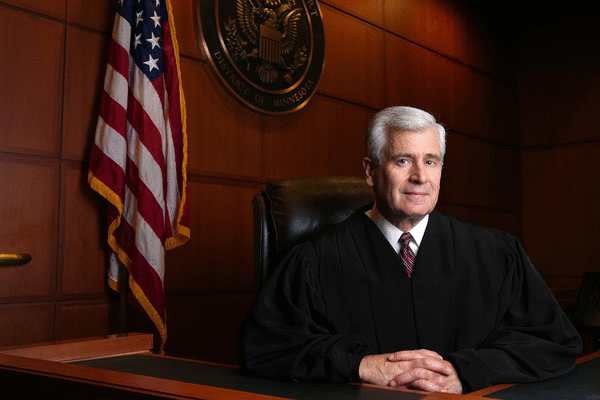
MINNEAPOLIS — In the first half of 2026, Minnesota’s chief federal judge Patrick Schiltz quickly emerged as one of the most critical voices of the Trump administration’s mass deportation campaign in Minnesota, Operation Metro Surge.
Throughout a series of orders, Schiltz, a George W. Bush appointee, showed his growing frustration with the U.S. government over flouted court orders tied to immigration cases that placed tremendous strain on the courts.
On Monday, Schiltz issued another blistering ruling, this time blocking a half dozen subpoenas sought by the Justice Department against several Minnesota elected officials.
Schiltz’s remarks stood in stark contrast to the low profile Schiltz once told the Minnesota Star Tribune he hoped to take on when he took the position in 2022.
“He’s the consummate judge where it’s all about getting it right. And I think he’s really committed to that,” said Carl Tobias, a law professor at the University of Richmond, told the Minnesota Star Tribune Monday.
Schiltz is a Duluth native and Harvard Law graduate whose rise to judgeship was spent swirling in conservative circles.
After graduation, he clerked for Antonin Scalia — first at the U.S. Court of Appeals in the District of Columbia Circuit and again upon Scalia’s nomination to the U.S. Supreme Court, according to a biography written by his own clerk. He was supposed to clerk for Justice Sandra Day O’Connor, but pivoted to Scalia instead, and sat in the immediate row behind the late conservative justice upon his official nomination.
After serving a stint in private practice in Minneapolis, Schiltz left to teach at the University of Notre Dame Law School in the mid-1990s. There, he taught future Supreme Court Justice Amy Coney Barrett.
He returned to Minnesota in 2000 to become a founding associate dean at the University of St. Thomas Law School. Five years later, a vacancy opened up on the U.S. District of Minnesota’s federal bench. Schiltz applied and was appointed to the job. Scalia was in attendance when he was sworn in.
Schiltz became Minnesota’s chief judge on the heels of a tumultuous time for Minneapolis and its courts. The COVID-19 pandemic disrupted proceedings across the country.
After assuming the role, Schiltz oversaw the high-profile sex trafficking trial of former GOP operative Anton Lazzaro as well as sentencing for a defendant who pleaded guilty to torching a Minneapolis police station in 2020.
He previously told the Minnesota Star Tribune that judicial security remained one of his highest concerns at the time he took over the position.
“There is a much more poisonous, angry atmosphere out there we are functioning in,” he said at the time.
He reiterated similar concerns again this year as threats and harassment against Minnesota’s federal judges saw another peak this year during Operation Metro Surge.
Operation Metro Surge and the strain it placed on the courts have largely shaped the last several months of Schiltz’s tenure as chief judge.
The tension reached an unprecedented height in January when Schiltz summoned the former head of ICE to his courtroom, saying his patience was “at an end” over numerous violations of court orders. He ultimately canceled the hearing when the U.S. government fulfilled his conditions, but Schiltz said his apprehension persisted.
“ICE has likely violated more court orders in January 2026 than some federal agencies have violated in their entire existence,” Schiltz wrote.
One month later, Schiltz repeated his concerns and threatened to hold U.S. officials in criminal contempt if the violations continued.
“Increasingly, this court has had to resort to using the threat of civil contempt to force ICE to comply with orders. This court is not aware of another occasion in the history of the United States in which a federal court has had to threaten contempt — again and again and again — to force the United States government to comply with court orders," Schiltz wrote. “This court will continue to do whatever is required to protect the rule of law, including, if necessary, moving to the use of criminal contempt. One way or another, ICE will comply with this court’s orders.”
©2026 The Minnesota Star Tribune. Visit at startribune.com. Distributed by Tribune Content Agency, LLC.






Comments