Drug users don't lose their gun rights, Supreme Court rules
Published in News & Features
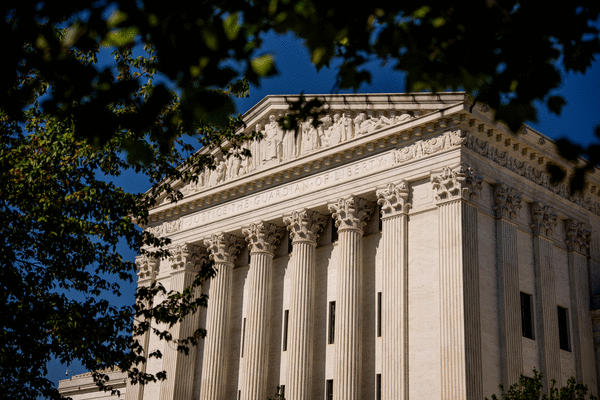
WASHINGTON — The Supreme Court ruled for gun rights and against drug laws on Thursday, striking down part of a federal law that made it crime for an “unlawful user” of an illegal drug like marijuana to own firearms.
All nine justices agreed the law was too broad and overly harsh.
They left open the possibly that “addicts” and “unusually dangerous” people who were impaired by drugs could be denied guns.
The Trump administration had urged the court to uphold the prosecution of Ali Hemani, a Texas man who was investigated for alleged terrorist ties and admitted to being a regular user of marijuana.
Since 1968, federal law has prohibited gun possession by felons, fugitives and any other person is “an unlawful user of or addicted to any controlled substance.”
In defense of the law, Solicitor Gen. D. John Sauer argued that “habitual” drugs users were akin to “habitual drunkards” in early American history, and could therefore be denied the gun rights protected by the 2nd Amendment.
But that historical argument fell flat, including with the court’s conservatives.
Justice Neil M. Gorsuch is a skeptic of laws that gives prosecutors broad and unchecked power.
“The law automatically bans an individual from possessing a gun from the moment he becomes an unlawful user of any controlled substance until he ceases being one,” he wrote in U.S. vs. Hemani. “It doesn’t matter what controlled substance an individual uses, in what amounts he does so, or whether his drug use has ever made him a danger to himself or others.”
The government’s view “suggests that the millions of Americans who now regularly use marijuana are categorically and unusually dangerous.”
And a conviction can lead to a 15-year prison term, he added.
The American Civil Liberties Union welcomed the ruling.
“The court has sent a strong message that the government cannot criminalize the conduct of large numbers of people by making categorical and unfounded assumptions about whether they are dangerous,” said Cecillia Wang, legal director at the ACLU. “With nearly half of Americans reporting marijuana use at some point in their lives, this ruling protects the rights of millions and curbs the government’s ability to impose arbitrary and discriminatory penalties.”
Some defenders of gun regulation opposed the ruling.
“We disagree with the Supreme Court’s ruling in Hemani,” said Janet Carter, managing director of 2nd Amendment litigation at Everytown Law. “That said, the court has stressed that its decision is limited — rightly recognizing that drugs and guns can make for a dangerous mix, and leaving open the possibility of prosecuting someone with proof that their drug use renders their gun possession dangerous to themselves or others.”
Two years ago, Hunter Biden, the president’s son, was charged and convicted under the gun law for making a false statement when he applied for a gun permit. He denied being a drug user at a time when prosecutors said he was addicted to crack cocaine.
Then-President Biden gave him a full pardon in December 2024.
Hemani was investigated by the FBI for suspected ties to terrorists but was not charged with such a crime.
In 2020, he and his parents and his parents “traveled to Iran to participate in a celebration of the life of Qasem [Suleimani], an Iranian general and terrorist who had been killed by an American drone strike the month before,” the administration told the court last year.
The FBI obtained a warrant to search Hemani’s family home. Agents found a Glock 9-millimeter pistol, 60 grams of marijuana and 4.7 grams of cocaine.
When questioned, Hemani said he used marijuana about every other day.
A federal grand jury in Texas charged him with possessing a firearm as an unlawful habitual user of marijuana.
But the 5th Circuit Court of Appeals ruled this restriction on guns violated the 2nd Amendment. It said that “there is no historical justification for disarming a sober citizen not presently under an impairing influence.”
Appealing to the Supreme Court, the Trump administration urged the justices to uphold the law.
“Habitual illegal drug users with firearms present unique dangers to society — especially because they pose a grave risk of armed, hostile encounters with police officers while impaired,” the solicitor general said.
But the justices affirmed the 5th Circuit’s decision.
Still pending before the court is a 2nd Amendment challenge to new laws in Hawaii and California that would prohibit carrying guns into private businesses unless the owner or manager had given their express approval.
Gun rights advocates said such laws, if enforced, are intended to deny their rights to carry concealed weapons when they leave home. The case is Wolford vs Lopez.
The justices will issue decisions next Tuesday and Thursday.
©2026 Los Angeles Times. Visit at latimes.com. Distributed by Tribune Content Agency, LLC.






Comments