FBI records raise new questions about uncharged player in multimillion-dollar food fraud
Published in News & Features
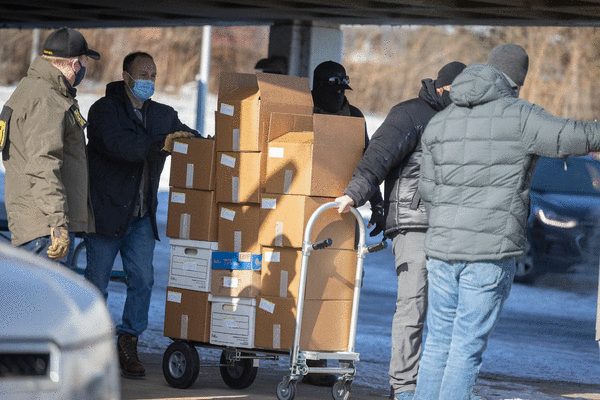
MINNEAPOLIS — A few days after the FBI raided the headquarters of Feeding Our Future and the home of its leader, Aimee Bock, federal authorities raided Partners in Nutrition, Bock’s biggest competitor and another suspected sponsor of fraudulent meal sites.
But the nature and outcome of those visits in 2022 were starkly different.
After questioning Bock, FBI agents left with her laptop, $13,000 in cash and boxes of incriminating documents that helped the government convict her and dozens of business associates of looting $250 million from a federally funded meals program.
But when FBI agents visited Partners in Nutrition, or PIN, they were met by an attorney, who told them to avoid speaking to the firm’s founder and chief executive, Kara Lomen.
FBI agent Jared Kary later testified in court that he and other agents eventually left the St. Paul nonprofit without key documents. They never interviewed Lomen about her role in the nonprofit approving nearly $100 million in payments to men and women who falsely claimed to be feeding thousands of needy kids each day.
Several meal sites operators later convicted of fraud told FBI agents that Lomen participated in the scheme, according to FBI interviews recently obtained by the Minnesota Star Tribune. A former PIN employee also told federal investigators that Lomen took kickbacks from fraudsters in exchange for her help in obtaining millions of dollars in government funds and paid employees to keep them quiet.
The documents raise new questions from state lawmakers and others as to how Lomen and PIN avoided criminal charges for doing the same thing Feeding our Future did: sponsoring fraudulent meal sites and failing to deny grossly inflated claims about the number of children being served.
Instead, PIN has remained in a strange legal limbo. The nonprofit is sitting on $18 million in cash earned by sponsoring hundreds of meal sites across Minnesota, many of which turned out to be fake. So far, the only penalty it faced was in 2024 when the Minnesota Department of Education barred the organization, Lomen and seven other employees from participating in the meals program for at least seven years.
Lomen declined interview requests. Her attorney, Brett Kelley, said his client denies the allegations.
“Kara did not receive kickbacks, authorize kickbacks or participate in any kickbacks or ‘hush money’ arrangement,” Kelley said in a written response to questions.
The records also cast fresh doubts on the ability of Minnesota regulators to police or prevent fraud in federally funded programs. Federal investigative records show frontline regulators at the Education Department were deeply suspicious of Partners in Nutrition, with officials noting irregularities as early as October 2020.
State officials failed to act on those concerns.
Former U.S. Attorney Andy Luger, who prosecuted 70 people for defrauding the meals program from 2022 to 2025, said federal rules bar him from explaining why his office declined to press charges against Lomen or other PIN officials.
“I am proud of the work of our highly motivated and dedicated prosecutors, who brought decades of experience to their meticulous work to bring these important cases,” Luger said in a written response to questions. “Federal law does not allow me to explain our charging decisions. But we did the right thing, every day, in every case.”
Attorneys involved in the investigation said it is unlikely federal officials will bring charges against PIN now that the local U.S. Attorney’s Office has deferred action to the Minnesota Attorney General’s Office, which is pursuing a civil fraud case.
Before they became rivals, Bock and Lomen worked together at Partners in Nutrition. In 2018, Bock’s tenure as the nonprofit’s executive director ended after she was fired for unspecified “misconduct,” according to a letter Lomen wrote to regulators.
In a 2026 interview with the Star Tribune, Bock claimed she was fired after raising objections about Lomen’s romantic relationship with a co-worker, Julius Scarver, arguing that it should be disclosed to state regulators and that Lomen should be removed as Scarver’s direct supervisor.
Bock didn’t leave empty-handed. Over Lomen’s objections, Bock assumed control of Feeding Our Future, a dormant nonprofit created by PIN leaders in the event it didn’t win approval to participate in the meals program from the Department of Education.
Under Bock’s leadership, Feeding Our Future became a major player in the program, in part by taking dozens of sites from PIN, state records show. Partners in Nutrition complained that Feeding Our Future was breaking the rules by initiating contact with its providers, but state regulators dismissed the complaint in 2020, saying the allegations “could not be substantiated,” records show.
Lomen then allegedly shifted tactics to maintain market share. Scarver told the FBI in 2022 that competition between the two nonprofits was devastating for PIN, which he said was struggling to keep its doors open in 2020. “To stay in business, PIN joined FOF in the fraud scheme,” Scarver told investigators.
One of PIN’s most important collaborators, according to court records, was Empire Cuisine & Market, a Shakopee restaurant and catering business co-owned by Abdiaziz Farah. Altogether, Empire received nearly $30 million from PIN by inflating its invoices, according to court records. Farah was convicted of fraud and sentenced to 28 years in prison.
At Farah’s trial in 2024, prosecutors provided evidence showing he provided a kickback of $10,000 to Scarver. U.S. District Judge Nancy Brasel allowed the evidence after ruling the government proved by a preponderance of the evidence that Lomen was a member of the criminal conspiracy.
In his closing argument, former Assistant U.S. Attorney Joe Thompson explained Scarver’s role in the scheme and the reason for the kickbacks: “They needed him to get these fraudulent claims submitted. … They needed him to grease the skids with Kara Lomen. And that is exactly what he did.”
Thompson declined an interview request through a spokesperson.
Prosecutors also provided evidence showing PIN approved $2.5 million in payments to Scarver’s company, the Free Minded Institute, for its participation in the meals program. Witnesses testified that nearly all of the money was diverted to other conspirators instead of being spent on providing meals, while Scarver was supposed to keep 5% of the overall proceeds.
Scarver told federal investigators that Lomen knew his nonprofit would engage in fraud and helped him set up the organization. Scarver said nobody from PIN ever inspected his meal sites because “there was nothing to inspect,” according to the FBI report.
“When the checks first started coming in, Scarver thought ‘holy shit,’ this is out of hand and we’re going to get in trouble,” according to the FBI’s report based on a 2024 interview with Scarver.
Other conspirators provided information to federal investigators that corroborated Scarver’s claims.
Anab Awad, who pled guilty to stealing nearly $10 million by defrauding the meals program, described Kara Lomen as a “devil” in her interview with the FBI, saying Lomen repeatedly pressured her to increase her reimbursement claims, in some cases by making up numbers for days in which she was not on site to record attendance.
Convicted fraudster Haji Salad told the FBI that he paid “north of $60,000” in kickbacks to Lomen, saying he initially made these payments through Scarver and later made them directly to Lomen.
Salad’s companies — including Haji’s Kitchen and U.S. Halal Foods — fraudulently obtained more than $11 million from PIN, according to court records. He told investigators that he paid kickbacks to Lomen so that his “paperwork would get processed or be moved to the top of the pile.”
“To stay on good terms with Lomen, Salad provided a variety of services, paid for items and provided cash to Lomen,” Salad told FBI agents in 2022, according to an internal report documenting the interview. “Salad recalled he withdrew over $10,000 one time around Lomen’s birthday to provide her a big birthday present. Salad gave Lomen cash directly and told her to have a good birthday.”
Scarver told investigators that he personally received an $8,000 Chevy Avalanche from Salad when he did not have a car. Scarver called it a “bribe,” noting he showed Salad how to “get away” with defrauding the program.
Scarver and Salad told investigators that Lomen became worried about the size of the scheme in 2021, when PIN received more than $190 million from the Education Department, nine times higher than what it received a year earlier. Instead of letting conspirators bill the state for 2,000 meals a day at a single site, Scarver said, PIN would set up four sites claiming 500 meals each.
To keep her employees from discussing the nonprofit’s fraudulent practices, Scarver told investigators, Lomen handed out five-figure bonuses in October 2021. Scarver told the FBI he and Lomen broke up in 2022 “because of everything that was going on with the investigation.”
PIN employee Xavier Munoz confirmed the payments, telling investigators that he and a co-worker each received bonuses of $29,000 in October 2021. Munoz later sent an anonymous whistleblower complaint to the FBI alerting them to fraud at PIN, estimating that at least 60% of the sites overseen by the nonprofit were fraudulent, according to his interview with federal investigators. He said he had shared his concerns with Lomen but never saw anything done to address his concerns.
Kelley said the five-figure payments to employees reflected “salary increases” for people who worked “extraordinary hours” during the pandemic. He said the payments were made in a lump sum, retroactively, once they were approved by state regulators in 2021.
Kelley said Lomen deserves credit for being the “original whistleblower,” noting Lomen filed complaints against Bock and Feeding Our Future with state and federal authorities, beginning in 2018.
“If MDE and state authorities had fully investigated her complaint back then, that likely would have prevented Bock and Feeding Our Future from receiving a single dollar of public funds,” Kelley said in a written response to questions. “Federal prosecutors fully investigated, decided not to charge Kara, and have no intent to charge her.”
Kelley said Lomen has not worked for PIN since 2022. The organization has no other employees and appears inactive, according to recent tax filings.
Scarver, who has not been criminally charged, did not respond to interview requests. The Star Tribune provided a detailed summary of Scarver’s statements to his attorney, Dan Adkins, who did not challenge their authenticity.
“Julius Scarver was investigated for more than a year, cooperated fully and effectively, and with all its resources and investigative findings, the Government through the United States Attorney’s Office in Minnesota declined to charge him with any crime,” Adkins said in a written response to questions. “That decision, which has not been revisited (nor will it), speaks volumes, without need for further clarification.”
Rep. Kristin Robbins, R-Maple Grove, who chairs the House Fraud Prevention Committee, said the FBI reports and court evidence are “incredibly damning.”
“I wish I knew why they weren’t charged,” said Robbins, who criticized the U.S. Attorney’s Office and the Minnesota Attorney General’s Office at a legislative hearing in April for not taking action against Partners in Nutrition. “I don’t know why (Scarver) is not in jail. And Lomen.”
For her part, Bock told the Star Tribune last month that she’s angry that nobody from PIN was criminally charged because it makes it look like she’s the only “mastermind” who ripped off the meals program.
“I would say they are guiltier than myself or my organization,” Bock said from the Sherburne County jail. “But I’m the individual sitting here in my green outfit, behind bars.”
As Lomen’s concerns about a possible federal investigation grew, witnesses told investigators, she tried to keep regulators focused on Feeding Our Future.
Salad told the FBI that Lomen encouraged him to file anonymous complaints about “questionable” meal sites operated by Feeding Our Future.
“Lomen knew Bock was doing the same thing they were doing, she just wanted Bock reported,” Salad told investigators, according to the report.
Altogether, Lomen and PIN filed more than a dozen complaints against Feeding Our Future with state regulators, according to a 2024 report by the Legislative Auditor. PIN also was the first to alert the FBI to the fraud at Feeding Our Future, beating state regulators by two months, an FBI agent later testified.
The state auditor’s report noted that MDE handled many complaints by “inappropriately” asking Feeding Our Future to “investigate itself.”
“Unless there is a conviction for any business-related offense, or the organization is no longer in good standing with the IRS, I prefer not to be kept informed of developments related to the dispute” an MDE official told PIN in 2018 after Lomen accused Bock of forging her signature on corporate records.
MDE officials later told federal investigators that they were so concerned about the growth of PIN’s meal business that they brought Lomen in for weekly meetings, where she was grilled about the huge numbers of children who were supposedly being fed at her sites. Camille Jones, a meals program coordinator at the department, said Lomen repeatedly promised to reduce questionable claims but never did.
Jones told federal investigators in 2022 that she did not see how PIN was not involved in criminal activity. Her question in the wake of the January 2022 raids on Feeding Our Future was: “What about PIN?”
In administrative proceedings, state officials have blamed PIN for handing out millions of dollars to fraudsters, saying the organization “abjectly failed” to properly monitor the program.
In 2025, Assistant Attorney General Joe Weiner said the organization’s claims were implausible on their face, noting PIN claimed to be feeding 600,000 children a day when there were just 850,000 children in the entire state at the time.
PIN challenged its termination in the meals program, claiming it was never given a proper chance to remedy any oversight weaknesses. But the Minnesota Supreme Court rejected that appeal in 2025.
Altogether, the Minnesota U.S. Attorney’s Office filed charges against 22 people who collectively received $99.2 million in fraudulent proceeds from Partners in Nutrition, according to a Star Tribune review of the charges and related records. So far, 17 of those people have been convicted or pleaded guilty.
Attorney Ben Eastburn, who represents PIN, declined to comment after being given a detailed list of the Star Tribune’s findings.
Several former prosecutors, including former U.S. Attorney B. Todd Jones, said they were surprised the government chose not to file charges against anybody at PIN given the allegations against the nonprofit’s leaders. But they said it would have been a challenging case to handle at the same time the government was prosecuting Bock and dozens of other conspirators.
“These are not easy cases to bring,” said Jones, who oversaw the successful prosecution of Tom Petters on a $3.65 billion Ponzi scheme in 2009. “I don’t know why they haven’t been charged. It could be a whole variety of things.”
One of the challenges may have been getting key witnesses to testify in open court. Paul Applebaum, who represents Salad, said his client made it clear that he had no intention to testify against anyone else who may have been involved in the scam.
“His sole motivation was to communicate early on his acceptance of responsibility for his conduct,” Applebaum said in a written response to questions. “Whatever considerations the government weighed in making charging decisions relating to other targets were of no concern to Haji.”
Federal prosecutor Joe Teirab, who recently rejoined the local U.S. Attorney’s Office as second-in-command to U.S. Attorney Dan Rosen, declined to comment on the possibility of future charges against anyone at PIN.
“This office has led the nation in prosecuting fraud against government programs,” Teirab said. “Regarding the charging decisions that you asked about, we refer you to the lawyers who made those decisions and who are no longer in the office.”
People familiar with the case said state investigators were not given the green light to proceed with a civil investigation of PIN until a year ago, when the Minnesota Attorney General’s Office opened a False Claims Act investigation. A source said state officials hope to recover as much as $18 million from bank accounts currently controlled by PIN.
Brian Evans, a spokesman for the Attorney General’s Office, confirmed the investigation is ongoing.
“PIN’s current board has been cooperating with the Attorney General’s Office, and both parties are actively working towards an agreement that recovers taxpayer funds and resolves other outstanding issues,” Evans said.
©2026 The Minnesota Star Tribune. Visit at startribune.com. Distributed by Tribune Content Agency, LLC.





Comments