Supreme Court curtails gun ban for drug users
Published in News & Features
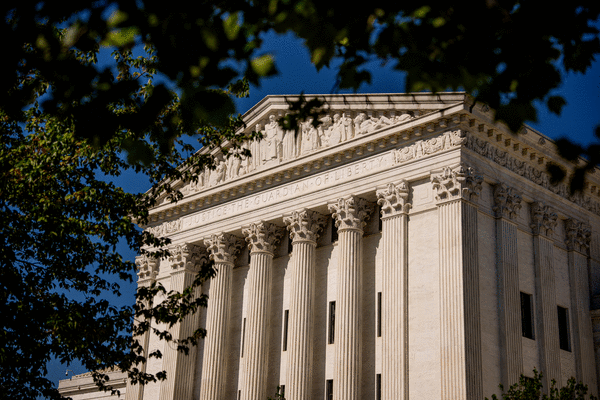
WASHINGTON — The Supreme Court on Thursday limited a federal law that prohibits illegal drug users from possessing firearms, in a case involving a man who was charged after investigators found a gun in his home and he admitted using marijuana about every other day.
In a unanimous decision, the justices found that the prosecution of Ali Danial Hemani violated the Second Amendment, the latest in a series of high court cases since 2022 that have expanded gun rights.
The main opinion, written by Justice Neil M. Gorsuch and joined by six other justices, found that just the possession or use of an illegal drug such as marijuana, or using a spouse’s Ambien, could not be used to deprive Americans of their right to bear arms without other court process.
The Trump administration had argued that the Constitution allows Congress to regulate firearms for dangerous people, including the modern-day equivalent of the colonial era’s “habitual drunkards.”
The federal law prohibits anyone who is “an unlawful user of or addicted to any controlled substance” from buying or possessing a firearm. Congress first passed the restriction in 1968.
But Gorsuch wrote that current law “sweeps in large numbers of people without regard to whether their substance use has the kind of incapacitating effect on them that historical habitual drunkard laws normally required.”
And the opinion noted that “habitual drunkards” laws were far more extensive than the law used to prosecute Hemani, because they required someone be so regularly drunk that they could not function in day-to-day life. Gorsuch contrasted that with a law that automatically considers it a crime for anyone who uses any restricted drug to also possess a firearm.
“They targeted different kinds of people, did so for different purposes, and operated in different ways,” Gorsuch wrote.
The decision noted that the government could still pursue cases to disarm addicts or ban gun possession by people who are actively intoxicated. Gorsuch also wrote that Congress still had the power to target users of a particular drug if they posed a “special risk” of misusing firearms.
Several justices wrote separately. Justice Clarence Thomas argued that the law itself exceeded Congress’ authority under the Constitution.
Justice Samuel A. Alito Jr., joined by Justice Elena Kagan, wrote that he disagreed with the reasoning for the decision.
Hemani was living in the Dallas area with his parents and had a stable job when the government searched the family home in 2022, according to the decision. He surrendered his gun, pointed agents to some marijuana and admitted to using it.
More than six months later, Hemani was charged with knowingly possessing a gun in his home while being an “unlawful user” of a controlled substance, which meant he faced up to 15 years in prison and disarmament for life, Gorsuch wrote in the majority opinion.
“No matter that the government did not assert Mr. Hemani was a drug addict. No matter that it did not contend his drug use had ever led him to pose a danger to himself or others,” Gorsuch wrote. “No matter, too, that the government did not claim Mr. Hemani had done anything with his gun other than possess it in his home.”
Gorsuch also noted the “awkwardly positioned” federal government, which has relaxed marijuana prosecutions as most states have legalized some form of its consumption.
Outside groups argued that changing the standard would make it more difficult for the government to administer the background check system.
The case is the latest in a series of firearms law cases taken by the Supreme Court since the conservative majority expanded gun rights in the 2022 case of New York State Rifle & Pistol Association Inc. v. Bruen, which held that gun restrictions had to have historical examples to pass muster under the Second Amendment.
The case is United States v. Hemani.
©2026 CQ-Roll Call, Inc., All Rights Reserved. Visit cqrollcall.com. Distributed by Tribune Content Agency, LLC.





Comments