Trump administration can install its own slavery exhibits at President's House, appeals court rules
Published in News & Features
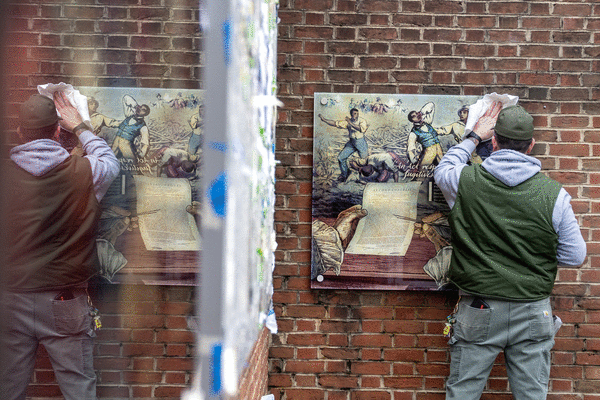
PHILADELPHIA — President Donald Trump’s administration can replace the slavery exhibits it removed in January from George Washington’s Philadelphia residence, a federal appeals court ruled.
A three-judge 3rd Circuit Court of Appeals panel unanimously agreed Thursday to toss out an injunction issued by a Philadelphia district court judge in February that ordered the National Park Service to restore interpretive panels telling the history of the nine individuals who were enslaved by Washington at the President’s House.
The city doesn’t have a right to dictate the content of the panels, the court found.
The judges further found that the federal government’s proposed replacement panels, which historians say whitewash Washington’s role in slavery, “are full of historical context.”
The proposed panels “highlight the momentous events that took place in the President’s House and the other sites at Independence National Historical Park,” Judge Thomas M. Hardiman, a George W. Bush appointee, wrote in the opinion. “They acknowledge the evil of slavery, including its injustices and hypocrisies, and, by telling the story of the nine slaves that Washington kept in the President’s House, remind us of their essential humanity.”
Judges Luis F. Restrepo, appointed by Barack Obama, and Peter J. Phipps, appointed by Trump, joined the opinion.
It was not immediately clear what would happen next at the site. The federal government did not immediately outline its next steps, and there are conflicting court rulings over the Trump administration’s push to remove content from national parks that “inappropriately disparages Americans past or living.”
But the ruling does bring to a close a chapter in the President’s House litigation, the first courtroom clash between Trump and Mayor Cherelle L. Parker’s administration. Any further review of the injunction is at the discretion of the three judges, full 3rd Circuit, or the Supreme Court and not guaranteed.
The city was unable to convince the 3rd Circuit it has joint decision making power with the federal government over the entirety of Independence National Historic Park because of the local ownership of Independence Hall.
Philadelphia has standing to argue in court that the federal government violated the contract signed when the city donated the President’s House to the National Park Service, Hardiman wrote. The agreement included a guarantee the federal agency would maintain the site.
But the city had to prove it could win based on that argument to keep the injunction alive, and the judges disagreed.
“The duty to ‘maintain’ is better understood as a general management obligation that accompanies ownership, not a promise that the exhibits will forever remain in place regardless of the owner’s wishes,” the opinion said.
The city’s claim that the removal was “arbitrary and capricious” under the Administrative Procedure Act also didn’t find purchase. The federal law only allows challenges to “final” agency actions, but the newly proposed panels show the January removal was not the Trump administration’s “last word on the matter.”
The ruling vacates District Judge Cynthia M. Rufe’s injunction from February that ordered the full restoration of the site to its state before exhibits were removed. The National Park Service restored some exhibits, but some metal interpretive panels couldn’t be reinstalled because they required fixes.
Avenging the Ancestors Coalition, one of advocacy groups leading efforts to protect the President’s House, said in a statement that the group was disappointed by the decision but would persevere. The coalition was consulting its legal team to consider potential next steps.
“This is definitely not the end of this fight, nor does it diminish the importance of ensuring that the full truth of our nation’s history is preserved and presented accurately,” the organization said.
The city had no immediate comment on the ruling.
A spokesperson for the U.S. Department of Interior simply said: “Trust in Trump.”
Debate over history
The ruling is an inflection point in the tumultuous legal saga over whether the federal government has power to determine which version of U.S. history is displayed for public viewing — an issue even more salient ahead of the country’s 250th birthday on July Fourth.
The Trump administration ordering the removal of the site’s exhibits in January after almost a year of scrutiny of the site. Almost six months later, the government offered its own vision for how those panels would be replaced, quietly uploading them to the National Park Service website in April.
An Inquirer review of the panels found that the federal government softened Washington’s role as an enslaver.
For instance, one proposed panel argues the people who were enslaved at the President’s House “experienced a greater modicum of autonomy than elsewhere in the South such as to explore the city and sometimes even attend the theater, with Washington buying the tickets.”
Historians argued the original panels were accurate, well-researched, and site-specific. The development of the site in the early 2000s was the product of collaboration across various disciplines including historians, artists, architects, and advocates.
But the new ruling says the Trump administration’s proposed displays offer a nuanced view on Washington’s and John Adams’ roles or opinions on slavery, adequately highlight the stories of the nine people enslaved at President’s House, thoroughly acknowledge the horrors and brutality of slavery, and uplift key figures in Black history.
“One panel... explains that Washington ‘often expressed discomfort with the institution and a desire to see it abolished,” but, ‘as a Virginia plantation owner, his wealth and livelihood were deeply tied to it,’“ Hardiman wrote. ”Other panels provide an even broader overview of slavery and the struggle to extirpate it."
The ruling landed just less than three weeks before the 250th anniversary celebrations, and the day before Juneteenth. Attorneys for the federal government said the new panels had been manufactured and were ready to be installed.
U.S. Rep. Brendan Boyle, D.-Philadelphia, whose district includes Independence Park, said in a statement that Thursday’s ruling highlighted the urgency of passing his Protecting American History Act, which would shield historical displays at the park from government censorship.
“Just a block away from where our nation was founded, Donald Trump is choosing the path of tyrants who rewrite history instead of learning from it,” Boyle said. “As we approach America’s 250th anniversary, we must tell the full truth of our nation’s history — the good and the bad."
Another legal case
Last week, Massachusetts district judge Angel Kelley ordered the Trump administration to restore all exhibits it had removed as part of its “restoring truth and sanity to American history” push. Following the 3rd Circuit ruling, the Joe Biden appointee rejected a Justice Department request for a stay on the order, saying other circuits weren’t binding on her.
The administration has appealed to the 1st Circuit Court of Appeals.
There isn’t a prescriptive way to resolve such conflicting rulings, which is why some legal scholars argue against so-called universal injunctions in which one district judge’s ruling affects the entire country. The Supreme Court signaled its discomfort with these types of orders last year.
These types of conflicting rulings has become more prevalent during Trump’s tenure, as his administration has issued drastic measures that take immediate effect, said Michael Foreman, a professor at the Penn State Dickinson School of Law.
Which order ends up prevailing will depend on whether the Massachusetts ruling is stayed, or if the issue escalates to the Supreme Court.
_____
©2026 The Philadelphia Inquirer. Visit inquirer.com. Distributed by Tribune Content Agency, LLC.



Comments