The historically women's Moore College of Art and Design will enroll men beginning in 2027-28
Published in News & Features
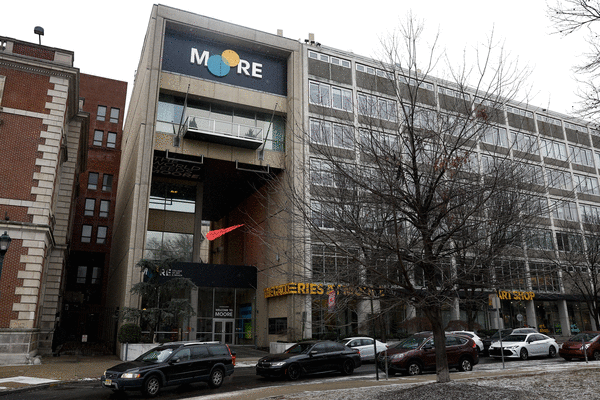


PHILADELPHIA — The historically women’s Moore College of Art and Design will open its doors to all genders, including men, beginning in 2027-28, the college announced Tuesday.
The decision followed a near-unanimous vote by the college’s 23-member boards of trustees and managers and several months of community forums gathering input from nearly 500 students, alumni, faculty, and staff, the college said.
With the change, the 177-year-old Moore will give up its status as the “only historically visual arts college for women in the nation.”
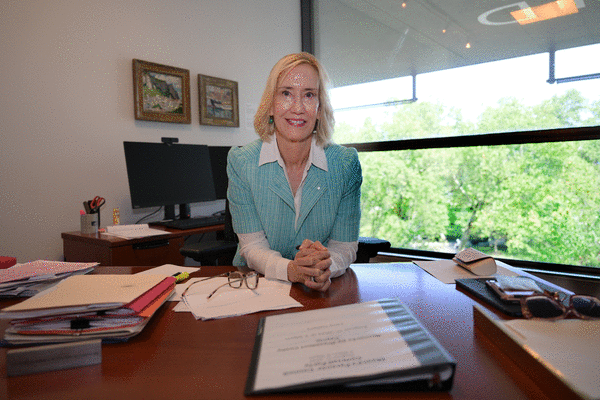
“I think there’s a real excitement from people about this next evolution of the college and a recognition that it’s a continuation of our mission,” Moore president Cathy Young said in an interview. “We want to serve students of all identities, and we want to serve the city by graduating those students into the creative economy here.”
The college, which already concluded its spring semester, informed the campus community Tuesday afternoon. The change, which the college announced it was considering in February, is subject to approval by the Middle States Commission on Higher Education and other regulatory bodies.
The decision comes as colleges nationally are coping with greater enrollment pressures from a declining pool of available high school graduates, financial challenges, and increased competition. Those pressures are hitting art and design colleges particularly hard. The University of the Arts in Philadelphia and the Delaware College of Art and Design closed in 2024, and the Pennsylvania Academy of the Fine Arts ended its degree programs last year.
And the number of women’s colleges nationally has been on the decline. At one time, there were more than 200; today, there are only about 30.
Young acknowledged the challenges but emphasized that Moore, which enrolls 466 undergraduate students, made its decision from a position of strength. The school has had operating surpluses for the last 24 consecutive years, a school spokesperson said in February. And Moore fared among the top small private colleges in the Philadelphia region for financial health in a 2024 Inquirer review. Moore’s net tuition climbed from $10.8 million to $12.7 million in fiscal 2024 and to $16.5 million in fiscal 2025, financial records show.
Tuition, fees, and room and board at Moore will top $77,000 in 2026-27. The college awarded $11.23 million in scholarships in 2025-26 and it provides up to $10,000 in housing grants for students with high financial need.
“The world of higher education is changing rapidly,” Young said, “and responsible institutions must be willing to lead rather than react.”
Bryn Mawr College will be the only remaining women’s school in the Philadelphia region. (In Allentown, Cedar Crest College remains primarily a women’s college.)
Several other colleges in the region that were formerly for women have gone coed over the last decades, including Rosemont on Philadelphia’s Main Line in 2008, Immaculata University in Chester County in 2005, and Chestnut Hill College in Philadelphia in 2003.
Moore already admits men into its graduate programs. And over the last few years, it has expanded admissions into its undergraduate program. In 2015, Moore began admitting “all qualified students who live as women and who consistently identify as women at the time of application.”
Then in 2020, Moore also opened admission to nonbinary and gender-nonconforming students. Since then, the number of those students has been growing. They made up 6% of the first freshman class under the new policy in 2021. By fall 2022, they accounted for 21%, and by fall 2023, 26%. Last fall, that grew to one-third of the freshman class.
In the alumni and student community, reaction to Tuesday’s announcement was mixed.
“I think it makes sense,” Morgan O’Halloran, a 2025 Moore graduate, said of the decision, “just because they are the last private arts college in Philly and expanding access is what they are all about.”
O’Halloran, who works as a full-time video editor for a Philadelphia advertising agency, said it might also help the school’s case in getting some or all of the former UArts endowment. The college has argued in Orphans Court that it should receive the entire $77 million because it is most like UArts. But other colleges vying for the money have argued that one reason it should not is because Moore is a women’s school, and UArts was not.
Others were upset about the decision.
“I’m quite angry for the Moore community,” said Claudia Rubio, who got a degree in photography from Moore in 2024. “I feel disheartened to have attended a college that seems to have forgotten its important and unique history. This change will only create an environment that is mimicking every other art department across universities in Philadelphia.”
Janelle Cray, a 2025 graduate who had been an illustration major, understands those who are unhappy.
“I feel a part of Moore’s charm is being a safe space for women and non-cis men,” Cray said. “And now people feel like that’s being taken away from them.”
But Ashley Hines, 22, a photography major who graduated in May, said she does not understand why it can’t be a safe space for men as well.
“As long as they are respectful toward their peers and a very dedicated artist, they should also have the same chance that we got,” Hines said.
A handful of Moore faculty were sad to lose the tradition of being a women’s college but understand the demographic pressures the college is facing, said Claudine Thomas, chief academic officer. Faculty are supportive, she said.
“What they’ve expressed to me is that whatever the college can do to remain vibrant and supportive and, most importantly, uplift art and design education, especially in Philadelphia, they’re on board to do it,” Thomas said.
Kristin Brivchik, the alumni council president, who got her degree from Moore in 1995 in graphic design communication, supports the move to accept men.
“Moore has really changed the trajectory of my life and career,” said Brivchik, who is director of digital video and multiplatform marketing at FX Networks, a Disney company. “What matters most to me is ensuring that generations have that opportunity I had to get a solid education in the arts and go out in the world and make an impact.”
Moore projects about 10 men will be part of the fall 2027 class and grow from there, Young said. The college has room to accommodate about 650 undergraduates — nearly 200 more than it has now — with plenty of dorm space, she said.
“We don’t necessarily need to grow to that size, but we have the capacity to do it and we want our doors to be open,” she said.
Growth would likely occur slowly over time, she said, noting that the school’s small size is its “superpower.”
The school is not likely to lose many applicants from the change — and more likely to gain them — if surveys of prior applicants are any indication. Only 6% of Moore applicants chose the school because of its status as a women’s college out of 885 survey respondents over the last dozen years, the college said. Meanwhile, a quarter of respondents said they decided not to attend for that reason, the college said.
“The market and what students are looking for is changing,” Young said. “We may be able to reach a wider group of students with this change.”
She said the decision was also driven by the closure of UArts and the discontinuation of degree programs at PAFA. Moore wants to fill that void by serving all students in the region, she said.
While members of the Moore community differed on whether the school should open undergraduate admissions to men, they were united in their belief in the college and its importance as a “transformative institution,” Young said.
Some were concerned about the loss of Moore as the only historically women’s arts college in the country and expressed sadness that future students would not get the same experience they had, Young said.
She emphasized that much of that experience — Moore will remain a small, career-focused art and design school — will be unchanged.
“All the individual mentoring and supportive community will remain,” she said. “There’s a real intentionality from students, faculty, and staff to preserve the parts of the culture that are so treasured, which are inclusivity, celebrating people’s authentic voices, and a strong sense of community support.“
_____
©2026 The Philadelphia Inquirer. Visit inquirer.com. Distributed by Tribune Content Agency, LLC.






Comments