Seattle council member says mayor must turn on police cameras
Published in News & Features
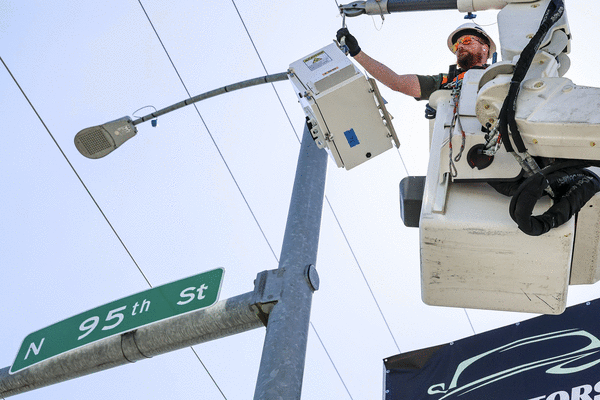
SEATTLE — Mayor Katie Wilson does not have legal authority to pause Seattle’s rollout of police surveillance cameras, Council member Bob Kettle argued to her Monday.
Wilson's office pushed back, arguing that the decision of when, whether and how to use cameras was well within the mayor's purview. Still, the exchange represents an escalation in the standoff between the two branches of city government over the hotly contested devices.
The council signed off on an expansion of the police department’s existing surveillance network last year, with the support of then-Mayor Bruce Harrell. But Wilson, who’s under pressure from privacy and civil rights advocates to slow or even reverse the camera installation, has moved cautiously, to the frustration of Kettle and other members of the council.
Wilson said earlier this year she was pausing the addition of new cameras while the city partnered with a team at New York University to study their possible effects. She promised a longer-term decision later this year.
She did agree, however, not to turn off the cameras already in use. She also gave the green light to install new cameras near the stadium district in advance of the Seattle matches of the FIFA Men's World Cup, but said they would only be turned on in the event of a “credible threat.”
Her initial announcement was generally met with mixed emotions by advocates for removing the cameras and those pushing for an expanded network.
But in recent days and weeks, advocates for the cameras have grown impatient, particularly as the World Cup comes closer into view. In a fiery speech last week, Council member Rob Saka recalled running in the 2013 Boston Marathon and hearing the explosions that killed three and injured many more.
“I believe that waiting for a credible threat before activating those tools is far too reactive for an event of this magnitude,” he said of the World Cup. “We’re failing to meet the moment.”
In his letter to Wilson, Kettle argued that the mayor did not follow the proper steps for a “pause,” as laid out in the original ordinance. The law says a pause should take place in the event of a warrant, subpoena or court order for use in civil immigration enforcement or if the city determines the data is being used to track people seeking reproductive or gender-related care or for immigration enforcement.
Because there’s no evidence those things have happened, Wilson should not be allowed to pause the rollout, Kettle said.
“She’s not conducting herself, and her team is not doing this, the right way and there’s really no justification to do this,” Kettle said in an interview.
Wilson's office disagreed, saying the council has the authority to pause the use of the cameras but can't require it.
"The Mayor’s position is unchanged," a spokesperson said in an email. "The Mayor is ensuring that our use of surveillance technology is protective of civil rights, liberties, and privacy and provides sufficient data privacy safeguards. The Mayor has a duty to make sure our use of these technologies is responsible.
Seattle already has more than working 60 cameras located along Aurora Avenue, downtown and in the Chinatown International District.
The bill passed last year authorized new cameras near Garfield High School, on Capitol Hill and near the stadiums.
Privacy advocates and civil rights groups, including the local chapter of the ACLU, pressed Wilson on the campaign trail to pause the expansion. The election of President Donald Trump and his immigration agenda sowed fear that the footage could be misused.
The laws regulating the cameras say they must be turned off for 60 days if the city catches wind of the cameras being used by federal officers. Nevertheless, Wilson said during her campaign that she favored halting the expansion.
Since taking office, though, she’s been more equivocal. In announcing the pause in March, she said there’s “no doubt that these cameras make it easier to solve some crimes, including serious ones like homicides,” while at the same time expressing concern about backing the city into a surveillance state.
For boosters of the cameras, her position on the stadium district has been most frustrating. Kettle and others doubt waiting for a “credible threat” during the World Cup is realistic.
“If something tragic happens then that’s going to be her legacy and her responsibility and something for her to deal with,” he said.
Friction between the council and mayor over policy implementation is not uncommon. Past councils have chafed at some mayors’ refusal to spend appropriations, but have had little power to force their hand.
Kettle said this situation goes further. He consulted with city lawyers and believes the council has more leverage to push Wilson into turning the cameras on.
At the same time, he said he was not planning to sue.
“I’m not looking to go there, but I’m looking to raise the issue now that the stadium cameras are set so we can be on our best foot,” he said.
_____
© 2026 The Seattle Times. Visit www.seattletimes.com. Distributed by Tribune Content Agency, LLC.






Comments