A new wave of enforcement leaves Chicago street vendors fearful and struggling
Published in News & Features
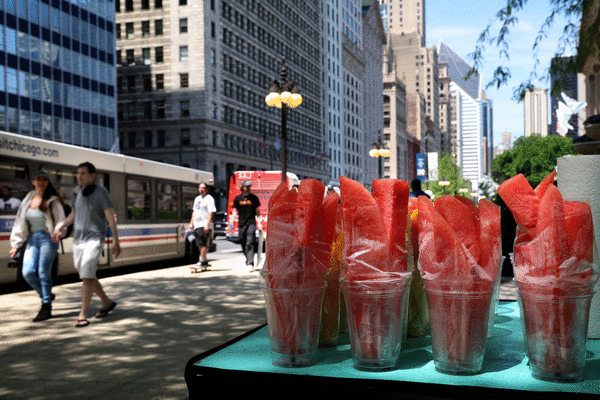
CHICAGO — Hoping to earn enough money to cover her son’s daycare, María Cuetia made her way downtown on Mother’s Day to sell mangos near Randolph Street and Michigan Avenue. Walking beside her cart was her 3-year-old son, proudly pushing his own toy cart through the crowded streets.
The boy had been sick for a few days, forcing Cuetia to stay home to care for him and lose valuable income. Holidays, she said, are often one of the few opportunities street vendors have to earn enough to get ahead, so she had decided to head downtown to sell fruit.
But moments after setting up her cart, a group of Chicago police officers approached her. Though other vendors nearby ran, she didn’t, worried that it would frighten her son. She calmly pleaded with officers, telling them she would leave the area. She begged them not to arrest her and not to take the cart she depended on to survive.
“I asked for a Spanish speaker and explained my situation. Initially they only gave me a court date and let me go, but as I began walking away, another group of officers approached me and took my cart away,” she told the Tribune in Spanish.
Cuetia, who came to Chicago seeking asylum from Colombia, returned home that day with less than she started with: no cart, no money and little hope.
“My crime was trying to provide for my child,” she said. “I don’t understand why they (police) were so heartless. I was already walking away.”
Like Cuetia, street vendors across Chicago say they are facing a new and aggressive wave of enforcement from Chicago police. In recent weeks, dozens of vendors have been arrested, ticketed, cited or had their merchandise confiscated, particularly along Michigan Avenue and outside major events across the city, according to the Street Vendors Association of Chicago.
Recently, a viral video showed a couple in handcuffs escorted by a police officer outside Soldier Field on the night of May 17 after a Bruno Mars concert. As they walked, a child cried and tried to hold the woman’s hand. Witnesses said the couple had been selling hot dogs. In Little Village and other immigrant neighborhoods, vendors say they’ve also been ticketed, fined and ordered to appear in court.
Meanwhile, Cuetia said she has been unable to recover her cart and has been relying on what little savings she has left while waiting for her immigration check-in.
Chicago’s street vending and peddling laws are not new. Certain areas, including Michigan Avenue and portions of the city’s parks, have long prohibited vendors from selling, even with a permit. In recent years, however, enforcement was sporadic, allowing vendors selling food, souvenirs and other goods to operate near Millennium Park. Despite receiving citations or being arrested, some vendors continue to return, saying the profits in the area outweighed the risks and exceeded what they could earn elsewhere in the city.
The recent uptick in enforcement has alarmed many immigrant advocates and vendors, particularly because some of the same communities were targeted last year during the immigration crackdown under the second administration of President Donald Trump. For some, the sudden enforcement raises questions about why the city is acting now and whether there are other ways to address violations without arrests, confiscations and criminal penalties.
“Not too long ago, CPD showed what good policing looks like when it protected tamale vendors from predators. The recent arrests of street vendors undermine the trust that was built at a moment when immigrant families are already afraid of police due to the trauma of Operation Midway Blitz,” said Linda Xóchitl Tortolero, CEO of the Latino Policy Forum. “Instead of criminalizing people who are trying to put food on the table, the city has a responsibility to protect its workers by passing the Street Vendor Ordinance now and placing a moratorium on vendor arrests until it does.”
On Wednesday, vendors and leaders of the Street Vendor Association will meet at Buckingham Memorial Fountain to chart a path forward in response to the crackdown.
While Chicago has long regulated street vending through permits and restrictions, vendors and advocates say the recent enforcement appears more coordinated and punitive than in the past.
In an email to the Tribune, a Chicago Police Department spokesperson said that the department “enforces all laws, including laws related to peddling and unlicensed vendors.” But the spokesperson did not respond to questions about its enforcement strategy or provide details about specific arrests.
Meanwhile, the mayor’s office said the city’s goal is to protect workers and ensure vendors are operating safely and legally.
Still, some elected officials say the crackdown raises broader questions about how Chicago treats workers in the informal economy, many of them immigrants who lack work authorization or who rely on vending to survive.
In 2019, former Mayor Lori Lightfoot proposed an ordinance that would replace temporary “emerging business permits” with permanent licensing, reduced the uncertainty and repeated renewal burdens vendors faced and expanded legal recognition and legitimacy for street vendors across Chicago. Despite support from vendor advocates and organizers, the proposal ultimately stalled and has never been approved by City Council, though the Street Vendor Association and other advocates are still pushing for its passage.
“We’ve been trying to figure out the best ways to allow folks to be able to operate their business. If we wanna get into a world where we know folks could barely make ends meet, having CPD criminalize folks isn’t gonna help anybody,” said Ald. Andre Vásquez, 40th.
“And if we’re not allowing them the opportunity to sell on the street, then it becomes a public safety issue as people try to find other ways to make sure they get revenue coming in,” he continued. “Creating more opportunities for people to be able to do this legally and safely is the goal, and so that’s what we’re gonna keep working towards.”
On a recent afternoon, a plainclothes officer displaying only his badge approached a woman selling mangoes outside the Art Institute of Chicago. The woman, whose name the Tribune is withholding out of her fear of retaliation, said that despite the risk of arrest, she continues to come downtown in hopes of earning money as the summer season returns.
“No bueno,” the officer told the woman. “OK, OK, ya me voy. OK, I’m leaving,” she told him.
Relieved to have avoided a citation or arrest, she said many fellow vendors have not been as fortunate, with some losing their merchandise to confiscation and facing steep fines ranging from $200 to $500.
During recent sweeps, vendors with licenses have also been arrested and ticketed, according to the Street Vendor Association, which has been tracking the enforcement.
That was the case for Margarita García, who has been selling tamales and other items on the same corner on 26th Street for nearly two decades. Despite showing police her license, officers on Mother’s Day issued her a $200 ticket, which was reviewed by the Tribune.
“We have been doing this work for a very long time, always following the law. It’s unfair that the city suddenly comes after us without notice,” García said.
María Lourdes Ochoa, of the Street Vendor Association, said the group helps vendors get licenses and permits. She said the group has requested a meeting with the city to understand the uptake in enforcement.
“We want to work with the city to educate our vendors, to help create an environment where they can thrive, especially after they were attacked last year by immigration authorities,” Ochoa said. “Some of their (police) tactics are simply heartless, leaving families without their merchandise and a way to make any income — not even giving them a chance to walk away, there’s gotta be a better way to deal with this.”
Ochoa said that while some vendors may not understand the peddling and vending policies in the city, the enforcement should be conducted in a way that will not make the vendors vulnerable to U.S. Immigration and Customs Enforcement.
Before hundreds of migrants, most of them from Venezuela, arrived in Chicago after Texas Gov. Greg Abbott began sending buses to sanctuary cities as a political maneuver, most street vendors in Chicago were middle-aged or older workers in the country without permission. Many sold elotes, tamales, fruit and other Mexican snacks or goods that were difficult to find outside predominantly Latino neighborhoods.
Since then, the landscape of street vending has changed, Ochoa said. Many of the migrants have turned to peddling as a way to survive.
Cuetia is one of them.
She arrived in Chicago from Colombia in 2022 while nearly nine months’ pregnant. Though the father of her child initially supported her financially, she said he abandoned them before the child turned 1. Since then, Cuetia said she has done everything possible to care for her child while also fighting for her asylum case.
A spokesperson for the mayor acknowledged the concerns of the vendors and said the administration of Mayor Brandon Johnson is “exploring potential measures to address many of these concerns while enhancing the overall street vendor ecosystem.”
“The Mayor’s Office is cognizant of community concerns surrounding enforcement action and continues to work with BACP on outreach efforts, which help to ensure vendors adhere to proper permitting and community safety requirements,” the spokesperson said.
Street vendors and neighborhood entrepreneurs, according to the spokesperson, “play a vital role within our commercial corridors and the City deeply values the contributions they make to the vibrancy of Chicago.”
In an email to the Tribune, Irene Tostado, spokesperson for the Chicago Park District, said the Chicago Police Department is coordinating with Park Public Safety and the Chicago Department of Business Affairs and Consumer Protection “to reduce unauthorized concession operations on CPD property.”
BACP, which oversees licenses and permits for street vendors, said it investigates complaints and can issue citations for violations of the city code, according to BACP spokesperson Elisa Sledzinska.
BACP data shows enforcement has doubled this year. From Jan. 1 to May 21, the agency issued 220 enforcement actions and received 109 complaints involving peddlers and vendors, up from 183 enforcement actions and 94 complaints during the same period in 2025.
The number of enforcement actions, however, do not reflect the number or arrests, citations or tickets CPD has issued in recent months.
Christian Ascencio noticed a child crying, trying to hold the hand of a woman in handcuffs after the Bruno Mars concert. He took out his phone to record. He had seen the woman and a man selling hot dogs earlier outside Soldier Field.
“No llores. Don’t cry,” the woman can be heard telling the child as a police officer walks with them.
Ascencio, who had attended the concert with his daughter, was concerned for the child.
“It was heartless,” he said. “I can imagine the trauma of that child seeing her parents getting arrested for trying to make an honest living.”
_____
©2026 Chicago Tribune. Visit chicagotribune.com. Distributed by Tribune Content Agency, LLC.






Comments